


.avif)





Blogs
Stay updated with our latest blog posts.


If you are addressing uneven cooling in Derby's multi-level homes before school starts, you already know the frustration of a second floor that feels like a sauna while the living room feels like a refrigerator. The late August back-to-school heat brings a specific kind of stress to local households. Just as you are trying to re-establish early bedtimes and steady morning routines, your children are tossing and turning in stubbornly hot upstairs bedrooms. The transition from relaxed summer schedules to early school mornings is difficult enough without the physical toll of poor sleep caused by trapped indoor heat.
A pattern our team at MJB Heating & Cooling sees often on late-summer service calls is the nightly dilemma parents face: do you keep cranking down the main-level thermostat to force cold air upstairs, or do you leave it at a normal temperature and let the second floor swelter? This is a structural and thermodynamic challenge, not necessarily a sign that your air conditioning unit is completely broken. When intense heat and high humidity continue through late August and September in Kansas, stagnant upstairs air becomes increasingly sticky and uncomfortable, exacerbating the architectural flaws of two-story layouts.
Solving this thermal imbalance requires targeted, professional airflow strategies rather than whole-house overcooling. Relying on professional HVAC services ensures that the root cause of the airflow restriction is properly diagnosed. By understanding the physics of how your home breathes, we can help you implement permanent solutions that restore comfort to every bedroom, allowing your family to start the school year fully rested.
To understand why your second floor refuses to cool down, you have to look at the underlying physics of your home. In our years of servicing classic Derby KS two-story homes, our technicians typically see heat stratification as a constant battle. The basic principles of thermodynamics dictate that warm air is less dense than cold air, causing it to naturally rise to the highest point in the structure. Simultaneously, the heavy, chilled air produced by your air conditioner settles on the ground floor. This creates a natural thermal divide right at your staircase.
Compounding the rising heat from below is the massive amount of solar radiant heat absorbed by your roof. During a late-summer heatwave, attic temperatures can easily soar past 130 degrees. This trapped thermal energy presses down through the ceiling insulation, radiating heat directly into the second-story bedrooms. At MJB Heating & Cooling, our specific expertise in diagnosing ductwork layouts unique to Derby's multi-level and split-level homes allows us to pinpoint exactly where this thermal boundary forms.
Furthermore, standard single-zone HVAC systems are inherently flawed when dealing with multi-level architecture. The thermostat is almost always located on the main floor. Because cold air sinks, the main floor reaches its target temperature quickly, signaling the thermostat to shut the entire system off long before the upstairs bedrooms receive adequate cooling.
• Second Floor — Thermal Load Source: Radiant heat from the roof and rising warm air from below. — Airflow Challenge: Low static pressure due to long vertical duct runs from the basement. — Thermostat Impact: System shuts off before this level reaches a comfortable temperature.
• Main Floor — Thermal Load Source: Standard perimeter heat gain (windows, doors). — Airflow Challenge: High static pressure and strong airflow due to proximity to the blower. — Thermostat Impact: Satisfies the thermostat quickly, prematurely halting the cooling cycle.
The physical distance between your indoor air handler (usually located in a basement or utility closet) and your upstairs registers plays a massive role in uneven cooling. Longer duct runs to the second floor mean more friction against the metal walls of the ductwork, which naturally reduces the velocity of the moving air.
Key factors we regularly see reducing upstairs airflow include:
• Vertical climbs: Pushing heavy, cold air straight up two stories requires significant blower motor power.
• Bends and elbows: Every 90-degree turn in the vertical ductwork disrupts the smooth flow of air, creating turbulence and reducing the volume of chilled air delivered upstairs.
• Branch lines: As air travels up the main trunk line, it bleeds off into main-floor branch ducts, leaving very little static pressure remaining for the end of the line on the second floor.
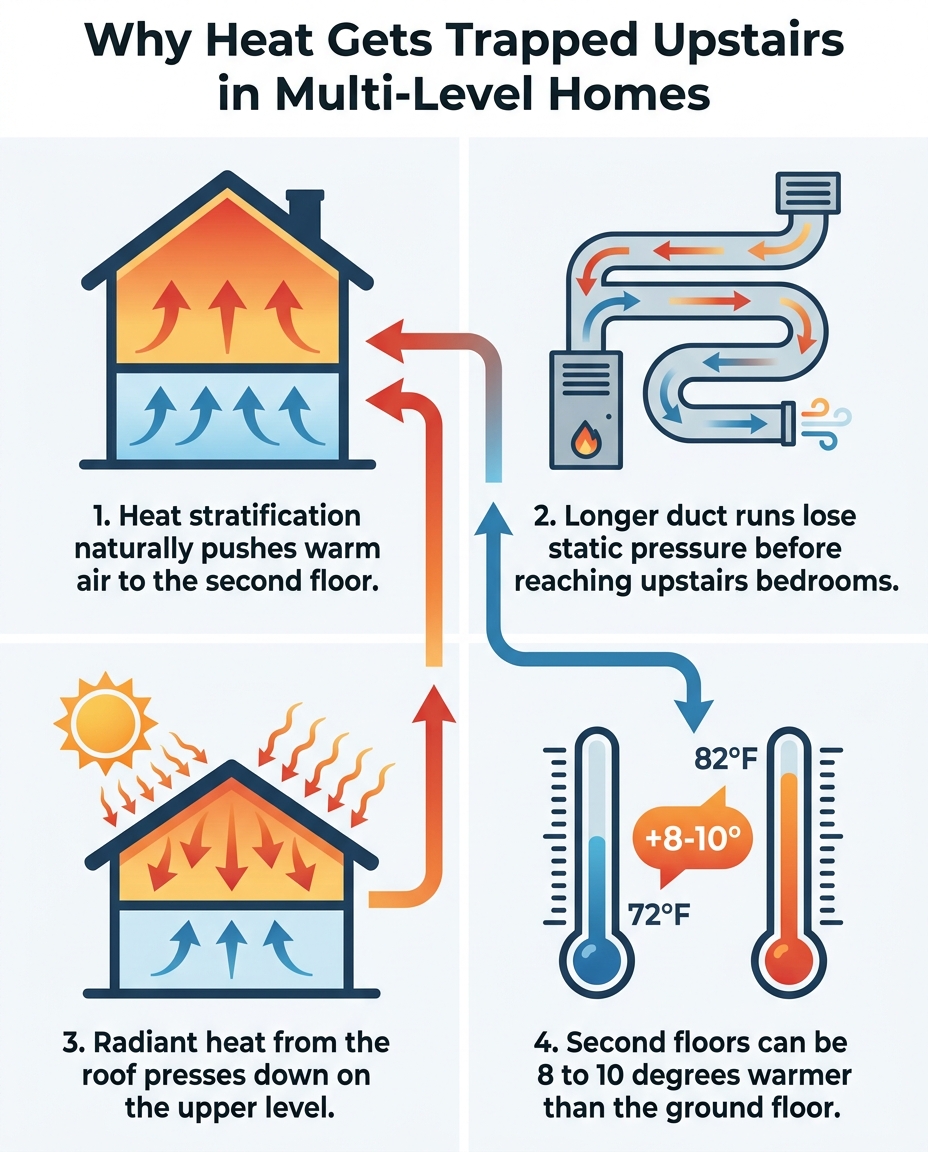

When the upstairs is sweltering, the most common reflex we encounter is a homeowner walking over to the thermostat and dropping the temperature to 68 degrees. The goal is to keep the system running long enough to eventually push some of that cold air up the stairs, getting the bedrooms down to a tolerable 75 degrees. However, we always caution against this strategy because it wastes massive amounts of energy, creates a freezing environment on the ground floor, and dramatically increases your monthly utility bills.
Another widespread myth is that closing all the vents on the main floor will force the cold air upstairs. This is one of the most damaging actions a homeowner can take. Your HVAC system is engineered to move a specific volume of air, and it needs to breathe freely to function correctly. Closing downstairs vents does not magically redirect that air up the stairs; instead, it creates a severe bottleneck.
The cascading failure of closed vents:
1. Increased Static Pressure: The blower motor pushes against a wall of restricted air, causing pressure inside the ductwork to spike.
2. Motor Stress: The blower motor works much harder, drawing more electricity and risking premature failure from overheating.
3. Restricted Airflow: Because the air cannot escape the ducts, the total volume of air moving across the indoor evaporator coil drops significantly.
4. Frozen Coils: Without enough warm return air blowing over the coil to absorb the cooling energy, the refrigerant temperature drops below freezing. Condensation on the coil turns to solid ice.
If you notice your AC not cooling properly in extreme heat, our team frequently finds a frozen coil caused by closed vents to be the culprit. Restricting airflow causes rapid wear and tear on your compressor rather than solving the thermal imbalance. Professional solutions are required to move air safely and efficiently.
When our customers want the most effective structural solution for uneven cooling in a multi-level home, we typically recommend the installation of an HVAC zoning system. Zoning divides your home into distinct climate areas—typically separating the main floor from the upstairs bedrooms—using a network of motorized dampers installed directly inside your ductwork. Each zone is controlled by its own dedicated thermostat, all wired back to a central control panel.
Zoning allows the second floor to call for cooling entirely independently of the main floor. If the downstairs is a comfortable 72 degrees but the upstairs is 78 degrees, the upstairs thermostat will signal the system to turn on. The system then directs the cooling capacity exactly where it is needed, which is incredibly beneficial for evening sleep routines. You no longer have to waste energy cooling an empty kitchen just to make a child's bedroom comfortable.
It is important to note that installing a zoning system requires professional load calculations and ductwork modifications. A licensed technician must ensure proper air bypass routes are established so that when one zone closes, the excess static pressure does not damage the blower motor.
Motorized dampers act as traffic cops for the airflow inside your ducts. They are heavy-duty metal blades connected to small electric motors that open and close based on the signals from the zone control panel.
When the upstairs thermostat calls for cooling, the downstairs dampers close partially or completely. This physically blocks the cold air from dumping into the main floor, redirecting the maximum volume of chilled air upward through the vertical ducts. Once the upstairs reaches the target temperature, the dampers reset to their neutral position, ensuring balanced airflow when the whole house requires cooling.
In some multi-level homes we evaluate, retrofitting the existing ductwork for a zoning system simply isn't feasible. The ducts might be inaccessible behind finished drywall, or the original trunk lines may be too undersized to handle the pressure changes of motorized dampers. In these cases, we often install ductless mini-split heat pumps as a highly efficient way to add dedicated cooling to specific upstairs bedrooms.
Ductless mini-splits bypass the central ductwork entirely. They consist of a small outdoor compressor connected by narrow refrigerant lines to a sleek indoor air handler mounted high on the bedroom wall. Because they generate and deliver the cold air directly into the room, they eliminate all the friction, duct leakage, and distance issues associated with traditional central air conditioning.
The advantages of supplemental ductless cooling:
• Independent Temperature Control: Each unit comes with its own remote or smart thermostat, allowing you to cool a specific bedroom without turning on the main house AC.
• Whisper-Quiet Operation: Mini-splits use variable-speed inverter technology, making them virtually silent—ideal for nurseries or children's bedrooms where sleep is the priority.
• High Efficiency: Because there is no ductwork to lose energy through, the cooling process is incredibly direct and energy-efficient.
One typical pattern we see locally—echoing the experience of a homeowner who recently reached out for summer home AC service because their system was struggling—is that timely, upfront evaluations often reveal the main unit is functioning perfectly. It simply needs supplemental help reaching the upper floors. Adding a mini-split solves the problem without replacing the entire central system. Additionally, federal tax credits may apply to qualifying high-efficiency heat pump and ductless installations, making them a smart long-term investment (always consult a tax professional to verify current program eligibility).
Before recommending major hardware upgrades like zoning or mini-splits, our professionals use a rigorous diagnostic process to optimize your existing system. A professional ductwork assessment and balancing service can often uncover hidden blockages or airflow leaks that are starving your second floor of cold air.
Technicians use specialized tools, such as digital manometers and velometers, to measure the exact static pressure inside the ductwork and the airflow velocity at each individual register. This data tells us exactly how much air is being lost between the basement blower and the upstairs bedrooms.
What a professional assessment uncovers:
• Air Balancing Needs: Technicians adjust manual dampers located near the indoor plenum to slightly restrict airflow to the main floor, pushing more air up the vertical trunk lines safely.
• Disconnected Joints: Over time, metal duct joints can separate, blowing precious cold air into wall cavities instead of your bedrooms.
• Crushed Flex Ducts: Flexible ductwork in the attic can easily be crushed by stored boxes or degraded by extreme heat, choking off the air supply.
• Degraded Insulation: If the ductwork running through a hot attic lacks proper insulation, the chilled air inside will warm up significantly before it ever reaches the vent.
Executing these diagnostics and performing air balancing requires specialized training to ensure the system's static pressure remains within safe operating limits. Homeowners across Derby and surrounding communities rely on these precise adjustments to maximize the performance of their current equipment before the late-summer heatwaves peak.
Parents do not have to choose between freezing the main floor and letting the kids sweat upstairs. The structural challenges of multi-level homes are well understood, and the thermodynamics of heat stratification can be overcome with the right technical approach.
Whether the solution involves installing a precise zoning system, balancing the existing ductwork, or adding whisper-quiet ductless mini-splits to key bedrooms, a professional evaluation by our team will pinpoint the exact cause of your home's thermal imbalance. Do not let late-summer heatwaves disrupt your family's sleep routines any longer. Take action to schedule a cooling evaluation now to ensure a smooth, comfortable transition into the new school year.
Why is my upstairs so much hotter than my downstairs?
Heat naturally rises due to the laws of thermodynamics, causing warm air to pool on the second floor. Additionally, the upstairs absorbs radiant heat from the roof and attic, while the cold air from your AC settles on the ground floor, creating a significant temperature gap.
How do you fix uneven cooling in a two-story house?
Fixing uneven cooling requires addressing the airflow distribution rather than just lowering the thermostat. Professional solutions include installing an HVAC zoning system with motorized dampers, balancing the ductwork to push more air upward, or adding ductless mini-splits for targeted cooling.
Does closing downstairs vents help cool the upstairs?
Closing downstairs vents does not help and can actually cause severe damage to your HVAC system. Restricting the airflow increases static pressure inside the ducts, which strains the blower motor and can cause the indoor evaporator coil to freeze solid.
How can I cool my second floor in the summer?
To effectively cool the second floor, ensure your attic is properly insulated to block radiant heat and have a technician evaluate your ductwork for leaks. If the central system cannot push enough air upstairs, installing a supplemental ductless mini-split is a highly effective way to cool the space.
Can a ductless mini-split be added to just one bedroom?
Yes, a ductless mini-split is specifically designed to provide targeted cooling to individual rooms. Because it operates independently of your central ductwork, it is an ideal solution for a single hot bedroom, nursery, or home office.
Is it normal for a two-story house to have a 10-degree temperature difference?
While it is common for multi-level homes to experience a 10-degree temperature difference due to heat stratification and ductwork distance, it is not something you have to live with. Proper duct balancing, zoning, or supplemental cooling can eliminate this gap and restore even comfort throughout the home.


Our A/C stopped working on a Sunday and due to health issues, we needed to find a service company available on a Sunday. I called MJB and left a message on their emergency voice mail. Within 10 minutes Tom Buck called me to hear my description of the symptoms. He was just finishing an appointment in Wichita and would be on his way to my home on the south end of Derby. He arrived within 30 minutes! From start to finish he was the perfect example of what you could ever hope for in an HVAC tech and a human being. His evaluation of our system inside and out was as thorough as I could ever imagine and once he was done with the repair, our system is running as well or better than ever. Well worth the price for the evaluation, parts, and labor. Thank you again Tom for an awesome experience.
Our AC went out during the hottest days of the year, and they were out next day! We have been jerked around by a shoddy home warranty for years. We finally had a chance to pick our own repair people, and MJB came highly recommended. I can see why! I was impressed with the honesty and speed at which they fixed our AC unit!
Our commercial building had a lightening/electrical strike and damaged our 20 ton AC unit. No one could find us a new unit before the end of September. Imagining going all of August and September with no AC in Kansas and working inside near 100 degree temps is less than thrilling. Dale and the team at MJB called around and saved the day. They had us a new unit 5 weeks earlier than other could promise and I now have happy employees. The unit is amazingly quiet, super cold and so much more energy efficient. Thank you for being our super hero!
Came out and installed my new furnace. Was very polite and affordable. They are very acknowledgeable and I highly recommend!
Thank you very much. We had our 1st warm night in 3weeks. MJB took the time and effort to find the real problem. And the employees were kind and thoughtful and explained things very well. I cannot thank you and all of MJB. Will recommend you highly. Thanks again Marjorie Herman Oxford Kansas
We had a new system installed and I was so impressed with how quick they were in come out and install it, in the middle of a hot summer day. They were so friendly & very professional. I had a small problem with a weird sound and they came over immediately and fixed it. Love them!


