.avif)





Blogs
Stay updated with our latest blog posts.
Understanding how air purification helps with allergies and asthma starts with one uncomfortable fact: the air inside your home can be up to five times more polluted than the air outside. For families in Wichita and across Central Kansas, that means prairie pollen, agricultural dust, pet dander, mold spores, and fine particles can build up indoors — quietly triggering sneezing, congestion, coughing, and asthma attacks day after day.
Here is a quick look at how air purification works to relieve those symptoms:
Americans spend around 90% of their time indoors. For the one in four adults who deal with seasonal allergies — and the millions more managing asthma — that statistic is not just a number. It is the reason indoor air quality deserves serious attention.
This guide walks you through exactly how air purification systems work, what the clinical research says, how to choose the right system for your Kansas home, and how to keep it running at its best.
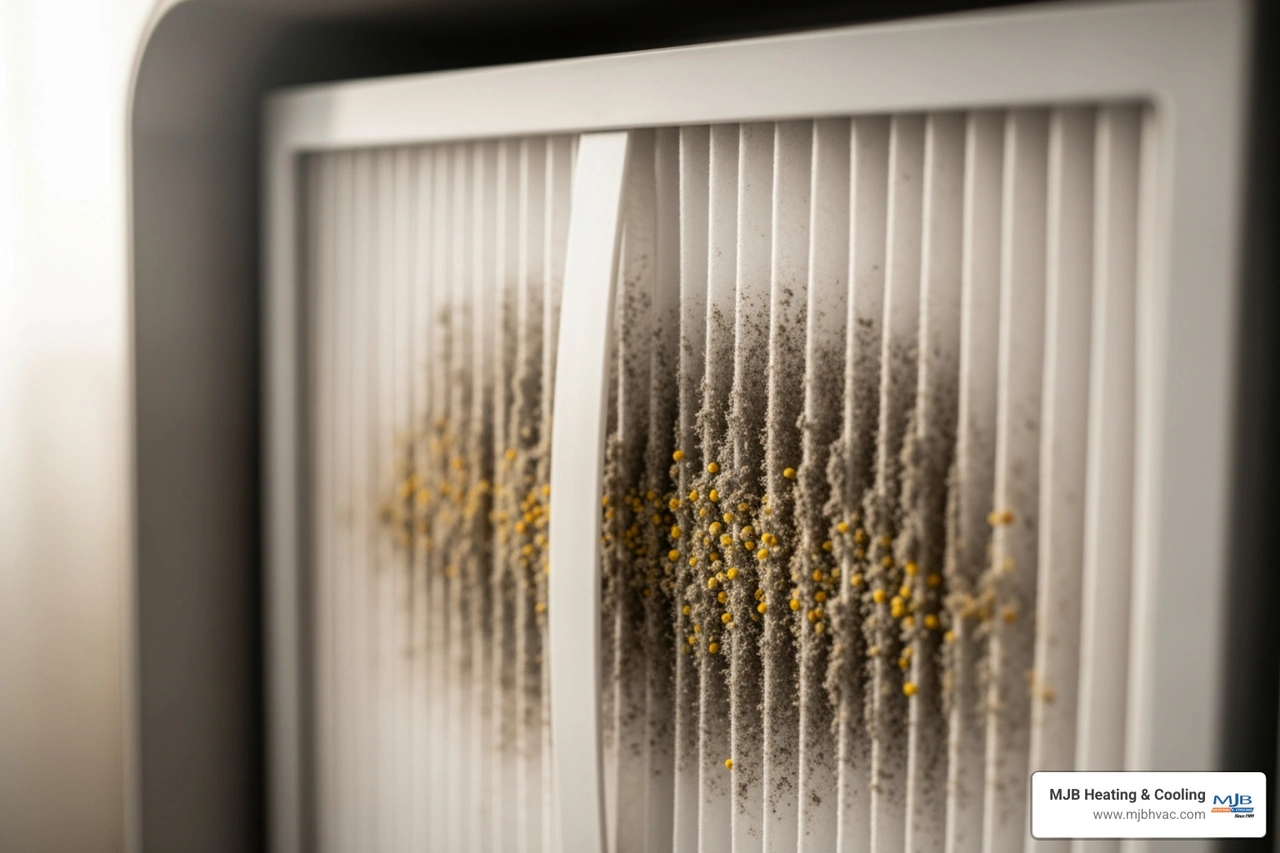
An air purifier is a device or whole-home system that pulls in indoor air, passes it through one or more filters, and sends cleaner air back out. In simple terms, it acts like a bouncer for your breathing space. Dust, pollen, pet dander, smoke particles, and mold spores are allowed in only long enough to get trapped.
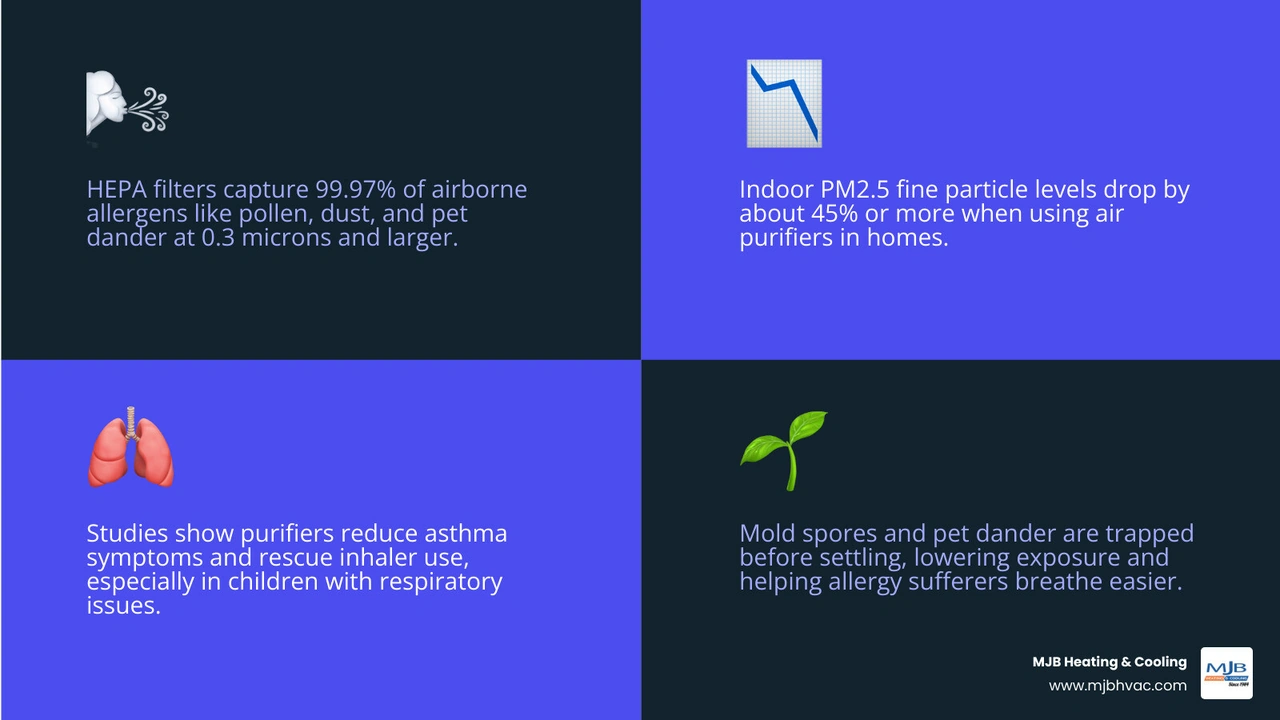
For allergy and asthma relief, mechanical filtration matters most. A true HEPA filter is the gold standard because it captures at least 99.97% of particles that are 0.3 microns in size. That size is important because it is considered one of the hardest particle sizes to catch. If a filter can handle that, it can do an excellent job with many common airborne irritants found in Kansas homes.
Most air purification systems work in stages:
That last part matters more than most people realize. Filtration only works on air that actually moves through the device. So while the filter efficiency is important, airflow and system sizing are just as important.
If you want a deeper look at the mechanics, our guide on how air purification removes allergens dust and pollutants breaks down the process in more detail.
It is also worth noting what air purifiers do not do well. Standard particle filters are excellent at trapping solids and liquid droplets in the air, but they are not a cure-all for every indoor air problem. A HEPA filter will not remove radon, and it will not fully solve gas or chemical issues without the help of activated carbon or other specialized media. It also will not pick up allergens that have already settled into carpet, bedding, or upholstery. That is why air purification works best as part of a bigger indoor air quality plan.
Central Kansas has some very real indoor air quality challenges. We see them every year in Wichita, Derby, Andover, Haysville, and surrounding communities.
Outdoor allergens and particles make their way inside through:
Once those contaminants get in, modern homes can trap them surprisingly well. That means symptoms may continue indoors long after you escape the windy spring day outside.
Common triggers in Kansas homes include:
For people with allergies, these particles can lead to sneezing, itchy eyes, stuffy noses, sinus pressure, and poor sleep. For people with asthma, the problem can go further. Fine particle pollution and airborne irritants can inflame the airways, increase coughing and wheezing, and raise the risk of flare-ups.
That is one reason indoor air quality deserves close attention. The EPA has long identified indoor air pollution as a major environmental health concern, and for families already dealing with breathing issues, that concern feels very personal.
Our article on how indoor air quality affects your health explains why the air inside your home can have such a big impact on daily comfort.
Research is not perfect, but overall it points in a helpful direction: good filtration can reduce airborne particle levels and can improve symptoms for many people with allergies or asthma.
Here are some of the most useful findings:
Researchers have also looked at markers like FeNO, which is used to measure airway inflammation in some asthma studies. Results vary, but some reviews suggest cleaner indoor air can support better asthma control, particularly in bedrooms and primary living spaces where exposure is highest.
Here is the practical takeaway: air purification is not magic, but it is useful. When a system is properly sized and consistently used, it can lower the amount of airborne material your lungs and sinuses have to deal with every day. Less irritation in the air often means fewer symptoms.
| Filter type | Best for | Less effective for |
|---|---|---|
| HEPA | Dust, pollen, pet dander, mold spores, fine airborne particles | Gases, odors, many VOCs |
| Activated carbon | Odors, smoke smells, some gases and VOCs | Capturing tiny particles by itself |
For many homes, the best setup uses both. HEPA handles particles. Carbon helps with odors and some airborne chemicals. They do different jobs, and together they create a more complete air-cleaning strategy.
Choosing the right system is about more than grabbing the first box that says "allergy relief" on it. Marketing can get dramatic. Your air purifier does not need to sound like a spaceship to work well.
Focus on these factors:
Look for a true HEPA filter, not "HEPA-type" or "HEPA-like." True HEPA means the filter meets the recognized standard of capturing 99.97% of 0.3-micron particles.
A purifier that is too small for the room will struggle. Match the unit to the actual square footage of the space, especially bedrooms and main living areas where your family spends the most time.
CADR stands for Clean Air Delivery Rate. It tells you how quickly the unit can clean the air for smoke, dust, and pollen. In general, higher CADR means faster cleaning for the same size room.
A good rule is to choose a unit that can provide at least 2 to 3 air changes per hour for the room, and more if someone in the home has significant asthma or allergy symptoms.
This one is important. Avoid purifiers that intentionally generate ozone. Ozone can irritate the lungs and worsen asthma symptoms. If a system uses active technology, make sure it is designed for safe, low-ozone or ozone-free operation.
Even the best system becomes much less helpful if the filter is overdue for replacement. Before choosing a system, make sure the maintenance schedule is realistic for your household.
Look for trusted verification such as AHAM ratings for portable units and asthma- and allergy-friendly certification where applicable. These can help you separate proven performance from flashy packaging.
If you are considering a more comprehensive option, our whole-home air purification pages for Derby and Andover explain how central systems can support cleaner air throughout the home.
Portable units and whole-home systems both have a place. The best choice depends on your layout, symptoms, and goals.
These are usually best when:
Portable HEPA units can be very effective when properly sized and run continuously. Bedrooms are often the first priority because that is where we spend many uninterrupted hours breathing the same air.
These systems integrate with your HVAC equipment and treat air as it moves through the duct system. They are usually the better fit when:
Whole-home systems often pair air purification with better HVAC filtration, such as MERV 11 to MERV 13 filters where the equipment supports it. This can be a smart balance between stronger particle capture and proper airflow. Some homes may also benefit from additional indoor air quality technologies, but they should always be selected carefully with safety and real-world performance in mind.
If you are wondering whether the upgrade is worth it, our article on is a whole house air purifier worth it can help you think through the pros and limitations.
The biggest difference is coverage. A portable purifier cleans one zone well. A whole-home system supports cleaner air across the house. For many families in Kansas, a layered approach works best: strong HVAC filtration for the whole home, plus a HEPA purifier in the bedroom.
A purifier only helps when it is used correctly. A surprising number of underperforming systems are not bad systems at all. They are just blocked, undersized, switched off, or overdue for maintenance.
Here is how we recommend getting the best results:
Intermittent use gives allergens time to build back up. For the best results, run portable units as continuously as practical, especially during peak pollen periods, dust events, and high-symptom days. If the purifier is in a bedroom, overnight use is especially helpful.
For portable systems:
If outdoor pollen and dust are constantly blowing in, your purifier has to work much harder. During heavy pollen days in Kansas, keeping the house closed up and using your cooling system on recirculate can help.
Typical maintenance ranges include:
Always follow the manufacturer guidance for your specific system.
Humidity is a big piece of the allergy puzzle. Keep indoor humidity below 50% to discourage mold growth and dust mites. Too much moisture gives allergens a comfortable place to thrive, which is rude of them, honestly.
Air purifiers help with airborne particles, but settled allergens still need to be removed manually. Pair filtration with:
Your HVAC system also plays a major role in indoor air quality. Our articles on how your HVAC system affects the air you breathe and air purification eliminates summer allergens explain how filtration, airflow, and seasonal conditions work together.
No. An air purifier can reduce exposure to airborne triggers, but it does not treat airway inflammation the way prescribed asthma medications do. Think of purification as an environmental support tool, not a substitute for your medical treatment plan. If you or your child has asthma, keep following your doctor’s guidance.
Usually the bedroom is the best starting point, because that is where you spend many hours at a time. Place the purifier where air can circulate freely, ideally a few feet from large obstacles. If symptoms are strongest in another room, such as a living room with pets or heavy traffic, that room may deserve priority.
Some do, which is why we recommend avoiding ozone-generating models. Ozone can irritate the lungs and may worsen asthma. For families with respiratory concerns, ozone-free systems are the safer choice. If you are comparing options, ask specifically whether the system produces ozone as part of normal operation.
Air purification can make a meaningful difference for many families dealing with allergy and asthma symptoms in Wichita and across the surrounding Central Kansas communities we serve. The biggest benefits come from using the right technology, sizing it properly, maintaining it well, and combining it with other smart indoor air quality habits.
At MJB Heating & Cooling, we have been serving the Wichita metro area since 1984 with a family-owned, honest approach to home comfort. If you are trying to figure out the best air quality solution for your home, we are here to help you sort through the options without the fluff.
You can learn more about whole-home solutions in Haysville, or if you are ready to take the next step, schedule your whole-home air quality consultation today.
Understanding how air purification helps with allergies and asthma starts with one uncomfortable fact: the air inside your home can be up to five times more polluted than the air outside. For families in Wichita and across Central Kansas, that means prairie pollen, agricultural dust, pet dander, mold spores, and fine particles can build up indoors — quietly triggering sneezing, congestion, coughing, and asthma attacks day after day.
Here is a quick look at how air purification works to relieve those symptoms:
Americans spend around 90% of their time indoors. For the one in four adults who deal with seasonal allergies — and the millions more managing asthma — that statistic is not just a number. It is the reason indoor air quality deserves serious attention.
This guide walks you through exactly how air purification systems work, what the clinical research says, how to choose the right system for your Kansas home, and how to keep it running at its best.
An air purifier is a device or whole-home system that pulls in indoor air, passes it through one or more filters, and sends cleaner air back out. In simple terms, it acts like a bouncer for your breathing space. Dust, pollen, pet dander, smoke particles, and mold spores are allowed in only long enough to get trapped.
For allergy and asthma relief, mechanical filtration matters most. A true HEPA filter is the gold standard because it captures at least 99.97% of particles that are 0.3 microns in size. That size is important because it is considered one of the hardest particle sizes to catch. If a filter can handle that, it can do an excellent job with many common airborne irritants found in Kansas homes.
Most air purification systems work in stages:
That last part matters more than most people realize. Filtration only works on air that actually moves through the device. So while the filter efficiency is important, airflow and system sizing are just as important.
If you want a deeper look at the mechanics, our guide on how air purification removes allergens dust and pollutants breaks down the process in more detail.
It is also worth noting what air purifiers do not do well. Standard particle filters are excellent at trapping solids and liquid droplets in the air, but they are not a cure-all for every indoor air problem. A HEPA filter will not remove radon, and it will not fully solve gas or chemical issues without the help of activated carbon or other specialized media. It also will not pick up allergens that have already settled into carpet, bedding, or upholstery. That is why air purification works best as part of a bigger indoor air quality plan.
Central Kansas has some very real indoor air quality challenges. We see them every year in Wichita, Derby, Andover, Haysville, and surrounding communities.
Outdoor allergens and particles make their way inside through:
Once those contaminants get in, modern homes can trap them surprisingly well. That means symptoms may continue indoors long after you escape the windy spring day outside.
Common triggers in Kansas homes include:
For people with allergies, these particles can lead to sneezing, itchy eyes, stuffy noses, sinus pressure, and poor sleep. For people with asthma, the problem can go further. Fine particle pollution and airborne irritants can inflame the airways, increase coughing and wheezing, and raise the risk of flare-ups.
That is one reason indoor air quality deserves close attention. The EPA has long identified indoor air pollution as a major environmental health concern, and for families already dealing with breathing issues, that concern feels very personal.
Our article on how indoor air quality affects your health explains why the air inside your home can have such a big impact on daily comfort.
Research is not perfect, but overall it points in a helpful direction: good filtration can reduce airborne particle levels and can improve symptoms for many people with allergies or asthma.
Here are some of the most useful findings:
Researchers have also looked at markers like FeNO, which is used to measure airway inflammation in some asthma studies. Results vary, but some reviews suggest cleaner indoor air can support better asthma control, particularly in bedrooms and primary living spaces where exposure is highest.
Here is the practical takeaway: air purification is not magic, but it is useful. When a system is properly sized and consistently used, it can lower the amount of airborne material your lungs and sinuses have to deal with every day. Less irritation in the air often means fewer symptoms.
| Filter type | Best for | Less effective for |
|---|---|---|
| HEPA | Dust, pollen, pet dander, mold spores, fine airborne particles | Gases, odors, many VOCs |
| Activated carbon | Odors, smoke smells, some gases and VOCs | Capturing tiny particles by itself |
For many homes, the best setup uses both. HEPA handles particles. Carbon helps with odors and some airborne chemicals. They do different jobs, and together they create a more complete air-cleaning strategy.
Choosing the right system is about more than grabbing the first box that says "allergy relief" on it. Marketing can get dramatic. Your air purifier does not need to sound like a spaceship to work well.
Focus on these factors:
Look for a true HEPA filter, not "HEPA-type" or "HEPA-like." True HEPA means the filter meets the recognized standard of capturing 99.97% of 0.3-micron particles.
A purifier that is too small for the room will struggle. Match the unit to the actual square footage of the space, especially bedrooms and main living areas where your family spends the most time.
CADR stands for Clean Air Delivery Rate. It tells you how quickly the unit can clean the air for smoke, dust, and pollen. In general, higher CADR means faster cleaning for the same size room.
A good rule is to choose a unit that can provide at least 2 to 3 air changes per hour for the room, and more if someone in the home has significant asthma or allergy symptoms.
This one is important. Avoid purifiers that intentionally generate ozone. Ozone can irritate the lungs and worsen asthma symptoms. If a system uses active technology, make sure it is designed for safe, low-ozone or ozone-free operation.
Even the best system becomes much less helpful if the filter is overdue for replacement. Before choosing a system, make sure the maintenance schedule is realistic for your household.
Look for trusted verification such as AHAM ratings for portable units and asthma- and allergy-friendly certification where applicable. These can help you separate proven performance from flashy packaging.
If you are considering a more comprehensive option, our whole-home air purification pages for Derby and Andover explain how central systems can support cleaner air throughout the home.
Portable units and whole-home systems both have a place. The best choice depends on your layout, symptoms, and goals.
These are usually best when:
Portable HEPA units can be very effective when properly sized and run continuously. Bedrooms are often the first priority because that is where we spend many uninterrupted hours breathing the same air.
These systems integrate with your HVAC equipment and treat air as it moves through the duct system. They are usually the better fit when:
Whole-home systems often pair air purification with better HVAC filtration, such as MERV 11 to MERV 13 filters where the equipment supports it. This can be a smart balance between stronger particle capture and proper airflow. Some homes may also benefit from additional indoor air quality technologies, but they should always be selected carefully with safety and real-world performance in mind.
If you are wondering whether the upgrade is worth it, our article on is a whole house air purifier worth it can help you think through the pros and limitations.
The biggest difference is coverage. A portable purifier cleans one zone well. A whole-home system supports cleaner air across the house. For many families in Kansas, a layered approach works best: strong HVAC filtration for the whole home, plus a HEPA purifier in the bedroom.
A purifier only helps when it is used correctly. A surprising number of underperforming systems are not bad systems at all. They are just blocked, undersized, switched off, or overdue for maintenance.
Here is how we recommend getting the best results:
Intermittent use gives allergens time to build back up. For the best results, run portable units as continuously as practical, especially during peak pollen periods, dust events, and high-symptom days. If the purifier is in a bedroom, overnight use is especially helpful.
For portable systems:
If outdoor pollen and dust are constantly blowing in, your purifier has to work much harder. During heavy pollen days in Kansas, keeping the house closed up and using your cooling system on recirculate can help.
Typical maintenance ranges include:
Always follow the manufacturer guidance for your specific system.
Humidity is a big piece of the allergy puzzle. Keep indoor humidity below 50% to discourage mold growth and dust mites. Too much moisture gives allergens a comfortable place to thrive, which is rude of them, honestly.
Air purifiers help with airborne particles, but settled allergens still need to be removed manually. Pair filtration with:
Your HVAC system also plays a major role in indoor air quality. Our articles on how your HVAC system affects the air you breathe and air purification eliminates summer allergens explain how filtration, airflow, and seasonal conditions work together.
No. An air purifier can reduce exposure to airborne triggers, but it does not treat airway inflammation the way prescribed asthma medications do. Think of purification as an environmental support tool, not a substitute for your medical treatment plan. If you or your child has asthma, keep following your doctor’s guidance.
Usually the bedroom is the best starting point, because that is where you spend many hours at a time. Place the purifier where air can circulate freely, ideally a few feet from large obstacles. If symptoms are strongest in another room, such as a living room with pets or heavy traffic, that room may deserve priority.
Some do, which is why we recommend avoiding ozone-generating models. Ozone can irritate the lungs and may worsen asthma. For families with respiratory concerns, ozone-free systems are the safer choice. If you are comparing options, ask specifically whether the system produces ozone as part of normal operation.
Air purification can make a meaningful difference for many families dealing with allergy and asthma symptoms in Wichita and across the surrounding Central Kansas communities we serve. The biggest benefits come from using the right technology, sizing it properly, maintaining it well, and combining it with other smart indoor air quality habits.
At MJB Heating & Cooling, we have been serving the Wichita metro area since 1984 with a family-owned, honest approach to home comfort. If you are trying to figure out the best air quality solution for your home, we are here to help you sort through the options without the fluff.
You can learn more about whole-home solutions in Haysville, or if you are ready to take the next step, schedule your whole-home air quality consultation today.
Understanding how air purification helps with allergies and asthma starts with one uncomfortable fact: the air inside your home can be up to five times more polluted than the air outside. For families in Wichita and across Central Kansas, that means prairie pollen, agricultural dust, pet dander, mold spores, and fine particles can build up indoors — quietly triggering sneezing, congestion, coughing, and asthma attacks day after day.
Here is a quick look at how air purification works to relieve those symptoms:
Americans spend around 90% of their time indoors. For the one in four adults who deal with seasonal allergies — and the millions more managing asthma — that statistic is not just a number. It is the reason indoor air quality deserves serious attention.
This guide walks you through exactly how air purification systems work, what the clinical research says, how to choose the right system for your Kansas home, and how to keep it running at its best.
An air purifier is a device or whole-home system that pulls in indoor air, passes it through one or more filters, and sends cleaner air back out. In simple terms, it acts like a bouncer for your breathing space. Dust, pollen, pet dander, smoke particles, and mold spores are allowed in only long enough to get trapped.
For allergy and asthma relief, mechanical filtration matters most. A true HEPA filter is the gold standard because it captures at least 99.97% of particles that are 0.3 microns in size. That size is important because it is considered one of the hardest particle sizes to catch. If a filter can handle that, it can do an excellent job with many common airborne irritants found in Kansas homes.
Most air purification systems work in stages:
That last part matters more than most people realize. Filtration only works on air that actually moves through the device. So while the filter efficiency is important, airflow and system sizing are just as important.
If you want a deeper look at the mechanics, our guide on how air purification removes allergens dust and pollutants breaks down the process in more detail.
It is also worth noting what air purifiers do not do well. Standard particle filters are excellent at trapping solids and liquid droplets in the air, but they are not a cure-all for every indoor air problem. A HEPA filter will not remove radon, and it will not fully solve gas or chemical issues without the help of activated carbon or other specialized media. It also will not pick up allergens that have already settled into carpet, bedding, or upholstery. That is why air purification works best as part of a bigger indoor air quality plan.
Central Kansas has some very real indoor air quality challenges. We see them every year in Wichita, Derby, Andover, Haysville, and surrounding communities.
Outdoor allergens and particles make their way inside through:
Once those contaminants get in, modern homes can trap them surprisingly well. That means symptoms may continue indoors long after you escape the windy spring day outside.
Common triggers in Kansas homes include:
For people with allergies, these particles can lead to sneezing, itchy eyes, stuffy noses, sinus pressure, and poor sleep. For people with asthma, the problem can go further. Fine particle pollution and airborne irritants can inflame the airways, increase coughing and wheezing, and raise the risk of flare-ups.
That is one reason indoor air quality deserves close attention. The EPA has long identified indoor air pollution as a major environmental health concern, and for families already dealing with breathing issues, that concern feels very personal.
Our article on how indoor air quality affects your health explains why the air inside your home can have such a big impact on daily comfort.
Research is not perfect, but overall it points in a helpful direction: good filtration can reduce airborne particle levels and can improve symptoms for many people with allergies or asthma.
Here are some of the most useful findings:
Researchers have also looked at markers like FeNO, which is used to measure airway inflammation in some asthma studies. Results vary, but some reviews suggest cleaner indoor air can support better asthma control, particularly in bedrooms and primary living spaces where exposure is highest.
Here is the practical takeaway: air purification is not magic, but it is useful. When a system is properly sized and consistently used, it can lower the amount of airborne material your lungs and sinuses have to deal with every day. Less irritation in the air often means fewer symptoms.
| Filter type | Best for | Less effective for |
|---|---|---|
| HEPA | Dust, pollen, pet dander, mold spores, fine airborne particles | Gases, odors, many VOCs |
| Activated carbon | Odors, smoke smells, some gases and VOCs | Capturing tiny particles by itself |
For many homes, the best setup uses both. HEPA handles particles. Carbon helps with odors and some airborne chemicals. They do different jobs, and together they create a more complete air-cleaning strategy.
Choosing the right system is about more than grabbing the first box that says "allergy relief" on it. Marketing can get dramatic. Your air purifier does not need to sound like a spaceship to work well.
Focus on these factors:
Look for a true HEPA filter, not "HEPA-type" or "HEPA-like." True HEPA means the filter meets the recognized standard of capturing 99.97% of 0.3-micron particles.
A purifier that is too small for the room will struggle. Match the unit to the actual square footage of the space, especially bedrooms and main living areas where your family spends the most time.
CADR stands for Clean Air Delivery Rate. It tells you how quickly the unit can clean the air for smoke, dust, and pollen. In general, higher CADR means faster cleaning for the same size room.
A good rule is to choose a unit that can provide at least 2 to 3 air changes per hour for the room, and more if someone in the home has significant asthma or allergy symptoms.
This one is important. Avoid purifiers that intentionally generate ozone. Ozone can irritate the lungs and worsen asthma symptoms. If a system uses active technology, make sure it is designed for safe, low-ozone or ozone-free operation.
Even the best system becomes much less helpful if the filter is overdue for replacement. Before choosing a system, make sure the maintenance schedule is realistic for your household.
Look for trusted verification such as AHAM ratings for portable units and asthma- and allergy-friendly certification where applicable. These can help you separate proven performance from flashy packaging.
If you are considering a more comprehensive option, our whole-home air purification pages for Derby and Andover explain how central systems can support cleaner air throughout the home.
Portable units and whole-home systems both have a place. The best choice depends on your layout, symptoms, and goals.
These are usually best when:
Portable HEPA units can be very effective when properly sized and run continuously. Bedrooms are often the first priority because that is where we spend many uninterrupted hours breathing the same air.
These systems integrate with your HVAC equipment and treat air as it moves through the duct system. They are usually the better fit when:
Whole-home systems often pair air purification with better HVAC filtration, such as MERV 11 to MERV 13 filters where the equipment supports it. This can be a smart balance between stronger particle capture and proper airflow. Some homes may also benefit from additional indoor air quality technologies, but they should always be selected carefully with safety and real-world performance in mind.
If you are wondering whether the upgrade is worth it, our article on is a whole house air purifier worth it can help you think through the pros and limitations.
The biggest difference is coverage. A portable purifier cleans one zone well. A whole-home system supports cleaner air across the house. For many families in Kansas, a layered approach works best: strong HVAC filtration for the whole home, plus a HEPA purifier in the bedroom.
A purifier only helps when it is used correctly. A surprising number of underperforming systems are not bad systems at all. They are just blocked, undersized, switched off, or overdue for maintenance.
Here is how we recommend getting the best results:
Intermittent use gives allergens time to build back up. For the best results, run portable units as continuously as practical, especially during peak pollen periods, dust events, and high-symptom days. If the purifier is in a bedroom, overnight use is especially helpful.
For portable systems:
If outdoor pollen and dust are constantly blowing in, your purifier has to work much harder. During heavy pollen days in Kansas, keeping the house closed up and using your cooling system on recirculate can help.
Typical maintenance ranges include:
Always follow the manufacturer guidance for your specific system.
Humidity is a big piece of the allergy puzzle. Keep indoor humidity below 50% to discourage mold growth and dust mites. Too much moisture gives allergens a comfortable place to thrive, which is rude of them, honestly.
Air purifiers help with airborne particles, but settled allergens still need to be removed manually. Pair filtration with:
Your HVAC system also plays a major role in indoor air quality. Our articles on how your HVAC system affects the air you breathe and air purification eliminates summer allergens explain how filtration, airflow, and seasonal conditions work together.
No. An air purifier can reduce exposure to airborne triggers, but it does not treat airway inflammation the way prescribed asthma medications do. Think of purification as an environmental support tool, not a substitute for your medical treatment plan. If you or your child has asthma, keep following your doctor’s guidance.
Usually the bedroom is the best starting point, because that is where you spend many hours at a time. Place the purifier where air can circulate freely, ideally a few feet from large obstacles. If symptoms are strongest in another room, such as a living room with pets or heavy traffic, that room may deserve priority.
Some do, which is why we recommend avoiding ozone-generating models. Ozone can irritate the lungs and may worsen asthma. For families with respiratory concerns, ozone-free systems are the safer choice. If you are comparing options, ask specifically whether the system produces ozone as part of normal operation.
Air purification can make a meaningful difference for many families dealing with allergy and asthma symptoms in Wichita and across the surrounding Central Kansas communities we serve. The biggest benefits come from using the right technology, sizing it properly, maintaining it well, and combining it with other smart indoor air quality habits.
At MJB Heating & Cooling, we have been serving the Wichita metro area since 1984 with a family-owned, honest approach to home comfort. If you are trying to figure out the best air quality solution for your home, we are here to help you sort through the options without the fluff.
You can learn more about whole-home solutions in Haysville, or if you are ready to take the next step, schedule your whole-home air quality consultation today.


Understanding how air purification helps with allergies and asthma starts with one uncomfortable fact: the air inside your home can be up to five times more polluted than the air outside. For families in Wichita and across Central Kansas, that means prairie pollen, agricultural dust, pet dander, mold spores, and fine particles can build up indoors — quietly triggering sneezing, congestion, coughing, and asthma attacks day after day.
Here is a quick look at how air purification works to relieve those symptoms:
Americans spend around 90% of their time indoors. For the one in four adults who deal with seasonal allergies — and the millions more managing asthma — that statistic is not just a number. It is the reason indoor air quality deserves serious attention.
This guide walks you through exactly how air purification systems work, what the clinical research says, how to choose the right system for your Kansas home, and how to keep it running at its best.
An air purifier is a device or whole-home system that pulls in indoor air, passes it through one or more filters, and sends cleaner air back out. In simple terms, it acts like a bouncer for your breathing space. Dust, pollen, pet dander, smoke particles, and mold spores are allowed in only long enough to get trapped.
For allergy and asthma relief, mechanical filtration matters most. A true HEPA filter is the gold standard because it captures at least 99.97% of particles that are 0.3 microns in size. That size is important because it is considered one of the hardest particle sizes to catch. If a filter can handle that, it can do an excellent job with many common airborne irritants found in Kansas homes.
Most air purification systems work in stages:
That last part matters more than most people realize. Filtration only works on air that actually moves through the device. So while the filter efficiency is important, airflow and system sizing are just as important.
If you want a deeper look at the mechanics, our guide on how air purification removes allergens dust and pollutants breaks down the process in more detail.
It is also worth noting what air purifiers do not do well. Standard particle filters are excellent at trapping solids and liquid droplets in the air, but they are not a cure-all for every indoor air problem. A HEPA filter will not remove radon, and it will not fully solve gas or chemical issues without the help of activated carbon or other specialized media. It also will not pick up allergens that have already settled into carpet, bedding, or upholstery. That is why air purification works best as part of a bigger indoor air quality plan.
Central Kansas has some very real indoor air quality challenges. We see them every year in Wichita, Derby, Andover, Haysville, and surrounding communities.
Outdoor allergens and particles make their way inside through:
Once those contaminants get in, modern homes can trap them surprisingly well. That means symptoms may continue indoors long after you escape the windy spring day outside.
Common triggers in Kansas homes include:
For people with allergies, these particles can lead to sneezing, itchy eyes, stuffy noses, sinus pressure, and poor sleep. For people with asthma, the problem can go further. Fine particle pollution and airborne irritants can inflame the airways, increase coughing and wheezing, and raise the risk of flare-ups.
That is one reason indoor air quality deserves close attention. The EPA has long identified indoor air pollution as a major environmental health concern, and for families already dealing with breathing issues, that concern feels very personal.
Our article on how indoor air quality affects your health explains why the air inside your home can have such a big impact on daily comfort.
Research is not perfect, but overall it points in a helpful direction: good filtration can reduce airborne particle levels and can improve symptoms for many people with allergies or asthma.
Here are some of the most useful findings:
Researchers have also looked at markers like FeNO, which is used to measure airway inflammation in some asthma studies. Results vary, but some reviews suggest cleaner indoor air can support better asthma control, particularly in bedrooms and primary living spaces where exposure is highest.
Here is the practical takeaway: air purification is not magic, but it is useful. When a system is properly sized and consistently used, it can lower the amount of airborne material your lungs and sinuses have to deal with every day. Less irritation in the air often means fewer symptoms.
| Filter type | Best for | Less effective for |
|---|---|---|
| HEPA | Dust, pollen, pet dander, mold spores, fine airborne particles | Gases, odors, many VOCs |
| Activated carbon | Odors, smoke smells, some gases and VOCs | Capturing tiny particles by itself |
For many homes, the best setup uses both. HEPA handles particles. Carbon helps with odors and some airborne chemicals. They do different jobs, and together they create a more complete air-cleaning strategy.
Choosing the right system is about more than grabbing the first box that says "allergy relief" on it. Marketing can get dramatic. Your air purifier does not need to sound like a spaceship to work well.
Focus on these factors:
Look for a true HEPA filter, not "HEPA-type" or "HEPA-like." True HEPA means the filter meets the recognized standard of capturing 99.97% of 0.3-micron particles.
A purifier that is too small for the room will struggle. Match the unit to the actual square footage of the space, especially bedrooms and main living areas where your family spends the most time.
CADR stands for Clean Air Delivery Rate. It tells you how quickly the unit can clean the air for smoke, dust, and pollen. In general, higher CADR means faster cleaning for the same size room.
A good rule is to choose a unit that can provide at least 2 to 3 air changes per hour for the room, and more if someone in the home has significant asthma or allergy symptoms.
This one is important. Avoid purifiers that intentionally generate ozone. Ozone can irritate the lungs and worsen asthma symptoms. If a system uses active technology, make sure it is designed for safe, low-ozone or ozone-free operation.
Even the best system becomes much less helpful if the filter is overdue for replacement. Before choosing a system, make sure the maintenance schedule is realistic for your household.
Look for trusted verification such as AHAM ratings for portable units and asthma- and allergy-friendly certification where applicable. These can help you separate proven performance from flashy packaging.
If you are considering a more comprehensive option, our whole-home air purification pages for Derby and Andover explain how central systems can support cleaner air throughout the home.
Portable units and whole-home systems both have a place. The best choice depends on your layout, symptoms, and goals.
These are usually best when:
Portable HEPA units can be very effective when properly sized and run continuously. Bedrooms are often the first priority because that is where we spend many uninterrupted hours breathing the same air.
These systems integrate with your HVAC equipment and treat air as it moves through the duct system. They are usually the better fit when:
Whole-home systems often pair air purification with better HVAC filtration, such as MERV 11 to MERV 13 filters where the equipment supports it. This can be a smart balance between stronger particle capture and proper airflow. Some homes may also benefit from additional indoor air quality technologies, but they should always be selected carefully with safety and real-world performance in mind.
If you are wondering whether the upgrade is worth it, our article on is a whole house air purifier worth it can help you think through the pros and limitations.
The biggest difference is coverage. A portable purifier cleans one zone well. A whole-home system supports cleaner air across the house. For many families in Kansas, a layered approach works best: strong HVAC filtration for the whole home, plus a HEPA purifier in the bedroom.
A purifier only helps when it is used correctly. A surprising number of underperforming systems are not bad systems at all. They are just blocked, undersized, switched off, or overdue for maintenance.
Here is how we recommend getting the best results:
Intermittent use gives allergens time to build back up. For the best results, run portable units as continuously as practical, especially during peak pollen periods, dust events, and high-symptom days. If the purifier is in a bedroom, overnight use is especially helpful.
For portable systems:
If outdoor pollen and dust are constantly blowing in, your purifier has to work much harder. During heavy pollen days in Kansas, keeping the house closed up and using your cooling system on recirculate can help.
Typical maintenance ranges include:
Always follow the manufacturer guidance for your specific system.
Humidity is a big piece of the allergy puzzle. Keep indoor humidity below 50% to discourage mold growth and dust mites. Too much moisture gives allergens a comfortable place to thrive, which is rude of them, honestly.
Air purifiers help with airborne particles, but settled allergens still need to be removed manually. Pair filtration with:
Your HVAC system also plays a major role in indoor air quality. Our articles on how your HVAC system affects the air you breathe and air purification eliminates summer allergens explain how filtration, airflow, and seasonal conditions work together.
No. An air purifier can reduce exposure to airborne triggers, but it does not treat airway inflammation the way prescribed asthma medications do. Think of purification as an environmental support tool, not a substitute for your medical treatment plan. If you or your child has asthma, keep following your doctor’s guidance.
Usually the bedroom is the best starting point, because that is where you spend many hours at a time. Place the purifier where air can circulate freely, ideally a few feet from large obstacles. If symptoms are strongest in another room, such as a living room with pets or heavy traffic, that room may deserve priority.
Some do, which is why we recommend avoiding ozone-generating models. Ozone can irritate the lungs and may worsen asthma. For families with respiratory concerns, ozone-free systems are the safer choice. If you are comparing options, ask specifically whether the system produces ozone as part of normal operation.
Air purification can make a meaningful difference for many families dealing with allergy and asthma symptoms in Wichita and across the surrounding Central Kansas communities we serve. The biggest benefits come from using the right technology, sizing it properly, maintaining it well, and combining it with other smart indoor air quality habits.
At MJB Heating & Cooling, we have been serving the Wichita metro area since 1984 with a family-owned, honest approach to home comfort. If you are trying to figure out the best air quality solution for your home, we are here to help you sort through the options without the fluff.
You can learn more about whole-home solutions in Haysville, or if you are ready to take the next step, schedule your whole-home air quality consultation today.
Understanding how air purification helps with allergies and asthma starts with one uncomfortable fact: the air inside your home can be up to five times more polluted than the air outside. For families in Wichita and across Central Kansas, that means prairie pollen, agricultural dust, pet dander, mold spores, and fine particles can build up indoors — quietly triggering sneezing, congestion, coughing, and asthma attacks day after day.
Here is a quick look at how air purification works to relieve those symptoms:
Americans spend around 90% of their time indoors. For the one in four adults who deal with seasonal allergies — and the millions more managing asthma — that statistic is not just a number. It is the reason indoor air quality deserves serious attention.
This guide walks you through exactly how air purification systems work, what the clinical research says, how to choose the right system for your Kansas home, and how to keep it running at its best.
An air purifier is a device or whole-home system that pulls in indoor air, passes it through one or more filters, and sends cleaner air back out. In simple terms, it acts like a bouncer for your breathing space. Dust, pollen, pet dander, smoke particles, and mold spores are allowed in only long enough to get trapped.
For allergy and asthma relief, mechanical filtration matters most. A true HEPA filter is the gold standard because it captures at least 99.97% of particles that are 0.3 microns in size. That size is important because it is considered one of the hardest particle sizes to catch. If a filter can handle that, it can do an excellent job with many common airborne irritants found in Kansas homes.
Most air purification systems work in stages:
That last part matters more than most people realize. Filtration only works on air that actually moves through the device. So while the filter efficiency is important, airflow and system sizing are just as important.
If you want a deeper look at the mechanics, our guide on how air purification removes allergens dust and pollutants breaks down the process in more detail.
It is also worth noting what air purifiers do not do well. Standard particle filters are excellent at trapping solids and liquid droplets in the air, but they are not a cure-all for every indoor air problem. A HEPA filter will not remove radon, and it will not fully solve gas or chemical issues without the help of activated carbon or other specialized media. It also will not pick up allergens that have already settled into carpet, bedding, or upholstery. That is why air purification works best as part of a bigger indoor air quality plan.
Central Kansas has some very real indoor air quality challenges. We see them every year in Wichita, Derby, Andover, Haysville, and surrounding communities.
Outdoor allergens and particles make their way inside through:
Once those contaminants get in, modern homes can trap them surprisingly well. That means symptoms may continue indoors long after you escape the windy spring day outside.
Common triggers in Kansas homes include:
For people with allergies, these particles can lead to sneezing, itchy eyes, stuffy noses, sinus pressure, and poor sleep. For people with asthma, the problem can go further. Fine particle pollution and airborne irritants can inflame the airways, increase coughing and wheezing, and raise the risk of flare-ups.
That is one reason indoor air quality deserves close attention. The EPA has long identified indoor air pollution as a major environmental health concern, and for families already dealing with breathing issues, that concern feels very personal.
Our article on how indoor air quality affects your health explains why the air inside your home can have such a big impact on daily comfort.
Research is not perfect, but overall it points in a helpful direction: good filtration can reduce airborne particle levels and can improve symptoms for many people with allergies or asthma.
Here are some of the most useful findings:
Researchers have also looked at markers like FeNO, which is used to measure airway inflammation in some asthma studies. Results vary, but some reviews suggest cleaner indoor air can support better asthma control, particularly in bedrooms and primary living spaces where exposure is highest.
Here is the practical takeaway: air purification is not magic, but it is useful. When a system is properly sized and consistently used, it can lower the amount of airborne material your lungs and sinuses have to deal with every day. Less irritation in the air often means fewer symptoms.
| Filter type | Best for | Less effective for |
|---|---|---|
| HEPA | Dust, pollen, pet dander, mold spores, fine airborne particles | Gases, odors, many VOCs |
| Activated carbon | Odors, smoke smells, some gases and VOCs | Capturing tiny particles by itself |
For many homes, the best setup uses both. HEPA handles particles. Carbon helps with odors and some airborne chemicals. They do different jobs, and together they create a more complete air-cleaning strategy.
Choosing the right system is about more than grabbing the first box that says "allergy relief" on it. Marketing can get dramatic. Your air purifier does not need to sound like a spaceship to work well.
Focus on these factors:
Look for a true HEPA filter, not "HEPA-type" or "HEPA-like." True HEPA means the filter meets the recognized standard of capturing 99.97% of 0.3-micron particles.
A purifier that is too small for the room will struggle. Match the unit to the actual square footage of the space, especially bedrooms and main living areas where your family spends the most time.
CADR stands for Clean Air Delivery Rate. It tells you how quickly the unit can clean the air for smoke, dust, and pollen. In general, higher CADR means faster cleaning for the same size room.
A good rule is to choose a unit that can provide at least 2 to 3 air changes per hour for the room, and more if someone in the home has significant asthma or allergy symptoms.
This one is important. Avoid purifiers that intentionally generate ozone. Ozone can irritate the lungs and worsen asthma symptoms. If a system uses active technology, make sure it is designed for safe, low-ozone or ozone-free operation.
Even the best system becomes much less helpful if the filter is overdue for replacement. Before choosing a system, make sure the maintenance schedule is realistic for your household.
Look for trusted verification such as AHAM ratings for portable units and asthma- and allergy-friendly certification where applicable. These can help you separate proven performance from flashy packaging.
If you are considering a more comprehensive option, our whole-home air purification pages for Derby and Andover explain how central systems can support cleaner air throughout the home.
Portable units and whole-home systems both have a place. The best choice depends on your layout, symptoms, and goals.
These are usually best when:
Portable HEPA units can be very effective when properly sized and run continuously. Bedrooms are often the first priority because that is where we spend many uninterrupted hours breathing the same air.
These systems integrate with your HVAC equipment and treat air as it moves through the duct system. They are usually the better fit when:
Whole-home systems often pair air purification with better HVAC filtration, such as MERV 11 to MERV 13 filters where the equipment supports it. This can be a smart balance between stronger particle capture and proper airflow. Some homes may also benefit from additional indoor air quality technologies, but they should always be selected carefully with safety and real-world performance in mind.
If you are wondering whether the upgrade is worth it, our article on is a whole house air purifier worth it can help you think through the pros and limitations.
The biggest difference is coverage. A portable purifier cleans one zone well. A whole-home system supports cleaner air across the house. For many families in Kansas, a layered approach works best: strong HVAC filtration for the whole home, plus a HEPA purifier in the bedroom.
A purifier only helps when it is used correctly. A surprising number of underperforming systems are not bad systems at all. They are just blocked, undersized, switched off, or overdue for maintenance.
Here is how we recommend getting the best results:
Intermittent use gives allergens time to build back up. For the best results, run portable units as continuously as practical, especially during peak pollen periods, dust events, and high-symptom days. If the purifier is in a bedroom, overnight use is especially helpful.
For portable systems:
If outdoor pollen and dust are constantly blowing in, your purifier has to work much harder. During heavy pollen days in Kansas, keeping the house closed up and using your cooling system on recirculate can help.
Typical maintenance ranges include:
Always follow the manufacturer guidance for your specific system.
Humidity is a big piece of the allergy puzzle. Keep indoor humidity below 50% to discourage mold growth and dust mites. Too much moisture gives allergens a comfortable place to thrive, which is rude of them, honestly.
Air purifiers help with airborne particles, but settled allergens still need to be removed manually. Pair filtration with:
Your HVAC system also plays a major role in indoor air quality. Our articles on how your HVAC system affects the air you breathe and air purification eliminates summer allergens explain how filtration, airflow, and seasonal conditions work together.
No. An air purifier can reduce exposure to airborne triggers, but it does not treat airway inflammation the way prescribed asthma medications do. Think of purification as an environmental support tool, not a substitute for your medical treatment plan. If you or your child has asthma, keep following your doctor’s guidance.
Usually the bedroom is the best starting point, because that is where you spend many hours at a time. Place the purifier where air can circulate freely, ideally a few feet from large obstacles. If symptoms are strongest in another room, such as a living room with pets or heavy traffic, that room may deserve priority.
Some do, which is why we recommend avoiding ozone-generating models. Ozone can irritate the lungs and may worsen asthma. For families with respiratory concerns, ozone-free systems are the safer choice. If you are comparing options, ask specifically whether the system produces ozone as part of normal operation.
Air purification can make a meaningful difference for many families dealing with allergy and asthma symptoms in Wichita and across the surrounding Central Kansas communities we serve. The biggest benefits come from using the right technology, sizing it properly, maintaining it well, and combining it with other smart indoor air quality habits.
At MJB Heating & Cooling, we have been serving the Wichita metro area since 1984 with a family-owned, honest approach to home comfort. If you are trying to figure out the best air quality solution for your home, we are here to help you sort through the options without the fluff.
You can learn more about whole-home solutions in Haysville, or if you are ready to take the next step, schedule your whole-home air quality consultation today.


Our A/C stopped working on a Sunday and due to health issues, we needed to find a service company available on a Sunday. I called MJB and left a message on their emergency voice mail. Within 10 minutes Tom Buck called me to hear my description of the symptoms. He was just finishing an appointment in Wichita and would be on his way to my home on the south end of Derby. He arrived within 30 minutes! From start to finish he was the perfect example of what you could ever hope for in an HVAC tech and a human being. His evaluation of our system inside and out was as thorough as I could ever imagine and once he was done with the repair, our system is running as well or better than ever. Well worth the price for the evaluation, parts, and labor. Thank you again Tom for an awesome experience.
Our AC went out during the hottest days of the year, and they were out next day! We have been jerked around by a shoddy home warranty for years. We finally had a chance to pick our own repair people, and MJB came highly recommended. I can see why! I was impressed with the honesty and speed at which they fixed our AC unit!
Our commercial building had a lightening/electrical strike and damaged our 20 ton AC unit. No one could find us a new unit before the end of September. Imagining going all of August and September with no AC in Kansas and working inside near 100 degree temps is less than thrilling. Dale and the team at MJB called around and saved the day. They had us a new unit 5 weeks earlier than other could promise and I now have happy employees. The unit is amazingly quiet, super cold and so much more energy efficient. Thank you for being our super hero!
Came out and installed my new furnace. Was very polite and affordable. They are very acknowledgeable and I highly recommend!
Thank you very much. We had our 1st warm night in 3weeks. MJB took the time and effort to find the real problem. And the employees were kind and thoughtful and explained things very well. I cannot thank you and all of MJB. Will recommend you highly. Thanks again Marjorie Herman Oxford Kansas
We had a new system installed and I was so impressed with how quick they were in come out and install it, in the middle of a hot summer day. They were so friendly & very professional. I had a small problem with a weird sound and they came over immediately and fixed it. Love them!