.avif)





Blogs
Stay updated with our latest blog posts.
If you've noticed your ac making strange noises, what they mean could range from a minor fix to a sign that your system is headed for a costly breakdown. A healthy air conditioner should produce a steady, low hum and a gentle rush of air through your vents — anything outside that pattern is your system asking for attention.
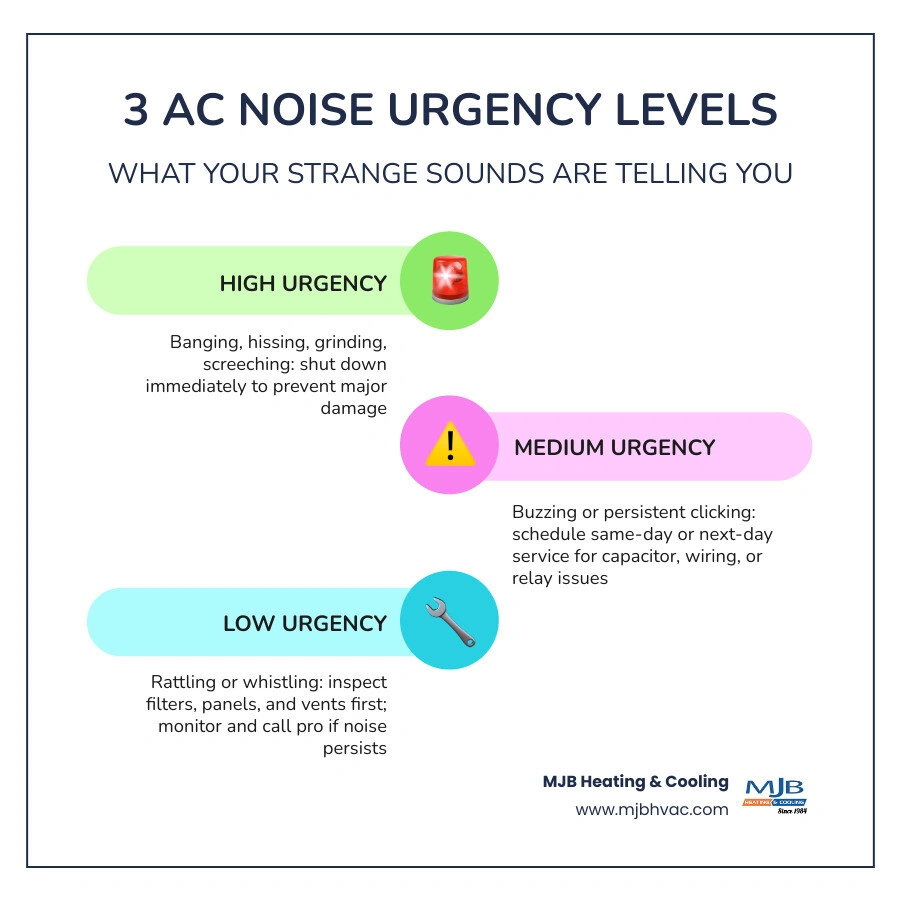
Here's a quick-reference guide to the most common AC noises and what they typically signal:
| Sound | Most Likely Cause | Urgency |
|---|---|---|
| Banging / Clanking | Loose or broken part in compressor or blower | High — shut down immediately |
| Hissing | Refrigerant leak or internal valve issue | High — shut down immediately |
| Screeching / Squealing | Worn motor bearings or high compressor pressure | High — shut down immediately |
| Grinding | Metal-on-metal bearing wear | High — shut down immediately |
| Buzzing / Humming | Failing capacitor, loose wiring, or frozen coils | Medium — schedule same-day service |
| Clicking (persistent) | Faulty contactor, capacitor, or thermostat relay | Medium — schedule service soon |
| Rattling | Loose panels, hardware, or debris in the unit | Low to Medium — inspect and monitor |
| Whistling | Clogged air filter or blocked return vent | Low — check filter first |
| Gurgling / Bubbling | Clogged condensate drain or refrigerant leak | Low to Medium — inspect drain line |
Wichita summers are no joke. The combination of high heat, humidity, and near-constant system runtime puts real strain on AC equipment — and what starts as a faint rattle in June can turn into a full compressor failure by July. Modern air conditioners are designed to run between 25 and 55 decibels, roughly the volume of a quiet conversation. When your unit starts pushing past that, something has changed.
The good news is that most strange AC noises are early warnings, not death sentences. Catching them early is the difference between a minor repair and a major replacement. With proper maintenance, a well-cared-for system can last 15 to 20 years — but ignoring those early audio clues is one of the fastest ways to cut that lifespan short.
This guide walks you through every major AC noise, what it means, how urgent it is, and what you can do about it.
When we step into a backyard in Derby or Andover to diagnose a system, the first thing we do is listen. An HVAC system making strange noises is often trying to tell us exactly where it hurts.
If your unit sounds like it’s hosting a construction site, you likely have a loose or broken part. In the outdoor condenser, this often points to a problem with the compressor—the "heart" of your system. It could be a loose connecting rod, a piston pin, or a crankshaft that has finally given out. Inside the home, banging usually indicates an imbalanced blower wheel or a loose blower motor mount. These are serious signs your AC needs repair. If left running, a loose part can fly off and cause catastrophic damage to the surrounding components, turning a repair into a full system replacement.
Sometimes the noise is rhythmic. If you hear a "thwapping" sound, it might be something as simple as a piece of loose insulation or even a small toy that fell into the blower assembly. However, if the banging is heavy and metallic, it’s often the compressor mounts. These are small rubber or metal parts that keep the compressor steady. When they wear out, the compressor can physically strike the side of the unit casing.
Hissing is one of the most distinct sounds an AC can make, and it’s rarely good news. In many cases, it signals a refrigerant leak. Refrigerant is the lifeblood of your cooling system, but it’s also a hazardous chemical that must be handled by EPA-certified pros. If you have an AC that's making hissing sounds in Haysville or Wichita, it could be coming from pinholes in the evaporator coil or a leak in the copper refrigerant lines.
Beyond leaks, hissing can indicate:
Not all noises mean the system is dying. A single "click" when the system starts or stops is completely normal—that’s just the thermostat relay engaging. However, if you hear HVAC making strange noises in Haysville like persistent, rapid clicking, you’re likely looking at an electrical failure.
This often stems from:
In the HVAC world, there are "nuisance" noises and "emergency" noises. If you hear a high-pitched screeching or a sound like a jet engine taking off, you need to head straight to your thermostat and flip it to the "off" position.
A loud, piercing screech usually indicates one of two things: high internal pressure in the compressor or failing motor bearings. If the noise lasts for 10–15 seconds at startup and then disappears, it might be high pressure equalizing. But if it’s persistent, it’s a red flag. Newer units in places like Maize or Rose Hill typically use direct-drive motors, so screeching often means the bearings are bone-dry or damaged.
When an AC starts making grinding noises in Haysville, it’s almost always metal-on-metal contact. This happens when motor bearings wear down completely. If you catch this early, we can often just replace the motor or bearings. If you ignore it, the motor will seize, likely overheating and potentially causing an electrical fire or damaging the compressor.
Emergency Shutdown Procedure:
To help us help you, it’s great if you can identify where the noise is coming from. You can do this by performing a "fan-only test." Turn your thermostat to "Fan On" and "Cool Off." If the noise persists, it’s likely in the indoor blower assembly. If the noise only happens when the cooling is active, it’s likely the outdoor condenser or the compressor.
| Source | Common Sounds | Potential Issues |
|---|---|---|
| Indoor Air Handler | Whistling, Thwapping, Gurgling | Clogged filter, blower imbalance, drain clog |
| Outdoor Condenser | Banging, Screeching, Rattling | Compressor failure, fan obstruction, debris |
| Ductwork | Popping, Booming | Metal expansion, loose joints, pressure changes |
In the Wichita metro area, we have unique environmental factors. In the spring and early summer, cottonwood seeds can coat your outdoor coils like a thick blanket, causing the unit to hum loudly as it struggles for air. High winds can also blow twigs, pebbles, or even fir needles into the top grille of your condenser. If these hit the fan blades, you'll hear a rhythmic "clack-clack-clack" that sounds much scarier than it actually is.
While we always recommend professional help for electrical or refrigerant issues, there are a few things you can do to keep things quiet.
One of the most common causes of a "whistling" AC is restricted airflow. Many homeowners close vents in unused rooms to "save energy," but this actually increases pressure in your ductwork. You should keep at least 80% of your supply vents open at all times. If too many are closed, your AC will sound like a tea kettle as air is forced through tiny gaps.
A filthy air filter is the root of many evils. It can cause the evaporator coil to freeze into a block of ice, leading to a strange buzzing or thumping sound. Additionally, if you hear gurgling or bubbling, check your condensate drain line. Algae and debris can clog these PVC pipes. You can often use a wet/dry vac on the outdoor end of the pipe to suck out the clog and stop the noise.
Because of our high humidity, your system works twice as hard to remove moisture from the air. This makes regular maintenance vital. Here is a quick DIY checklist:
No. A loud banging or clanking noise is a sign of mechanical failure. Continuing to run the unit can cause "catastrophic damage"—meaning a part could break off and destroy the entire system. Turn it off immediately.
This is usually caused by restricted airflow. Check your air filter first; if it’s clogged with dust, the fan has to work harder to pull air through, creating that whistling effect. Also, ensure your return vents aren't blocked by furniture or curtains.
Absolutely. High winds can blow debris into the fan housing, and our extreme temperature swings cause the metal cabinet to expand and contract, which can lead to popping or rattling sounds as the unit cycles on and off.
At MJB Heating & Cooling, we’ve been the "quiet experts" for the Wichita metro area since 1984. As a family-owned business founded in Derby, we believe in an honest business approach and quality workmanship. We know that when your ac making strange noises what they mean is usually a worry about your family's comfort and your wallet.
Whether you're in Haysville, Andover, or El Dorado, don't let a small "chirp" turn into a major breakdown. Catching these audio clues early can save your system and keep your home a peaceful, cool oasis all summer long.
If your AC is trying to tell you something, we're here to listen. Schedule your professional AC service today and let us bring the sound of silence back to your home.
If you've noticed your ac making strange noises, what they mean could range from a minor fix to a sign that your system is headed for a costly breakdown. A healthy air conditioner should produce a steady, low hum and a gentle rush of air through your vents — anything outside that pattern is your system asking for attention.
Here's a quick-reference guide to the most common AC noises and what they typically signal:
| Sound | Most Likely Cause | Urgency |
|---|---|---|
| Banging / Clanking | Loose or broken part in compressor or blower | High — shut down immediately |
| Hissing | Refrigerant leak or internal valve issue | High — shut down immediately |
| Screeching / Squealing | Worn motor bearings or high compressor pressure | High — shut down immediately |
| Grinding | Metal-on-metal bearing wear | High — shut down immediately |
| Buzzing / Humming | Failing capacitor, loose wiring, or frozen coils | Medium — schedule same-day service |
| Clicking (persistent) | Faulty contactor, capacitor, or thermostat relay | Medium — schedule service soon |
| Rattling | Loose panels, hardware, or debris in the unit | Low to Medium — inspect and monitor |
| Whistling | Clogged air filter or blocked return vent | Low — check filter first |
| Gurgling / Bubbling | Clogged condensate drain or refrigerant leak | Low to Medium — inspect drain line |
Wichita summers are no joke. The combination of high heat, humidity, and near-constant system runtime puts real strain on AC equipment — and what starts as a faint rattle in June can turn into a full compressor failure by July. Modern air conditioners are designed to run between 25 and 55 decibels, roughly the volume of a quiet conversation. When your unit starts pushing past that, something has changed.
The good news is that most strange AC noises are early warnings, not death sentences. Catching them early is the difference between a minor repair and a major replacement. With proper maintenance, a well-cared-for system can last 15 to 20 years — but ignoring those early audio clues is one of the fastest ways to cut that lifespan short.
This guide walks you through every major AC noise, what it means, how urgent it is, and what you can do about it.
When we step into a backyard in Derby or Andover to diagnose a system, the first thing we do is listen. An HVAC system making strange noises is often trying to tell us exactly where it hurts.
If your unit sounds like it’s hosting a construction site, you likely have a loose or broken part. In the outdoor condenser, this often points to a problem with the compressor—the "heart" of your system. It could be a loose connecting rod, a piston pin, or a crankshaft that has finally given out. Inside the home, banging usually indicates an imbalanced blower wheel or a loose blower motor mount. These are serious signs your AC needs repair. If left running, a loose part can fly off and cause catastrophic damage to the surrounding components, turning a repair into a full system replacement.
Sometimes the noise is rhythmic. If you hear a "thwapping" sound, it might be something as simple as a piece of loose insulation or even a small toy that fell into the blower assembly. However, if the banging is heavy and metallic, it’s often the compressor mounts. These are small rubber or metal parts that keep the compressor steady. When they wear out, the compressor can physically strike the side of the unit casing.
Hissing is one of the most distinct sounds an AC can make, and it’s rarely good news. In many cases, it signals a refrigerant leak. Refrigerant is the lifeblood of your cooling system, but it’s also a hazardous chemical that must be handled by EPA-certified pros. If you have an AC that's making hissing sounds in Haysville or Wichita, it could be coming from pinholes in the evaporator coil or a leak in the copper refrigerant lines.
Beyond leaks, hissing can indicate:
Not all noises mean the system is dying. A single "click" when the system starts or stops is completely normal—that’s just the thermostat relay engaging. However, if you hear HVAC making strange noises in Haysville like persistent, rapid clicking, you’re likely looking at an electrical failure.
This often stems from:
In the HVAC world, there are "nuisance" noises and "emergency" noises. If you hear a high-pitched screeching or a sound like a jet engine taking off, you need to head straight to your thermostat and flip it to the "off" position.
A loud, piercing screech usually indicates one of two things: high internal pressure in the compressor or failing motor bearings. If the noise lasts for 10–15 seconds at startup and then disappears, it might be high pressure equalizing. But if it’s persistent, it’s a red flag. Newer units in places like Maize or Rose Hill typically use direct-drive motors, so screeching often means the bearings are bone-dry or damaged.
When an AC starts making grinding noises in Haysville, it’s almost always metal-on-metal contact. This happens when motor bearings wear down completely. If you catch this early, we can often just replace the motor or bearings. If you ignore it, the motor will seize, likely overheating and potentially causing an electrical fire or damaging the compressor.
Emergency Shutdown Procedure:
To help us help you, it’s great if you can identify where the noise is coming from. You can do this by performing a "fan-only test." Turn your thermostat to "Fan On" and "Cool Off." If the noise persists, it’s likely in the indoor blower assembly. If the noise only happens when the cooling is active, it’s likely the outdoor condenser or the compressor.
| Source | Common Sounds | Potential Issues |
|---|---|---|
| Indoor Air Handler | Whistling, Thwapping, Gurgling | Clogged filter, blower imbalance, drain clog |
| Outdoor Condenser | Banging, Screeching, Rattling | Compressor failure, fan obstruction, debris |
| Ductwork | Popping, Booming | Metal expansion, loose joints, pressure changes |
In the Wichita metro area, we have unique environmental factors. In the spring and early summer, cottonwood seeds can coat your outdoor coils like a thick blanket, causing the unit to hum loudly as it struggles for air. High winds can also blow twigs, pebbles, or even fir needles into the top grille of your condenser. If these hit the fan blades, you'll hear a rhythmic "clack-clack-clack" that sounds much scarier than it actually is.
While we always recommend professional help for electrical or refrigerant issues, there are a few things you can do to keep things quiet.
One of the most common causes of a "whistling" AC is restricted airflow. Many homeowners close vents in unused rooms to "save energy," but this actually increases pressure in your ductwork. You should keep at least 80% of your supply vents open at all times. If too many are closed, your AC will sound like a tea kettle as air is forced through tiny gaps.
A filthy air filter is the root of many evils. It can cause the evaporator coil to freeze into a block of ice, leading to a strange buzzing or thumping sound. Additionally, if you hear gurgling or bubbling, check your condensate drain line. Algae and debris can clog these PVC pipes. You can often use a wet/dry vac on the outdoor end of the pipe to suck out the clog and stop the noise.
Because of our high humidity, your system works twice as hard to remove moisture from the air. This makes regular maintenance vital. Here is a quick DIY checklist:
No. A loud banging or clanking noise is a sign of mechanical failure. Continuing to run the unit can cause "catastrophic damage"—meaning a part could break off and destroy the entire system. Turn it off immediately.
This is usually caused by restricted airflow. Check your air filter first; if it’s clogged with dust, the fan has to work harder to pull air through, creating that whistling effect. Also, ensure your return vents aren't blocked by furniture or curtains.
Absolutely. High winds can blow debris into the fan housing, and our extreme temperature swings cause the metal cabinet to expand and contract, which can lead to popping or rattling sounds as the unit cycles on and off.
At MJB Heating & Cooling, we’ve been the "quiet experts" for the Wichita metro area since 1984. As a family-owned business founded in Derby, we believe in an honest business approach and quality workmanship. We know that when your ac making strange noises what they mean is usually a worry about your family's comfort and your wallet.
Whether you're in Haysville, Andover, or El Dorado, don't let a small "chirp" turn into a major breakdown. Catching these audio clues early can save your system and keep your home a peaceful, cool oasis all summer long.
If your AC is trying to tell you something, we're here to listen. Schedule your professional AC service today and let us bring the sound of silence back to your home.
If you've noticed your ac making strange noises, what they mean could range from a minor fix to a sign that your system is headed for a costly breakdown. A healthy air conditioner should produce a steady, low hum and a gentle rush of air through your vents — anything outside that pattern is your system asking for attention.
Here's a quick-reference guide to the most common AC noises and what they typically signal:
| Sound | Most Likely Cause | Urgency |
|---|---|---|
| Banging / Clanking | Loose or broken part in compressor or blower | High — shut down immediately |
| Hissing | Refrigerant leak or internal valve issue | High — shut down immediately |
| Screeching / Squealing | Worn motor bearings or high compressor pressure | High — shut down immediately |
| Grinding | Metal-on-metal bearing wear | High — shut down immediately |
| Buzzing / Humming | Failing capacitor, loose wiring, or frozen coils | Medium — schedule same-day service |
| Clicking (persistent) | Faulty contactor, capacitor, or thermostat relay | Medium — schedule service soon |
| Rattling | Loose panels, hardware, or debris in the unit | Low to Medium — inspect and monitor |
| Whistling | Clogged air filter or blocked return vent | Low — check filter first |
| Gurgling / Bubbling | Clogged condensate drain or refrigerant leak | Low to Medium — inspect drain line |
Wichita summers are no joke. The combination of high heat, humidity, and near-constant system runtime puts real strain on AC equipment — and what starts as a faint rattle in June can turn into a full compressor failure by July. Modern air conditioners are designed to run between 25 and 55 decibels, roughly the volume of a quiet conversation. When your unit starts pushing past that, something has changed.
The good news is that most strange AC noises are early warnings, not death sentences. Catching them early is the difference between a minor repair and a major replacement. With proper maintenance, a well-cared-for system can last 15 to 20 years — but ignoring those early audio clues is one of the fastest ways to cut that lifespan short.
This guide walks you through every major AC noise, what it means, how urgent it is, and what you can do about it.
When we step into a backyard in Derby or Andover to diagnose a system, the first thing we do is listen. An HVAC system making strange noises is often trying to tell us exactly where it hurts.
If your unit sounds like it’s hosting a construction site, you likely have a loose or broken part. In the outdoor condenser, this often points to a problem with the compressor—the "heart" of your system. It could be a loose connecting rod, a piston pin, or a crankshaft that has finally given out. Inside the home, banging usually indicates an imbalanced blower wheel or a loose blower motor mount. These are serious signs your AC needs repair. If left running, a loose part can fly off and cause catastrophic damage to the surrounding components, turning a repair into a full system replacement.
Sometimes the noise is rhythmic. If you hear a "thwapping" sound, it might be something as simple as a piece of loose insulation or even a small toy that fell into the blower assembly. However, if the banging is heavy and metallic, it’s often the compressor mounts. These are small rubber or metal parts that keep the compressor steady. When they wear out, the compressor can physically strike the side of the unit casing.
Hissing is one of the most distinct sounds an AC can make, and it’s rarely good news. In many cases, it signals a refrigerant leak. Refrigerant is the lifeblood of your cooling system, but it’s also a hazardous chemical that must be handled by EPA-certified pros. If you have an AC that's making hissing sounds in Haysville or Wichita, it could be coming from pinholes in the evaporator coil or a leak in the copper refrigerant lines.
Beyond leaks, hissing can indicate:
Not all noises mean the system is dying. A single "click" when the system starts or stops is completely normal—that’s just the thermostat relay engaging. However, if you hear HVAC making strange noises in Haysville like persistent, rapid clicking, you’re likely looking at an electrical failure.
This often stems from:
In the HVAC world, there are "nuisance" noises and "emergency" noises. If you hear a high-pitched screeching or a sound like a jet engine taking off, you need to head straight to your thermostat and flip it to the "off" position.
A loud, piercing screech usually indicates one of two things: high internal pressure in the compressor or failing motor bearings. If the noise lasts for 10–15 seconds at startup and then disappears, it might be high pressure equalizing. But if it’s persistent, it’s a red flag. Newer units in places like Maize or Rose Hill typically use direct-drive motors, so screeching often means the bearings are bone-dry or damaged.
When an AC starts making grinding noises in Haysville, it’s almost always metal-on-metal contact. This happens when motor bearings wear down completely. If you catch this early, we can often just replace the motor or bearings. If you ignore it, the motor will seize, likely overheating and potentially causing an electrical fire or damaging the compressor.
Emergency Shutdown Procedure:
To help us help you, it’s great if you can identify where the noise is coming from. You can do this by performing a "fan-only test." Turn your thermostat to "Fan On" and "Cool Off." If the noise persists, it’s likely in the indoor blower assembly. If the noise only happens when the cooling is active, it’s likely the outdoor condenser or the compressor.
| Source | Common Sounds | Potential Issues |
|---|---|---|
| Indoor Air Handler | Whistling, Thwapping, Gurgling | Clogged filter, blower imbalance, drain clog |
| Outdoor Condenser | Banging, Screeching, Rattling | Compressor failure, fan obstruction, debris |
| Ductwork | Popping, Booming | Metal expansion, loose joints, pressure changes |
In the Wichita metro area, we have unique environmental factors. In the spring and early summer, cottonwood seeds can coat your outdoor coils like a thick blanket, causing the unit to hum loudly as it struggles for air. High winds can also blow twigs, pebbles, or even fir needles into the top grille of your condenser. If these hit the fan blades, you'll hear a rhythmic "clack-clack-clack" that sounds much scarier than it actually is.
While we always recommend professional help for electrical or refrigerant issues, there are a few things you can do to keep things quiet.
One of the most common causes of a "whistling" AC is restricted airflow. Many homeowners close vents in unused rooms to "save energy," but this actually increases pressure in your ductwork. You should keep at least 80% of your supply vents open at all times. If too many are closed, your AC will sound like a tea kettle as air is forced through tiny gaps.
A filthy air filter is the root of many evils. It can cause the evaporator coil to freeze into a block of ice, leading to a strange buzzing or thumping sound. Additionally, if you hear gurgling or bubbling, check your condensate drain line. Algae and debris can clog these PVC pipes. You can often use a wet/dry vac on the outdoor end of the pipe to suck out the clog and stop the noise.
Because of our high humidity, your system works twice as hard to remove moisture from the air. This makes regular maintenance vital. Here is a quick DIY checklist:
No. A loud banging or clanking noise is a sign of mechanical failure. Continuing to run the unit can cause "catastrophic damage"—meaning a part could break off and destroy the entire system. Turn it off immediately.
This is usually caused by restricted airflow. Check your air filter first; if it’s clogged with dust, the fan has to work harder to pull air through, creating that whistling effect. Also, ensure your return vents aren't blocked by furniture or curtains.
Absolutely. High winds can blow debris into the fan housing, and our extreme temperature swings cause the metal cabinet to expand and contract, which can lead to popping or rattling sounds as the unit cycles on and off.
At MJB Heating & Cooling, we’ve been the "quiet experts" for the Wichita metro area since 1984. As a family-owned business founded in Derby, we believe in an honest business approach and quality workmanship. We know that when your ac making strange noises what they mean is usually a worry about your family's comfort and your wallet.
Whether you're in Haysville, Andover, or El Dorado, don't let a small "chirp" turn into a major breakdown. Catching these audio clues early can save your system and keep your home a peaceful, cool oasis all summer long.
If your AC is trying to tell you something, we're here to listen. Schedule your professional AC service today and let us bring the sound of silence back to your home.

If you've noticed your ac making strange noises, what they mean could range from a minor fix to a sign that your system is headed for a costly breakdown. A healthy air conditioner should produce a steady, low hum and a gentle rush of air through your vents — anything outside that pattern is your system asking for attention.
Here's a quick-reference guide to the most common AC noises and what they typically signal:
| Sound | Most Likely Cause | Urgency |
|---|---|---|
| Banging / Clanking | Loose or broken part in compressor or blower | High — shut down immediately |
| Hissing | Refrigerant leak or internal valve issue | High — shut down immediately |
| Screeching / Squealing | Worn motor bearings or high compressor pressure | High — shut down immediately |
| Grinding | Metal-on-metal bearing wear | High — shut down immediately |
| Buzzing / Humming | Failing capacitor, loose wiring, or frozen coils | Medium — schedule same-day service |
| Clicking (persistent) | Faulty contactor, capacitor, or thermostat relay | Medium — schedule service soon |
| Rattling | Loose panels, hardware, or debris in the unit | Low to Medium — inspect and monitor |
| Whistling | Clogged air filter or blocked return vent | Low — check filter first |
| Gurgling / Bubbling | Clogged condensate drain or refrigerant leak | Low to Medium — inspect drain line |
Wichita summers are no joke. The combination of high heat, humidity, and near-constant system runtime puts real strain on AC equipment — and what starts as a faint rattle in June can turn into a full compressor failure by July. Modern air conditioners are designed to run between 25 and 55 decibels, roughly the volume of a quiet conversation. When your unit starts pushing past that, something has changed.
The good news is that most strange AC noises are early warnings, not death sentences. Catching them early is the difference between a minor repair and a major replacement. With proper maintenance, a well-cared-for system can last 15 to 20 years — but ignoring those early audio clues is one of the fastest ways to cut that lifespan short.
This guide walks you through every major AC noise, what it means, how urgent it is, and what you can do about it.
When we step into a backyard in Derby or Andover to diagnose a system, the first thing we do is listen. An HVAC system making strange noises is often trying to tell us exactly where it hurts.
If your unit sounds like it’s hosting a construction site, you likely have a loose or broken part. In the outdoor condenser, this often points to a problem with the compressor—the "heart" of your system. It could be a loose connecting rod, a piston pin, or a crankshaft that has finally given out. Inside the home, banging usually indicates an imbalanced blower wheel or a loose blower motor mount. These are serious signs your AC needs repair. If left running, a loose part can fly off and cause catastrophic damage to the surrounding components, turning a repair into a full system replacement.
Sometimes the noise is rhythmic. If you hear a "thwapping" sound, it might be something as simple as a piece of loose insulation or even a small toy that fell into the blower assembly. However, if the banging is heavy and metallic, it’s often the compressor mounts. These are small rubber or metal parts that keep the compressor steady. When they wear out, the compressor can physically strike the side of the unit casing.
Hissing is one of the most distinct sounds an AC can make, and it’s rarely good news. In many cases, it signals a refrigerant leak. Refrigerant is the lifeblood of your cooling system, but it’s also a hazardous chemical that must be handled by EPA-certified pros. If you have an AC that's making hissing sounds in Haysville or Wichita, it could be coming from pinholes in the evaporator coil or a leak in the copper refrigerant lines.
Beyond leaks, hissing can indicate:
Not all noises mean the system is dying. A single "click" when the system starts or stops is completely normal—that’s just the thermostat relay engaging. However, if you hear HVAC making strange noises in Haysville like persistent, rapid clicking, you’re likely looking at an electrical failure.
This often stems from:
In the HVAC world, there are "nuisance" noises and "emergency" noises. If you hear a high-pitched screeching or a sound like a jet engine taking off, you need to head straight to your thermostat and flip it to the "off" position.
A loud, piercing screech usually indicates one of two things: high internal pressure in the compressor or failing motor bearings. If the noise lasts for 10–15 seconds at startup and then disappears, it might be high pressure equalizing. But if it’s persistent, it’s a red flag. Newer units in places like Maize or Rose Hill typically use direct-drive motors, so screeching often means the bearings are bone-dry or damaged.
When an AC starts making grinding noises in Haysville, it’s almost always metal-on-metal contact. This happens when motor bearings wear down completely. If you catch this early, we can often just replace the motor or bearings. If you ignore it, the motor will seize, likely overheating and potentially causing an electrical fire or damaging the compressor.
Emergency Shutdown Procedure:
To help us help you, it’s great if you can identify where the noise is coming from. You can do this by performing a "fan-only test." Turn your thermostat to "Fan On" and "Cool Off." If the noise persists, it’s likely in the indoor blower assembly. If the noise only happens when the cooling is active, it’s likely the outdoor condenser or the compressor.
| Source | Common Sounds | Potential Issues |
|---|---|---|
| Indoor Air Handler | Whistling, Thwapping, Gurgling | Clogged filter, blower imbalance, drain clog |
| Outdoor Condenser | Banging, Screeching, Rattling | Compressor failure, fan obstruction, debris |
| Ductwork | Popping, Booming | Metal expansion, loose joints, pressure changes |
In the Wichita metro area, we have unique environmental factors. In the spring and early summer, cottonwood seeds can coat your outdoor coils like a thick blanket, causing the unit to hum loudly as it struggles for air. High winds can also blow twigs, pebbles, or even fir needles into the top grille of your condenser. If these hit the fan blades, you'll hear a rhythmic "clack-clack-clack" that sounds much scarier than it actually is.
While we always recommend professional help for electrical or refrigerant issues, there are a few things you can do to keep things quiet.
One of the most common causes of a "whistling" AC is restricted airflow. Many homeowners close vents in unused rooms to "save energy," but this actually increases pressure in your ductwork. You should keep at least 80% of your supply vents open at all times. If too many are closed, your AC will sound like a tea kettle as air is forced through tiny gaps.
A filthy air filter is the root of many evils. It can cause the evaporator coil to freeze into a block of ice, leading to a strange buzzing or thumping sound. Additionally, if you hear gurgling or bubbling, check your condensate drain line. Algae and debris can clog these PVC pipes. You can often use a wet/dry vac on the outdoor end of the pipe to suck out the clog and stop the noise.
Because of our high humidity, your system works twice as hard to remove moisture from the air. This makes regular maintenance vital. Here is a quick DIY checklist:
No. A loud banging or clanking noise is a sign of mechanical failure. Continuing to run the unit can cause "catastrophic damage"—meaning a part could break off and destroy the entire system. Turn it off immediately.
This is usually caused by restricted airflow. Check your air filter first; if it’s clogged with dust, the fan has to work harder to pull air through, creating that whistling effect. Also, ensure your return vents aren't blocked by furniture or curtains.
Absolutely. High winds can blow debris into the fan housing, and our extreme temperature swings cause the metal cabinet to expand and contract, which can lead to popping or rattling sounds as the unit cycles on and off.
At MJB Heating & Cooling, we’ve been the "quiet experts" for the Wichita metro area since 1984. As a family-owned business founded in Derby, we believe in an honest business approach and quality workmanship. We know that when your ac making strange noises what they mean is usually a worry about your family's comfort and your wallet.
Whether you're in Haysville, Andover, or El Dorado, don't let a small "chirp" turn into a major breakdown. Catching these audio clues early can save your system and keep your home a peaceful, cool oasis all summer long.
If your AC is trying to tell you something, we're here to listen. Schedule your professional AC service today and let us bring the sound of silence back to your home.
If you've noticed your ac making strange noises, what they mean could range from a minor fix to a sign that your system is headed for a costly breakdown. A healthy air conditioner should produce a steady, low hum and a gentle rush of air through your vents — anything outside that pattern is your system asking for attention.
Here's a quick-reference guide to the most common AC noises and what they typically signal:
| Sound | Most Likely Cause | Urgency |
|---|---|---|
| Banging / Clanking | Loose or broken part in compressor or blower | High — shut down immediately |
| Hissing | Refrigerant leak or internal valve issue | High — shut down immediately |
| Screeching / Squealing | Worn motor bearings or high compressor pressure | High — shut down immediately |
| Grinding | Metal-on-metal bearing wear | High — shut down immediately |
| Buzzing / Humming | Failing capacitor, loose wiring, or frozen coils | Medium — schedule same-day service |
| Clicking (persistent) | Faulty contactor, capacitor, or thermostat relay | Medium — schedule service soon |
| Rattling | Loose panels, hardware, or debris in the unit | Low to Medium — inspect and monitor |
| Whistling | Clogged air filter or blocked return vent | Low — check filter first |
| Gurgling / Bubbling | Clogged condensate drain or refrigerant leak | Low to Medium — inspect drain line |
Wichita summers are no joke. The combination of high heat, humidity, and near-constant system runtime puts real strain on AC equipment — and what starts as a faint rattle in June can turn into a full compressor failure by July. Modern air conditioners are designed to run between 25 and 55 decibels, roughly the volume of a quiet conversation. When your unit starts pushing past that, something has changed.
The good news is that most strange AC noises are early warnings, not death sentences. Catching them early is the difference between a minor repair and a major replacement. With proper maintenance, a well-cared-for system can last 15 to 20 years — but ignoring those early audio clues is one of the fastest ways to cut that lifespan short.
This guide walks you through every major AC noise, what it means, how urgent it is, and what you can do about it.
When we step into a backyard in Derby or Andover to diagnose a system, the first thing we do is listen. An HVAC system making strange noises is often trying to tell us exactly where it hurts.
If your unit sounds like it’s hosting a construction site, you likely have a loose or broken part. In the outdoor condenser, this often points to a problem with the compressor—the "heart" of your system. It could be a loose connecting rod, a piston pin, or a crankshaft that has finally given out. Inside the home, banging usually indicates an imbalanced blower wheel or a loose blower motor mount. These are serious signs your AC needs repair. If left running, a loose part can fly off and cause catastrophic damage to the surrounding components, turning a repair into a full system replacement.
Sometimes the noise is rhythmic. If you hear a "thwapping" sound, it might be something as simple as a piece of loose insulation or even a small toy that fell into the blower assembly. However, if the banging is heavy and metallic, it’s often the compressor mounts. These are small rubber or metal parts that keep the compressor steady. When they wear out, the compressor can physically strike the side of the unit casing.
Hissing is one of the most distinct sounds an AC can make, and it’s rarely good news. In many cases, it signals a refrigerant leak. Refrigerant is the lifeblood of your cooling system, but it’s also a hazardous chemical that must be handled by EPA-certified pros. If you have an AC that's making hissing sounds in Haysville or Wichita, it could be coming from pinholes in the evaporator coil or a leak in the copper refrigerant lines.
Beyond leaks, hissing can indicate:
Not all noises mean the system is dying. A single "click" when the system starts or stops is completely normal—that’s just the thermostat relay engaging. However, if you hear HVAC making strange noises in Haysville like persistent, rapid clicking, you’re likely looking at an electrical failure.
This often stems from:
In the HVAC world, there are "nuisance" noises and "emergency" noises. If you hear a high-pitched screeching or a sound like a jet engine taking off, you need to head straight to your thermostat and flip it to the "off" position.
A loud, piercing screech usually indicates one of two things: high internal pressure in the compressor or failing motor bearings. If the noise lasts for 10–15 seconds at startup and then disappears, it might be high pressure equalizing. But if it’s persistent, it’s a red flag. Newer units in places like Maize or Rose Hill typically use direct-drive motors, so screeching often means the bearings are bone-dry or damaged.
When an AC starts making grinding noises in Haysville, it’s almost always metal-on-metal contact. This happens when motor bearings wear down completely. If you catch this early, we can often just replace the motor or bearings. If you ignore it, the motor will seize, likely overheating and potentially causing an electrical fire or damaging the compressor.
Emergency Shutdown Procedure:
To help us help you, it’s great if you can identify where the noise is coming from. You can do this by performing a "fan-only test." Turn your thermostat to "Fan On" and "Cool Off." If the noise persists, it’s likely in the indoor blower assembly. If the noise only happens when the cooling is active, it’s likely the outdoor condenser or the compressor.
| Source | Common Sounds | Potential Issues |
|---|---|---|
| Indoor Air Handler | Whistling, Thwapping, Gurgling | Clogged filter, blower imbalance, drain clog |
| Outdoor Condenser | Banging, Screeching, Rattling | Compressor failure, fan obstruction, debris |
| Ductwork | Popping, Booming | Metal expansion, loose joints, pressure changes |
In the Wichita metro area, we have unique environmental factors. In the spring and early summer, cottonwood seeds can coat your outdoor coils like a thick blanket, causing the unit to hum loudly as it struggles for air. High winds can also blow twigs, pebbles, or even fir needles into the top grille of your condenser. If these hit the fan blades, you'll hear a rhythmic "clack-clack-clack" that sounds much scarier than it actually is.
While we always recommend professional help for electrical or refrigerant issues, there are a few things you can do to keep things quiet.
One of the most common causes of a "whistling" AC is restricted airflow. Many homeowners close vents in unused rooms to "save energy," but this actually increases pressure in your ductwork. You should keep at least 80% of your supply vents open at all times. If too many are closed, your AC will sound like a tea kettle as air is forced through tiny gaps.
A filthy air filter is the root of many evils. It can cause the evaporator coil to freeze into a block of ice, leading to a strange buzzing or thumping sound. Additionally, if you hear gurgling or bubbling, check your condensate drain line. Algae and debris can clog these PVC pipes. You can often use a wet/dry vac on the outdoor end of the pipe to suck out the clog and stop the noise.
Because of our high humidity, your system works twice as hard to remove moisture from the air. This makes regular maintenance vital. Here is a quick DIY checklist:
No. A loud banging or clanking noise is a sign of mechanical failure. Continuing to run the unit can cause "catastrophic damage"—meaning a part could break off and destroy the entire system. Turn it off immediately.
This is usually caused by restricted airflow. Check your air filter first; if it’s clogged with dust, the fan has to work harder to pull air through, creating that whistling effect. Also, ensure your return vents aren't blocked by furniture or curtains.
Absolutely. High winds can blow debris into the fan housing, and our extreme temperature swings cause the metal cabinet to expand and contract, which can lead to popping or rattling sounds as the unit cycles on and off.
At MJB Heating & Cooling, we’ve been the "quiet experts" for the Wichita metro area since 1984. As a family-owned business founded in Derby, we believe in an honest business approach and quality workmanship. We know that when your ac making strange noises what they mean is usually a worry about your family's comfort and your wallet.
Whether you're in Haysville, Andover, or El Dorado, don't let a small "chirp" turn into a major breakdown. Catching these audio clues early can save your system and keep your home a peaceful, cool oasis all summer long.
If your AC is trying to tell you something, we're here to listen. Schedule your professional AC service today and let us bring the sound of silence back to your home.


Our A/C stopped working on a Sunday and due to health issues, we needed to find a service company available on a Sunday. I called MJB and left a message on their emergency voice mail. Within 10 minutes Tom Buck called me to hear my description of the symptoms. He was just finishing an appointment in Wichita and would be on his way to my home on the south end of Derby. He arrived within 30 minutes! From start to finish he was the perfect example of what you could ever hope for in an HVAC tech and a human being. His evaluation of our system inside and out was as thorough as I could ever imagine and once he was done with the repair, our system is running as well or better than ever. Well worth the price for the evaluation, parts, and labor. Thank you again Tom for an awesome experience.
Our AC went out during the hottest days of the year, and they were out next day! We have been jerked around by a shoddy home warranty for years. We finally had a chance to pick our own repair people, and MJB came highly recommended. I can see why! I was impressed with the honesty and speed at which they fixed our AC unit!
Our commercial building had a lightening/electrical strike and damaged our 20 ton AC unit. No one could find us a new unit before the end of September. Imagining going all of August and September with no AC in Kansas and working inside near 100 degree temps is less than thrilling. Dale and the team at MJB called around and saved the day. They had us a new unit 5 weeks earlier than other could promise and I now have happy employees. The unit is amazingly quiet, super cold and so much more energy efficient. Thank you for being our super hero!
Came out and installed my new furnace. Was very polite and affordable. They are very acknowledgeable and I highly recommend!
Thank you very much. We had our 1st warm night in 3weeks. MJB took the time and effort to find the real problem. And the employees were kind and thoughtful and explained things very well. I cannot thank you and all of MJB. Will recommend you highly. Thanks again Marjorie Herman Oxford Kansas
We had a new system installed and I was so impressed with how quick they were in come out and install it, in the middle of a hot summer day. They were so friendly & very professional. I had a small problem with a weird sound and they came over immediately and fixed it. Love them!