


.avif)





Blogs
Stay updated with our latest blog posts.

A widespread myth in the heating industry is that when upgrading to a high-efficiency furnace, calculating the real payback period relies on a rigid, one-size-fits-all formula. Many homeowners assume that a generic calculation can predict exactly when an upgraded system will offset its initial installation effort. The reality is far more nuanced. The true payback of a heating system is not found in a standardized national average, but in a conceptual framework based strictly on your home's relative fuel utilization and energy waste over time.
As we approach the September pre-heating season transition, many homeowners face a concrete problem: choosing between a standard 80% AFUE furnace and a high-efficiency 96% AFUE model. Making this evaluation early in the fall gives you the clarity to weigh the long-term energy utilization against the upfront installation effort without the pressure of a mid-winter breakdown. Understanding this math empowers you to make a decision based on your specific household usage rather than marketing claims.
If you are evaluating your options ahead of the cold weather, exploring professional HVAC services and securing a reliable furnace installation in Derby ensures your home is equipped with a system that matches your long-term efficiency goals.
To accurately evaluate your options, you first need to understand the metric that drives the entire calculation: Annual Fuel Utilization Efficiency (AFUE). AFUE is a straightforward percentage that represents how much of the fuel consumed by your furnace is successfully converted into usable heat for your home, and how much is lost during the combustion process.
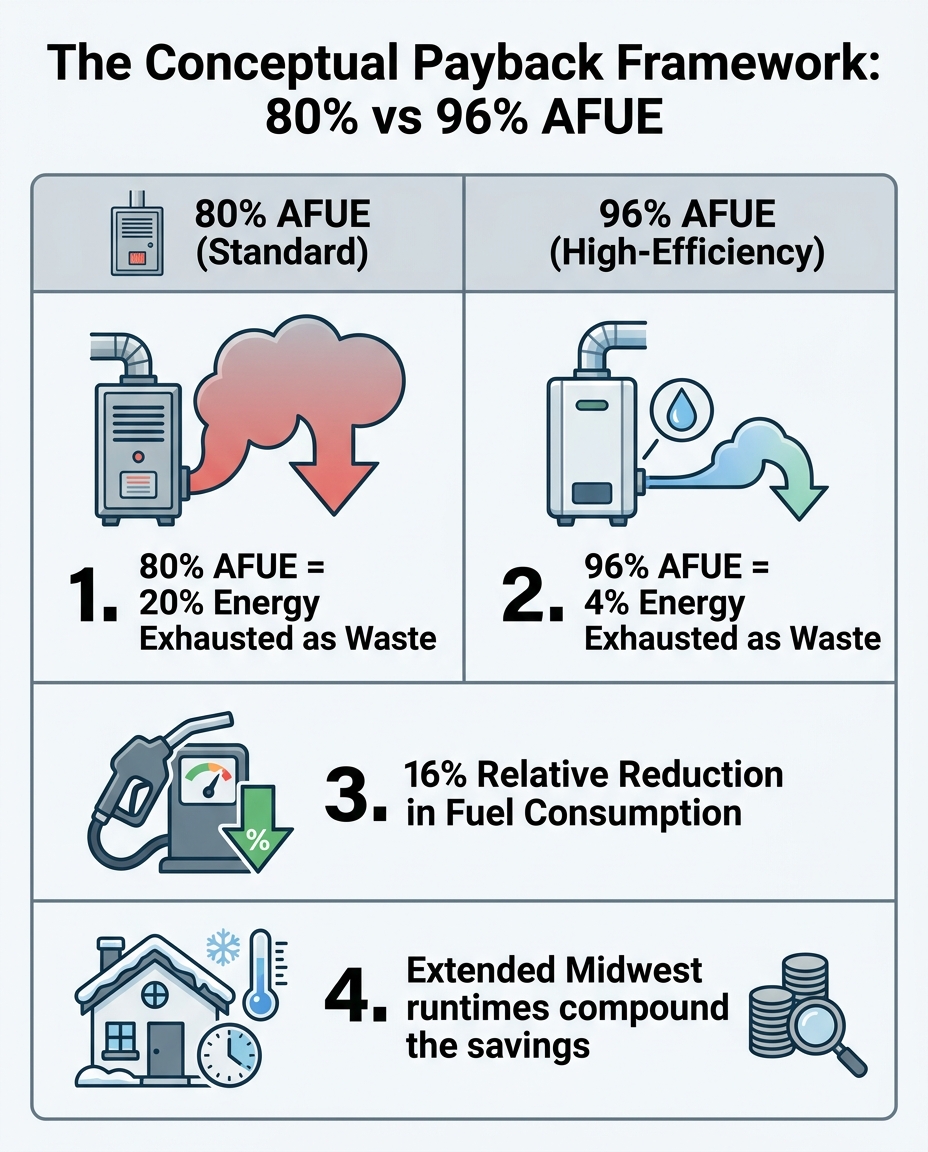
The standard baseline: An 80% AFUE furnace converts 80% of the energy it consumes into heat. The remaining 20% is exhausted straight up the flue pipe and out of your house as pure waste. For every unit of energy your system draws, one-fifth of it provides absolutely no comfort to your living space.
The high-efficiency alternative: A 96% AFUE model drastically alters this equation. By utilizing advanced internal components, this system captures nearly all the available heat, leaving only 4% to be exhausted as waste. The difference between the two systems is a 16% relative reduction in wasted fuel.
Rather than looking at immediate sticker tags, framing this 16% difference in terms of relative long-term fuel consumption provides a much clearer picture of your ongoing energy utilization.
• Usable Heat Generated — Standard Furnace (80% AFUE): 80% of consumed fuel — High-Efficiency Furnace (96% AFUE): 96% of consumed fuel
• Energy Exhausted as Waste — Standard Furnace (80% AFUE): 20% of consumed fuel — High-Efficiency Furnace (96% AFUE): 4% of consumed fuel
• Relative Efficiency Gain — Standard Furnace (80% AFUE): Baseline standard — High-Efficiency Furnace (96% AFUE): 16% improvement over baseline
• Primary Venting Method — Standard Furnace (80% AFUE): Traditional metal flue — High-Efficiency Furnace (96% AFUE): PVC piping (handles condensation)
By comparing the 80% vs 96% AFUE energy utilization side-by-side, it becomes clear that the high-efficiency unit is doing significantly more work with the exact same amount of fuel. The next step is understanding how your local environment accelerates this advantage.
Efficiency percentages do not exist in a vacuum. The actual impact of a 16% reduction in fuel waste depends entirely on how often your system needs to run. In a mild climate where a furnace only operates a few weeks out of the year, the compounding effect of that efficiency gain is minimal. However, local weather patterns completely change the equation.
Kansas winter heating degree days dictate extended furnace runtimes. With temperatures routinely dropping below freezing in Derby, KS, heating systems are forced to operate for long, continuous cycles to maintain indoor comfort. The more a system runs during a frigid day, the faster the 16% efficiency gain compounds. If an 80% AFUE unit is running constantly during a January cold snap, it is continuously exhausting 20% of its fuel as waste. A 96% AFUE unit running that same extended cycle is only losing 4%.
The toll on older systems: These extended runtimes place immense stress on standard or aging systems. Reliable heating is critical during Midwest cold snaps, and a system that has to work harder to overcome its own energy waste is often pushed to its limits. Being proactive before these heavy usage periods is critical. For example, one local homeowner needed a new system installed during the summer. Our professionals completed the new installation efficiently and kindly, ensuring the home was equipped with a robust system capable of handling the upcoming winter workload long before the freezing temperatures arrived.
If you are currently relying on an older system that struggles to keep up during long cycles, scheduling a professional assessment or furnace repair in Andover can help you determine if your current unit is wasting more energy than it should.
To determine if the higher initial installation effort of a 96% AFUE system makes sense for your home, you need a conceptual framework. While many calculators try to guess your exact utility rates, a more accurate method involves weighing relative AFUE savings against your specific household usage patterns. Here is the step-by-step conceptual framework for weighing relative AFUE savings against installation effort:
1. Step 1: Assess your home's relative energy usage. Look at your utility history during peak winter months. Instead of focusing on the final bill, look at the actual units of energy consumed (often measured in therms or CCF). A home with high baseline energy consumption stands to benefit much more from an efficiency upgrade than a heavily insulated home with low usage.
2. Step 2: Calculate the conceptual reduction in fuel waste. Apply the 16% efficiency difference to your baseline usage. By moving from an 80% to a 96% AFUE unit, you are effectively recapturing a significant portion of the fuel that was previously exhausted outside. This represents your relative reduction in ongoing energy consumption.
3. Step 3: Weigh the savings against the installation effort. High-efficiency systems require more labor and specialized materials to install (which we will cover in the next section). You must weigh the relative reduction in ongoing fuel consumption against this higher initial installation effort to determine your personal payback timeline.
4. Step 4: Factor in the expected lifespan of the equipment. A modern furnace is designed to operate for 15 to 20 years with proper maintenance. Visualize the 16% reduction in fuel waste compounding over two decades of Kansas winters. For homes with high winter usage, the long-term compounding effect often heavily outweighs the initial setup effort.
By using this formula, you remove the guesswork and base your decision on the 80% vs 96% AFUE energy utilization specific to your property.
Understanding why a 96% AFUE system achieves such high efficiency requires looking under the hood. The physical difference between an 80% standard unit and a 96% high-efficiency unit comes down to condensing technology. Standard furnaces burn fuel, extract the primary heat, and immediately vent the hot combustion gases outside. Those gases are still holding a significant amount of thermal energy, which is why 20% of the fuel's potential is lost.
High-efficiency condensing furnaces are engineered to capture that escaping heat. This advanced engineering inherently requires a more involved upfront installation effort, but it is the exact mechanism that drives the long-term energy savings.
The secret to achieving 96% AFUE lies in a component called the secondary heat exchanger. Here is how it functions:
• Capturing lost heat: After the primary heat exchanger does its job, the still-hot exhaust gases are routed into the secondary heat exchanger rather than being immediately vented outdoors.
• Extracting latent energy: The secondary heat exchanger cools these gases down to the point where the water vapor inside them condenses into a liquid. This phase change (from gas to liquid) releases a massive amount of latent heat, which the furnace captures and distributes into your home.
• Driving the efficiency rating: By squeezing every last drop of thermal energy out of the combustion gases, the secondary heat exchanger drives the efficiency rating from 80% up to 96%.
The installation difference: Because the secondary heat exchanger extracts so much heat, the remaining exhaust gases are significantly cooler and highly acidic due to the condensation. A traditional metal flue cannot handle this moisture and would quickly corrode. Therefore, a 96% AFUE furnace requires dedicated PVC venting to safely carry the acidic condensation away. Installing these new PVC vent pipes and managing the condensate drainage is why upgrading to a high-efficiency unit requires a more complex initial installation process compared to swapping out a standard 80% model.
When weighing the higher initial installation effort of a 96% AFUE system, it is important to factor in external programs designed to encourage energy efficiency. Qualifying high-efficiency installations may be eligible for generic local or federal energy incentives, which can significantly alter your conceptual payback timeline.
Federal and local programs: Various government and utility initiatives aim to reduce overall grid strain by incentivizing homeowners to adopt high-efficiency technology. These programs often apply to systems that meet strict ENERGY STAR guidelines, such as 96% AFUE condensing furnaces. By taking advantage of these programs, you effectively reduce the initial installation effort required to get the system up and running.
Shortening the timeline: Integrating these conceptual offsets into your overall payback calculation makes a 96% AFUE system much more accessible. When the initial barrier to entry is lowered by an incentive, the 16% relative reduction in ongoing fuel waste begins paying dividends much sooner in the equipment's lifespan.
Because these programs change frequently based on legislation and utility funding, we strongly advise readers to verify current programs with their local utility providers or a qualified tax professional. Exploring available Kansas energy rebates for HVAC upgrades during the September pre-heating season transition ensures you have all the necessary information before making a final decision.
Timing plays a massive role in making a sound heating decision. September is the optimal window to evaluate efficiency upgrades. The weather is mild, HVAC professionals have more flexible schedules, and you have the time to carefully weigh the 80% vs 96% decision thoughtfully.
Waiting until a frigid day can force rushed decisions. One local customer found themselves with a heater not working on a frigid day, creating an urgent need for heat. A technician arrived quickly, fixed the heater, and even identified a pipe that was not up to code on their hot water tank, resolving a potential safety issue. While that situation ended safely, evaluating your options during the early fall gives you the breathing room to avoid emergency scenarios entirely.
The value of transparent math: When you are considering an upgrade, it is vital to have multiple options presented clearly, allowing for a choice that fits your home's unique situation. At MJB Heating & Cooling, our commitment is to provide transparent, honest math to help homeowners make the right financial choice for their specific situation, rather than just upselling the most expensive equipment. We believe in contrasting transparent, educational math with high-pressure upsell tactics, ensuring you understand exactly how your new system will utilize fuel.
If you are ready to evaluate your home's heating needs, securing a professional furnace installation in Wichita before the winter rush ensures your home is prepared for whatever the Kansas winter delivers.
The right choice between an 80% and 96% AFUE furnace ultimately depends on your individual usage, your home's infrastructure, and transparent math. While a standard unit may require less upfront installation effort, a high-efficiency model offers a significant, compounding reduction in long-term fuel waste that proves its worth during long Midwest winters.
Taking advantage of the September pre-heating season transition allows you to evaluate these options calmly and thoroughly. If you are unsure which path makes the most sense for your property, our team is here to help run the conceptual numbers for your specific home, ensuring you invest in a heating solution that provides reliable comfort and efficient energy utilization for decades to come.
Is a high efficiency furnace worth the extra cost in Kansas?
Yes, for many homeowners in Kansas, a high-efficiency furnace proves its worth due to the extended winter heating degree days. Because local temperatures require heating systems to run for long, continuous cycles, the 16% reduction in fuel waste provided by a 96% AFUE unit compounds rapidly. Homes with higher baseline energy consumption will see the most significant long-term benefit from upgrading.
How do you calculate the payback period for a furnace without using exact dollar amounts?
You calculate the payback conceptually by comparing the relative energy waste of different AFUE ratings against your home's baseline fuel consumption. First, determine how much fuel your home uses during peak winter months. Next, factor in that a 96% AFUE furnace wastes 16% less fuel than a standard 80% model, and weigh that ongoing reduction in energy consumption against the higher initial installation effort over the 15-to-20-year lifespan of the equipment.
What is the physical difference between an 80% and 96% AFUE furnace?
The primary physical difference is the inclusion of a secondary heat exchanger in the 96% AFUE model. While an 80% furnace vents hot combustion gases directly outside through a metal flue, a 96% furnace routes those gases through the secondary exchanger to extract additional latent heat. This process causes condensation, requiring the high-efficiency unit to use specialized PVC piping for safe venting and drainage.
How does a secondary heat exchanger improve furnace efficiency?
A secondary heat exchanger improves efficiency by capturing thermal energy that standard furnaces exhaust as waste. It cools the combustion gases until the water vapor inside them condenses into a liquid, a phase change that releases a massive amount of latent heat. By capturing and distributing this latent heat, the furnace pushes its overall fuel utilization efficiency from a standard 80% up to 96%.
Do extended winter runtimes make a 96% AFUE furnace more beneficial?
Absolutely. The longer a furnace runs, the more fuel it consumes, which means the efficiency percentage plays a much larger role in your overall energy utilization. During extended Kansas winter cold snaps, an 80% AFUE unit will continuously exhaust 20% of its fuel as waste, whereas a 96% AFUE unit will only waste 4%, making the high-efficiency model highly beneficial during long runtimes.
When is the best time of year to upgrade my furnace in Derby?
The September pre-heating season transition is the optimal time to upgrade your furnace. Upgrading in early fall allows you to carefully evaluate your AFUE options and schedule an installation without the pressure of an emergency mid-winter breakdown. It also ensures your home is fully equipped with an efficient, reliable heating system before the first major cold snap hits.


Our A/C stopped working on a Sunday and due to health issues, we needed to find a service company available on a Sunday. I called MJB and left a message on their emergency voice mail. Within 10 minutes Tom Buck called me to hear my description of the symptoms. He was just finishing an appointment in Wichita and would be on his way to my home on the south end of Derby. He arrived within 30 minutes! From start to finish he was the perfect example of what you could ever hope for in an HVAC tech and a human being. His evaluation of our system inside and out was as thorough as I could ever imagine and once he was done with the repair, our system is running as well or better than ever. Well worth the price for the evaluation, parts, and labor. Thank you again Tom for an awesome experience.
Our AC went out during the hottest days of the year, and they were out next day! We have been jerked around by a shoddy home warranty for years. We finally had a chance to pick our own repair people, and MJB came highly recommended. I can see why! I was impressed with the honesty and speed at which they fixed our AC unit!
Our commercial building had a lightening/electrical strike and damaged our 20 ton AC unit. No one could find us a new unit before the end of September. Imagining going all of August and September with no AC in Kansas and working inside near 100 degree temps is less than thrilling. Dale and the team at MJB called around and saved the day. They had us a new unit 5 weeks earlier than other could promise and I now have happy employees. The unit is amazingly quiet, super cold and so much more energy efficient. Thank you for being our super hero!
Came out and installed my new furnace. Was very polite and affordable. They are very acknowledgeable and I highly recommend!
Thank you very much. We had our 1st warm night in 3weeks. MJB took the time and effort to find the real problem. And the employees were kind and thoughtful and explained things very well. I cannot thank you and all of MJB. Will recommend you highly. Thanks again Marjorie Herman Oxford Kansas
We had a new system installed and I was so impressed with how quick they were in come out and install it, in the middle of a hot summer day. They were so friendly & very professional. I had a small problem with a weird sound and they came over immediately and fixed it. Love them!


