.avif)





Blogs
Stay updated with our latest blog posts.
Figuring out how many mini split heads do I need is one of the first — and most important — questions to answer before installing a ductless system in your home. Get it right, and every room stays comfortable year-round without wasting energy. Get it wrong, and you're stuck with stuffy bedrooms, overworked equipment, or a system that short-cycles before it ever does its job.
Here's a quick answer based on home size:
| Home Size | Estimated Heads Needed |
|---|---|
| Up to 600 sq ft | 1 head |
| 600 – 1,200 sq ft | 1 – 2 heads |
| 1,200 – 2,000 sq ft | 2 – 3 heads |
| 2,000 – 3,000 sq ft | 3 – 5 heads |
| 3,000+ sq ft | 5 – 8 heads |
Quick rule of thumb: Plan for one indoor head per enclosed room — any space with a door you keep closed. Open-concept areas like a combined kitchen, dining, and living room can often share a single head.
For most homes in the Wichita metro area — whether you're in a ranch-style home in Derby, a two-story in Andover, or an older house in Newton with no existing ductwork — the answer falls somewhere between 2 and 5 indoor heads connected to a single outdoor unit.
But square footage is only part of the picture. Your home's layout, insulation, ceiling height, sun exposure, and how you actually use each room all play a role in getting the head count right. Central Kansas summers push temperatures well above 100°F, and winters demand reliable heat — which means proper sizing isn't optional. It's the difference between a system that performs and one that struggles.
This guide walks you through everything you need to know to plan the right number of mini split heads for your specific home.

When we talk about mini splits, we often use the word "zone." In the HVAC world, a zone is simply an area where you want independent temperature control. If your teenager wants their room at a crisp 68 degrees while you prefer the living room at 72, those are two separate zones.
Determining how many mini split heads do I need starts with identifying these zones. Unlike traditional central AC that blasts air through a whole house regardless of who is in which room, ductless systems allow us to be surgical. To understand the basics of this technology, it helps to first understand What is a Ductless Mini Split System.
In a standard Central Kansas home, we usually look at the "Door Rule." If a room has a door that stays closed most of the time — like a bedroom, a home office, or a basement guest room — it generally needs its own head. Air is a bit like water; it flows where it can, but it won't push through a closed wooden door.
For a typical three-bedroom ranch in Haysville or Bel Aire, you might look at:
Not necessarily. You don't need a head in every single square inch of the house. We typically advise against putting heads in:
Open-concept living is very popular in newer developments around Maize and Goddard. If your kitchen, dining room, and living room are all one large, unobstructed space, a single, correctly sized indoor head can often handle the whole area. As long as there aren't walls or narrow archways blocking the "throw" of the air, one unit can keep the entire "great room" comfortable.

While counting rooms is a great starting point, we have to look at the science of heat load to be sure. Central Kansas presents unique challenges. We have high humidity in the summer and biting winds in the winter.
BTU stands for British Thermal Unit, and it’s how we measure cooling and heating capacity. A standard rule of thumb is 20 BTUs per square foot.
However, "bigger" isn't always "better." If you put a massive 24,000 BTU head in a tiny 200-square-foot office, it will "short-cycle." This means it turns on, cools the air in two minutes, and shuts off before it has a chance to remove the humidity. You'll end up feeling cold and clammy.
Layout is the "hidden" factor. A 2,000-square-foot home that is wide open might only need three heads. A 2,000-square-foot historic home in Wichita’s Riverside district with lots of small, partitioned rooms might need six.
We also have to consider heat rise. In two-story homes in Andover or Augusta, the upstairs will always be warmer. We often recommend dedicated heads for the upstairs rooms to combat the natural rise of heat, even if the square footage is small.
At MJB Heating & Cooling, we don't just guess. We use what's called a Manual J load calculation. This is a scientific assessment that looks at:
This ensures your head count is based on data, not just a hunch.
Once you know how many heads you need, you have to decide how to power them. This is where we choose between single-zone and multi-zone systems.
| Feature | Single-Zone System | Multi-Zone System |
|---|---|---|
| Outdoor Units | One per indoor head | One for multiple indoor heads |
| Best For | Sunrooms, Garages, Additions | Whole-home cooling/heating |
| Control | One thermostat | Independent thermostats for each room |
| Capacity | Specialized for one space | High capacity (up to 8 zones) |
For more detail on these differences, check out our guide on Single vs Multi-Zone Ductless AC Systems and how they facilitate Temperature Zoning with Ductless AC Systems.
If you've just finished a basement in Derby or added a sunroom to your home in Park City, a single-zone system is perfect. It consists of one outdoor condenser connected to one indoor head. It’s simple, efficient, and doesn't require you to touch your existing HVAC system.
A multi-zone system uses one powerful outdoor condenser to support multiple indoor units (heads). Most residential units support 2 to 5 heads, though high-capacity systems can support up to 8.
One major advantage here is load diversity. Think about it: you probably aren't using your kitchen at full blast at 2:00 AM, and you aren't using your bedroom at 2:00 PM. A multi-zone system can shift its power to where it's needed most, allowing the total BTU capacity of the indoor heads to actually exceed the outdoor unit's capacity by up to 130%.
Yes! In many Central Kansas retrofits, we install one large outdoor unit that services the entire home. This keeps your yard tidy (no "army" of condensers) and allows for centralized maintenance. However, if you have a very large home (over 3,500 sq ft), we might suggest two separate multi-zone systems to ensure the refrigerant lines don't have to travel too far, which can sap efficiency.
If you don't like the look of multiple units hanging on your walls, there is a "hybrid" solution. A slim-ducted mini split (sometimes called a horizontal-ducted unit) is hidden away in an attic, crawlspace, or drop ceiling.
Imagine three small bedrooms located right next to each other in an older home in El Dorado. Instead of putting a wall-mounted head in every room, we can install one slim-ducted unit in the attic and run very short ducts to each bedroom. This gives you the efficiency of a mini split with the "invisible" look of central air.
Deciding where to put these is key, so we recommend looking at the Best Locations for AC Mini Split Installation.
Wall-mounted heads are still the kings of efficiency and individual control. With a slim-ducted unit serving three rooms, those three rooms generally share one thermostat. If you want absolute, room-by-room control, stick with the individual wall-mounted heads.
Whether you go with wall-mounted or slim-ducted, placement is everything. We aim to:
For a deeper dive into these strategies, read about AC Mini Split Placement for Maximum Efficiency.
Every home in the Wichita metro area has its own "personality." Here is how we typically plan for the most common rooms we see in our service area, from Valley Center to Wellington.
In the typical Kansas ranch home, the first floor is the heart of the house. Because of our 100-degree summers, the kitchen is a major heat source. We often recommend:
While DIY calculators are fun, they don't account for the "Kansas factor." Vaulted ceilings, 100-year-old brick walls in Newton, or leaky windows in an older Derby home can all throw off your numbers. A professional assessment ensures you don't buy more equipment than you need — or worse, too little.
We hear these questions often when visiting homeowners in Rose Hill, Mulvane, and beyond.
Typically, a standard 12,000 BTU head covers 400 to 600 square feet. However, in a well-insulated, modern home in Andover, that same head might easily handle 700 square feet. In a drafty historic home, it might struggle with 350.
You can, but there’s a catch. If you have a guest room that stays empty 90% of the time, you can leave the door open and let it "borrow" air from the hallway. Just know that when you have guests and close that door, the room will quickly become uncomfortable. Some homeowners choose to install a multi-zone outdoor unit with an extra port, allowing them to add a head to that guest room later if they decide they need it.
This is the number one mistake we see. Homeowners try to save money by putting one large unit in the hallway. Because the thermostat is on the unit in the hallway, it will turn off as soon as the hallway is cool. Meanwhile, the bedrooms (where the people actually are) remain hot and stuffy. Always put the head in the room where you spend your time.
Determining how many mini split heads do I need isn't just about counting walls; it's about planning for your lifestyle and the unique climate we share here in Central Kansas. Whether you're trying to solve the "hot upstairs" problem in your Andover home or looking for a whole-house solution in Wichita, the right head count is the foundation of your comfort.
At MJB Heating & Cooling, we’ve been helping our neighbors since 1984. We believe in quality workmanship and an honest approach — we won't sell you eight heads if you only need four. We live and work in these communities, and we know exactly what it takes to keep a Kansas home comfortable when the wind starts howling or the sun starts baking.
Ready to find the perfect configuration for your home? We’re here to help.
Contact us today to schedule your professional in-home assessment and stop the thermostat wars for good!
Figuring out how many mini split heads do I need is one of the first — and most important — questions to answer before installing a ductless system in your home. Get it right, and every room stays comfortable year-round without wasting energy. Get it wrong, and you're stuck with stuffy bedrooms, overworked equipment, or a system that short-cycles before it ever does its job.
Here's a quick answer based on home size:
| Home Size | Estimated Heads Needed |
|---|---|
| Up to 600 sq ft | 1 head |
| 600 – 1,200 sq ft | 1 – 2 heads |
| 1,200 – 2,000 sq ft | 2 – 3 heads |
| 2,000 – 3,000 sq ft | 3 – 5 heads |
| 3,000+ sq ft | 5 – 8 heads |
Quick rule of thumb: Plan for one indoor head per enclosed room — any space with a door you keep closed. Open-concept areas like a combined kitchen, dining, and living room can often share a single head.
For most homes in the Wichita metro area — whether you're in a ranch-style home in Derby, a two-story in Andover, or an older house in Newton with no existing ductwork — the answer falls somewhere between 2 and 5 indoor heads connected to a single outdoor unit.
But square footage is only part of the picture. Your home's layout, insulation, ceiling height, sun exposure, and how you actually use each room all play a role in getting the head count right. Central Kansas summers push temperatures well above 100°F, and winters demand reliable heat — which means proper sizing isn't optional. It's the difference between a system that performs and one that struggles.
This guide walks you through everything you need to know to plan the right number of mini split heads for your specific home.
When we talk about mini splits, we often use the word "zone." In the HVAC world, a zone is simply an area where you want independent temperature control. If your teenager wants their room at a crisp 68 degrees while you prefer the living room at 72, those are two separate zones.
Determining how many mini split heads do I need starts with identifying these zones. Unlike traditional central AC that blasts air through a whole house regardless of who is in which room, ductless systems allow us to be surgical. To understand the basics of this technology, it helps to first understand What is a Ductless Mini Split System.
In a standard Central Kansas home, we usually look at the "Door Rule." If a room has a door that stays closed most of the time — like a bedroom, a home office, or a basement guest room — it generally needs its own head. Air is a bit like water; it flows where it can, but it won't push through a closed wooden door.
For a typical three-bedroom ranch in Haysville or Bel Aire, you might look at:
Not necessarily. You don't need a head in every single square inch of the house. We typically advise against putting heads in:
Open-concept living is very popular in newer developments around Maize and Goddard. If your kitchen, dining room, and living room are all one large, unobstructed space, a single, correctly sized indoor head can often handle the whole area. As long as there aren't walls or narrow archways blocking the "throw" of the air, one unit can keep the entire "great room" comfortable.
While counting rooms is a great starting point, we have to look at the science of heat load to be sure. Central Kansas presents unique challenges. We have high humidity in the summer and biting winds in the winter.
BTU stands for British Thermal Unit, and it’s how we measure cooling and heating capacity. A standard rule of thumb is 20 BTUs per square foot.
However, "bigger" isn't always "better." If you put a massive 24,000 BTU head in a tiny 200-square-foot office, it will "short-cycle." This means it turns on, cools the air in two minutes, and shuts off before it has a chance to remove the humidity. You'll end up feeling cold and clammy.
Layout is the "hidden" factor. A 2,000-square-foot home that is wide open might only need three heads. A 2,000-square-foot historic home in Wichita’s Riverside district with lots of small, partitioned rooms might need six.
We also have to consider heat rise. In two-story homes in Andover or Augusta, the upstairs will always be warmer. We often recommend dedicated heads for the upstairs rooms to combat the natural rise of heat, even if the square footage is small.
At MJB Heating & Cooling, we don't just guess. We use what's called a Manual J load calculation. This is a scientific assessment that looks at:
This ensures your head count is based on data, not just a hunch.
Once you know how many heads you need, you have to decide how to power them. This is where we choose between single-zone and multi-zone systems.
| Feature | Single-Zone System | Multi-Zone System |
|---|---|---|
| Outdoor Units | One per indoor head | One for multiple indoor heads |
| Best For | Sunrooms, Garages, Additions | Whole-home cooling/heating |
| Control | One thermostat | Independent thermostats for each room |
| Capacity | Specialized for one space | High capacity (up to 8 zones) |
For more detail on these differences, check out our guide on Single vs Multi-Zone Ductless AC Systems and how they facilitate Temperature Zoning with Ductless AC Systems.
If you've just finished a basement in Derby or added a sunroom to your home in Park City, a single-zone system is perfect. It consists of one outdoor condenser connected to one indoor head. It’s simple, efficient, and doesn't require you to touch your existing HVAC system.
A multi-zone system uses one powerful outdoor condenser to support multiple indoor units (heads). Most residential units support 2 to 5 heads, though high-capacity systems can support up to 8.
One major advantage here is load diversity. Think about it: you probably aren't using your kitchen at full blast at 2:00 AM, and you aren't using your bedroom at 2:00 PM. A multi-zone system can shift its power to where it's needed most, allowing the total BTU capacity of the indoor heads to actually exceed the outdoor unit's capacity by up to 130%.
Yes! In many Central Kansas retrofits, we install one large outdoor unit that services the entire home. This keeps your yard tidy (no "army" of condensers) and allows for centralized maintenance. However, if you have a very large home (over 3,500 sq ft), we might suggest two separate multi-zone systems to ensure the refrigerant lines don't have to travel too far, which can sap efficiency.
If you don't like the look of multiple units hanging on your walls, there is a "hybrid" solution. A slim-ducted mini split (sometimes called a horizontal-ducted unit) is hidden away in an attic, crawlspace, or drop ceiling.
Imagine three small bedrooms located right next to each other in an older home in El Dorado. Instead of putting a wall-mounted head in every room, we can install one slim-ducted unit in the attic and run very short ducts to each bedroom. This gives you the efficiency of a mini split with the "invisible" look of central air.
Deciding where to put these is key, so we recommend looking at the Best Locations for AC Mini Split Installation.
Wall-mounted heads are still the kings of efficiency and individual control. With a slim-ducted unit serving three rooms, those three rooms generally share one thermostat. If you want absolute, room-by-room control, stick with the individual wall-mounted heads.
Whether you go with wall-mounted or slim-ducted, placement is everything. We aim to:
For a deeper dive into these strategies, read about AC Mini Split Placement for Maximum Efficiency.
Every home in the Wichita metro area has its own "personality." Here is how we typically plan for the most common rooms we see in our service area, from Valley Center to Wellington.
In the typical Kansas ranch home, the first floor is the heart of the house. Because of our 100-degree summers, the kitchen is a major heat source. We often recommend:
While DIY calculators are fun, they don't account for the "Kansas factor." Vaulted ceilings, 100-year-old brick walls in Newton, or leaky windows in an older Derby home can all throw off your numbers. A professional assessment ensures you don't buy more equipment than you need — or worse, too little.
We hear these questions often when visiting homeowners in Rose Hill, Mulvane, and beyond.
Typically, a standard 12,000 BTU head covers 400 to 600 square feet. However, in a well-insulated, modern home in Andover, that same head might easily handle 700 square feet. In a drafty historic home, it might struggle with 350.
You can, but there’s a catch. If you have a guest room that stays empty 90% of the time, you can leave the door open and let it "borrow" air from the hallway. Just know that when you have guests and close that door, the room will quickly become uncomfortable. Some homeowners choose to install a multi-zone outdoor unit with an extra port, allowing them to add a head to that guest room later if they decide they need it.
This is the number one mistake we see. Homeowners try to save money by putting one large unit in the hallway. Because the thermostat is on the unit in the hallway, it will turn off as soon as the hallway is cool. Meanwhile, the bedrooms (where the people actually are) remain hot and stuffy. Always put the head in the room where you spend your time.
Determining how many mini split heads do I need isn't just about counting walls; it's about planning for your lifestyle and the unique climate we share here in Central Kansas. Whether you're trying to solve the "hot upstairs" problem in your Andover home or looking for a whole-house solution in Wichita, the right head count is the foundation of your comfort.
At MJB Heating & Cooling, we’ve been helping our neighbors since 1984. We believe in quality workmanship and an honest approach — we won't sell you eight heads if you only need four. We live and work in these communities, and we know exactly what it takes to keep a Kansas home comfortable when the wind starts howling or the sun starts baking.
Ready to find the perfect configuration for your home? We’re here to help.
Contact us today to schedule your professional in-home assessment and stop the thermostat wars for good!
Figuring out how many mini split heads do I need is one of the first — and most important — questions to answer before installing a ductless system in your home. Get it right, and every room stays comfortable year-round without wasting energy. Get it wrong, and you're stuck with stuffy bedrooms, overworked equipment, or a system that short-cycles before it ever does its job.
Here's a quick answer based on home size:
| Home Size | Estimated Heads Needed |
|---|---|
| Up to 600 sq ft | 1 head |
| 600 – 1,200 sq ft | 1 – 2 heads |
| 1,200 – 2,000 sq ft | 2 – 3 heads |
| 2,000 – 3,000 sq ft | 3 – 5 heads |
| 3,000+ sq ft | 5 – 8 heads |
Quick rule of thumb: Plan for one indoor head per enclosed room — any space with a door you keep closed. Open-concept areas like a combined kitchen, dining, and living room can often share a single head.
For most homes in the Wichita metro area — whether you're in a ranch-style home in Derby, a two-story in Andover, or an older house in Newton with no existing ductwork — the answer falls somewhere between 2 and 5 indoor heads connected to a single outdoor unit.
But square footage is only part of the picture. Your home's layout, insulation, ceiling height, sun exposure, and how you actually use each room all play a role in getting the head count right. Central Kansas summers push temperatures well above 100°F, and winters demand reliable heat — which means proper sizing isn't optional. It's the difference between a system that performs and one that struggles.
This guide walks you through everything you need to know to plan the right number of mini split heads for your specific home.
When we talk about mini splits, we often use the word "zone." In the HVAC world, a zone is simply an area where you want independent temperature control. If your teenager wants their room at a crisp 68 degrees while you prefer the living room at 72, those are two separate zones.
Determining how many mini split heads do I need starts with identifying these zones. Unlike traditional central AC that blasts air through a whole house regardless of who is in which room, ductless systems allow us to be surgical. To understand the basics of this technology, it helps to first understand What is a Ductless Mini Split System.
In a standard Central Kansas home, we usually look at the "Door Rule." If a room has a door that stays closed most of the time — like a bedroom, a home office, or a basement guest room — it generally needs its own head. Air is a bit like water; it flows where it can, but it won't push through a closed wooden door.
For a typical three-bedroom ranch in Haysville or Bel Aire, you might look at:
Not necessarily. You don't need a head in every single square inch of the house. We typically advise against putting heads in:
Open-concept living is very popular in newer developments around Maize and Goddard. If your kitchen, dining room, and living room are all one large, unobstructed space, a single, correctly sized indoor head can often handle the whole area. As long as there aren't walls or narrow archways blocking the "throw" of the air, one unit can keep the entire "great room" comfortable.
While counting rooms is a great starting point, we have to look at the science of heat load to be sure. Central Kansas presents unique challenges. We have high humidity in the summer and biting winds in the winter.
BTU stands for British Thermal Unit, and it’s how we measure cooling and heating capacity. A standard rule of thumb is 20 BTUs per square foot.
However, "bigger" isn't always "better." If you put a massive 24,000 BTU head in a tiny 200-square-foot office, it will "short-cycle." This means it turns on, cools the air in two minutes, and shuts off before it has a chance to remove the humidity. You'll end up feeling cold and clammy.
Layout is the "hidden" factor. A 2,000-square-foot home that is wide open might only need three heads. A 2,000-square-foot historic home in Wichita’s Riverside district with lots of small, partitioned rooms might need six.
We also have to consider heat rise. In two-story homes in Andover or Augusta, the upstairs will always be warmer. We often recommend dedicated heads for the upstairs rooms to combat the natural rise of heat, even if the square footage is small.
At MJB Heating & Cooling, we don't just guess. We use what's called a Manual J load calculation. This is a scientific assessment that looks at:
This ensures your head count is based on data, not just a hunch.
Once you know how many heads you need, you have to decide how to power them. This is where we choose between single-zone and multi-zone systems.
| Feature | Single-Zone System | Multi-Zone System |
|---|---|---|
| Outdoor Units | One per indoor head | One for multiple indoor heads |
| Best For | Sunrooms, Garages, Additions | Whole-home cooling/heating |
| Control | One thermostat | Independent thermostats for each room |
| Capacity | Specialized for one space | High capacity (up to 8 zones) |
For more detail on these differences, check out our guide on Single vs Multi-Zone Ductless AC Systems and how they facilitate Temperature Zoning with Ductless AC Systems.
If you've just finished a basement in Derby or added a sunroom to your home in Park City, a single-zone system is perfect. It consists of one outdoor condenser connected to one indoor head. It’s simple, efficient, and doesn't require you to touch your existing HVAC system.
A multi-zone system uses one powerful outdoor condenser to support multiple indoor units (heads). Most residential units support 2 to 5 heads, though high-capacity systems can support up to 8.
One major advantage here is load diversity. Think about it: you probably aren't using your kitchen at full blast at 2:00 AM, and you aren't using your bedroom at 2:00 PM. A multi-zone system can shift its power to where it's needed most, allowing the total BTU capacity of the indoor heads to actually exceed the outdoor unit's capacity by up to 130%.
Yes! In many Central Kansas retrofits, we install one large outdoor unit that services the entire home. This keeps your yard tidy (no "army" of condensers) and allows for centralized maintenance. However, if you have a very large home (over 3,500 sq ft), we might suggest two separate multi-zone systems to ensure the refrigerant lines don't have to travel too far, which can sap efficiency.
If you don't like the look of multiple units hanging on your walls, there is a "hybrid" solution. A slim-ducted mini split (sometimes called a horizontal-ducted unit) is hidden away in an attic, crawlspace, or drop ceiling.
Imagine three small bedrooms located right next to each other in an older home in El Dorado. Instead of putting a wall-mounted head in every room, we can install one slim-ducted unit in the attic and run very short ducts to each bedroom. This gives you the efficiency of a mini split with the "invisible" look of central air.
Deciding where to put these is key, so we recommend looking at the Best Locations for AC Mini Split Installation.
Wall-mounted heads are still the kings of efficiency and individual control. With a slim-ducted unit serving three rooms, those three rooms generally share one thermostat. If you want absolute, room-by-room control, stick with the individual wall-mounted heads.
Whether you go with wall-mounted or slim-ducted, placement is everything. We aim to:
For a deeper dive into these strategies, read about AC Mini Split Placement for Maximum Efficiency.
Every home in the Wichita metro area has its own "personality." Here is how we typically plan for the most common rooms we see in our service area, from Valley Center to Wellington.
In the typical Kansas ranch home, the first floor is the heart of the house. Because of our 100-degree summers, the kitchen is a major heat source. We often recommend:
While DIY calculators are fun, they don't account for the "Kansas factor." Vaulted ceilings, 100-year-old brick walls in Newton, or leaky windows in an older Derby home can all throw off your numbers. A professional assessment ensures you don't buy more equipment than you need — or worse, too little.
We hear these questions often when visiting homeowners in Rose Hill, Mulvane, and beyond.
Typically, a standard 12,000 BTU head covers 400 to 600 square feet. However, in a well-insulated, modern home in Andover, that same head might easily handle 700 square feet. In a drafty historic home, it might struggle with 350.
You can, but there’s a catch. If you have a guest room that stays empty 90% of the time, you can leave the door open and let it "borrow" air from the hallway. Just know that when you have guests and close that door, the room will quickly become uncomfortable. Some homeowners choose to install a multi-zone outdoor unit with an extra port, allowing them to add a head to that guest room later if they decide they need it.
This is the number one mistake we see. Homeowners try to save money by putting one large unit in the hallway. Because the thermostat is on the unit in the hallway, it will turn off as soon as the hallway is cool. Meanwhile, the bedrooms (where the people actually are) remain hot and stuffy. Always put the head in the room where you spend your time.
Determining how many mini split heads do I need isn't just about counting walls; it's about planning for your lifestyle and the unique climate we share here in Central Kansas. Whether you're trying to solve the "hot upstairs" problem in your Andover home or looking for a whole-house solution in Wichita, the right head count is the foundation of your comfort.
At MJB Heating & Cooling, we’ve been helping our neighbors since 1984. We believe in quality workmanship and an honest approach — we won't sell you eight heads if you only need four. We live and work in these communities, and we know exactly what it takes to keep a Kansas home comfortable when the wind starts howling or the sun starts baking.
Ready to find the perfect configuration for your home? We’re here to help.
Contact us today to schedule your professional in-home assessment and stop the thermostat wars for good!
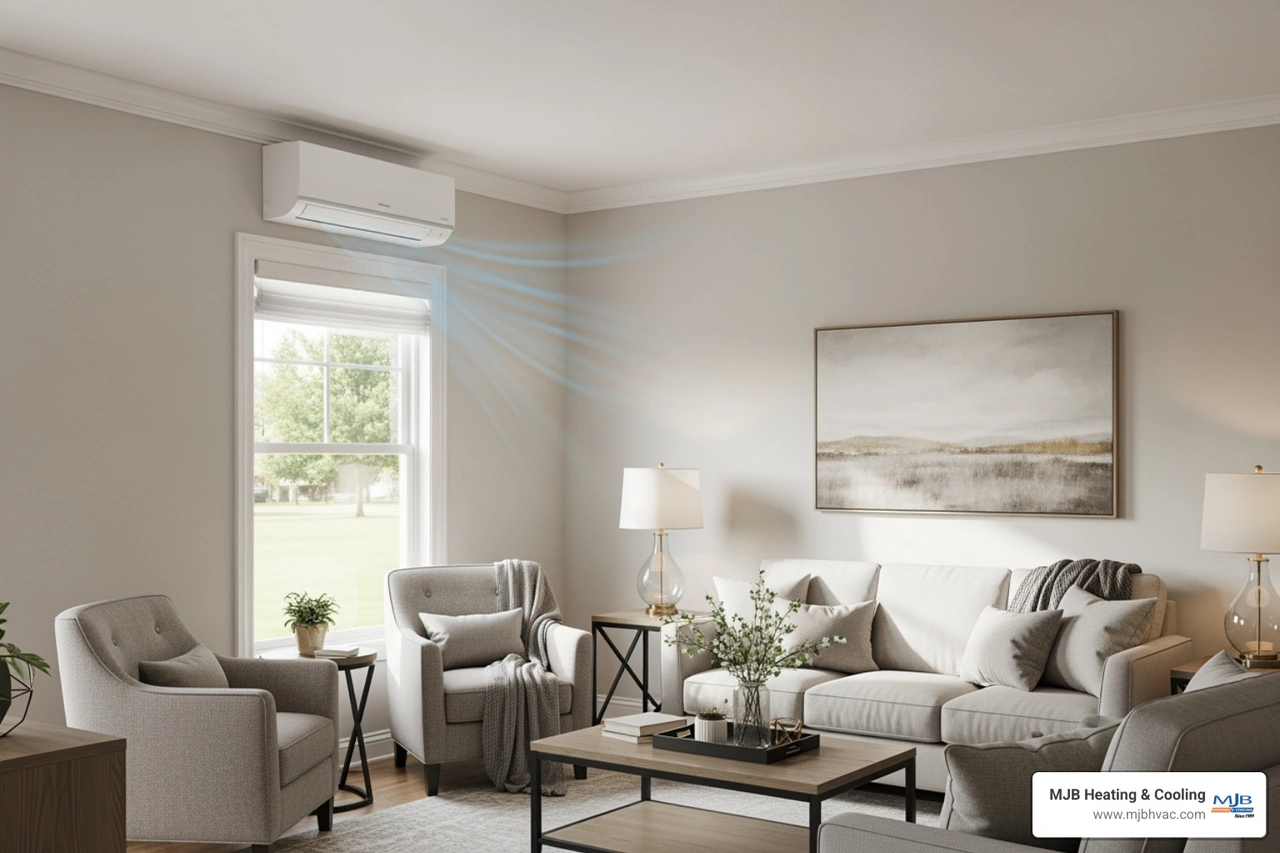

Figuring out how many mini split heads do I need is one of the first — and most important — questions to answer before installing a ductless system in your home. Get it right, and every room stays comfortable year-round without wasting energy. Get it wrong, and you're stuck with stuffy bedrooms, overworked equipment, or a system that short-cycles before it ever does its job.
Here's a quick answer based on home size:
| Home Size | Estimated Heads Needed |
|---|---|
| Up to 600 sq ft | 1 head |
| 600 – 1,200 sq ft | 1 – 2 heads |
| 1,200 – 2,000 sq ft | 2 – 3 heads |
| 2,000 – 3,000 sq ft | 3 – 5 heads |
| 3,000+ sq ft | 5 – 8 heads |
Quick rule of thumb: Plan for one indoor head per enclosed room — any space with a door you keep closed. Open-concept areas like a combined kitchen, dining, and living room can often share a single head.
For most homes in the Wichita metro area — whether you're in a ranch-style home in Derby, a two-story in Andover, or an older house in Newton with no existing ductwork — the answer falls somewhere between 2 and 5 indoor heads connected to a single outdoor unit.
But square footage is only part of the picture. Your home's layout, insulation, ceiling height, sun exposure, and how you actually use each room all play a role in getting the head count right. Central Kansas summers push temperatures well above 100°F, and winters demand reliable heat — which means proper sizing isn't optional. It's the difference between a system that performs and one that struggles.
This guide walks you through everything you need to know to plan the right number of mini split heads for your specific home.
When we talk about mini splits, we often use the word "zone." In the HVAC world, a zone is simply an area where you want independent temperature control. If your teenager wants their room at a crisp 68 degrees while you prefer the living room at 72, those are two separate zones.
Determining how many mini split heads do I need starts with identifying these zones. Unlike traditional central AC that blasts air through a whole house regardless of who is in which room, ductless systems allow us to be surgical. To understand the basics of this technology, it helps to first understand What is a Ductless Mini Split System.
In a standard Central Kansas home, we usually look at the "Door Rule." If a room has a door that stays closed most of the time — like a bedroom, a home office, or a basement guest room — it generally needs its own head. Air is a bit like water; it flows where it can, but it won't push through a closed wooden door.
For a typical three-bedroom ranch in Haysville or Bel Aire, you might look at:
Not necessarily. You don't need a head in every single square inch of the house. We typically advise against putting heads in:
Open-concept living is very popular in newer developments around Maize and Goddard. If your kitchen, dining room, and living room are all one large, unobstructed space, a single, correctly sized indoor head can often handle the whole area. As long as there aren't walls or narrow archways blocking the "throw" of the air, one unit can keep the entire "great room" comfortable.
While counting rooms is a great starting point, we have to look at the science of heat load to be sure. Central Kansas presents unique challenges. We have high humidity in the summer and biting winds in the winter.
BTU stands for British Thermal Unit, and it’s how we measure cooling and heating capacity. A standard rule of thumb is 20 BTUs per square foot.
However, "bigger" isn't always "better." If you put a massive 24,000 BTU head in a tiny 200-square-foot office, it will "short-cycle." This means it turns on, cools the air in two minutes, and shuts off before it has a chance to remove the humidity. You'll end up feeling cold and clammy.
Layout is the "hidden" factor. A 2,000-square-foot home that is wide open might only need three heads. A 2,000-square-foot historic home in Wichita’s Riverside district with lots of small, partitioned rooms might need six.
We also have to consider heat rise. In two-story homes in Andover or Augusta, the upstairs will always be warmer. We often recommend dedicated heads for the upstairs rooms to combat the natural rise of heat, even if the square footage is small.
At MJB Heating & Cooling, we don't just guess. We use what's called a Manual J load calculation. This is a scientific assessment that looks at:
This ensures your head count is based on data, not just a hunch.
Once you know how many heads you need, you have to decide how to power them. This is where we choose between single-zone and multi-zone systems.
| Feature | Single-Zone System | Multi-Zone System |
|---|---|---|
| Outdoor Units | One per indoor head | One for multiple indoor heads |
| Best For | Sunrooms, Garages, Additions | Whole-home cooling/heating |
| Control | One thermostat | Independent thermostats for each room |
| Capacity | Specialized for one space | High capacity (up to 8 zones) |
For more detail on these differences, check out our guide on Single vs Multi-Zone Ductless AC Systems and how they facilitate Temperature Zoning with Ductless AC Systems.
If you've just finished a basement in Derby or added a sunroom to your home in Park City, a single-zone system is perfect. It consists of one outdoor condenser connected to one indoor head. It’s simple, efficient, and doesn't require you to touch your existing HVAC system.
A multi-zone system uses one powerful outdoor condenser to support multiple indoor units (heads). Most residential units support 2 to 5 heads, though high-capacity systems can support up to 8.
One major advantage here is load diversity. Think about it: you probably aren't using your kitchen at full blast at 2:00 AM, and you aren't using your bedroom at 2:00 PM. A multi-zone system can shift its power to where it's needed most, allowing the total BTU capacity of the indoor heads to actually exceed the outdoor unit's capacity by up to 130%.
Yes! In many Central Kansas retrofits, we install one large outdoor unit that services the entire home. This keeps your yard tidy (no "army" of condensers) and allows for centralized maintenance. However, if you have a very large home (over 3,500 sq ft), we might suggest two separate multi-zone systems to ensure the refrigerant lines don't have to travel too far, which can sap efficiency.
If you don't like the look of multiple units hanging on your walls, there is a "hybrid" solution. A slim-ducted mini split (sometimes called a horizontal-ducted unit) is hidden away in an attic, crawlspace, or drop ceiling.
Imagine three small bedrooms located right next to each other in an older home in El Dorado. Instead of putting a wall-mounted head in every room, we can install one slim-ducted unit in the attic and run very short ducts to each bedroom. This gives you the efficiency of a mini split with the "invisible" look of central air.
Deciding where to put these is key, so we recommend looking at the Best Locations for AC Mini Split Installation.
Wall-mounted heads are still the kings of efficiency and individual control. With a slim-ducted unit serving three rooms, those three rooms generally share one thermostat. If you want absolute, room-by-room control, stick with the individual wall-mounted heads.
Whether you go with wall-mounted or slim-ducted, placement is everything. We aim to:
For a deeper dive into these strategies, read about AC Mini Split Placement for Maximum Efficiency.
Every home in the Wichita metro area has its own "personality." Here is how we typically plan for the most common rooms we see in our service area, from Valley Center to Wellington.
In the typical Kansas ranch home, the first floor is the heart of the house. Because of our 100-degree summers, the kitchen is a major heat source. We often recommend:
While DIY calculators are fun, they don't account for the "Kansas factor." Vaulted ceilings, 100-year-old brick walls in Newton, or leaky windows in an older Derby home can all throw off your numbers. A professional assessment ensures you don't buy more equipment than you need — or worse, too little.
We hear these questions often when visiting homeowners in Rose Hill, Mulvane, and beyond.
Typically, a standard 12,000 BTU head covers 400 to 600 square feet. However, in a well-insulated, modern home in Andover, that same head might easily handle 700 square feet. In a drafty historic home, it might struggle with 350.
You can, but there’s a catch. If you have a guest room that stays empty 90% of the time, you can leave the door open and let it "borrow" air from the hallway. Just know that when you have guests and close that door, the room will quickly become uncomfortable. Some homeowners choose to install a multi-zone outdoor unit with an extra port, allowing them to add a head to that guest room later if they decide they need it.
This is the number one mistake we see. Homeowners try to save money by putting one large unit in the hallway. Because the thermostat is on the unit in the hallway, it will turn off as soon as the hallway is cool. Meanwhile, the bedrooms (where the people actually are) remain hot and stuffy. Always put the head in the room where you spend your time.
Determining how many mini split heads do I need isn't just about counting walls; it's about planning for your lifestyle and the unique climate we share here in Central Kansas. Whether you're trying to solve the "hot upstairs" problem in your Andover home or looking for a whole-house solution in Wichita, the right head count is the foundation of your comfort.
At MJB Heating & Cooling, we’ve been helping our neighbors since 1984. We believe in quality workmanship and an honest approach — we won't sell you eight heads if you only need four. We live and work in these communities, and we know exactly what it takes to keep a Kansas home comfortable when the wind starts howling or the sun starts baking.
Ready to find the perfect configuration for your home? We’re here to help.
Contact us today to schedule your professional in-home assessment and stop the thermostat wars for good!
Figuring out how many mini split heads do I need is one of the first — and most important — questions to answer before installing a ductless system in your home. Get it right, and every room stays comfortable year-round without wasting energy. Get it wrong, and you're stuck with stuffy bedrooms, overworked equipment, or a system that short-cycles before it ever does its job.
Here's a quick answer based on home size:
| Home Size | Estimated Heads Needed |
|---|---|
| Up to 600 sq ft | 1 head |
| 600 – 1,200 sq ft | 1 – 2 heads |
| 1,200 – 2,000 sq ft | 2 – 3 heads |
| 2,000 – 3,000 sq ft | 3 – 5 heads |
| 3,000+ sq ft | 5 – 8 heads |
Quick rule of thumb: Plan for one indoor head per enclosed room — any space with a door you keep closed. Open-concept areas like a combined kitchen, dining, and living room can often share a single head.
For most homes in the Wichita metro area — whether you're in a ranch-style home in Derby, a two-story in Andover, or an older house in Newton with no existing ductwork — the answer falls somewhere between 2 and 5 indoor heads connected to a single outdoor unit.
But square footage is only part of the picture. Your home's layout, insulation, ceiling height, sun exposure, and how you actually use each room all play a role in getting the head count right. Central Kansas summers push temperatures well above 100°F, and winters demand reliable heat — which means proper sizing isn't optional. It's the difference between a system that performs and one that struggles.
This guide walks you through everything you need to know to plan the right number of mini split heads for your specific home.
When we talk about mini splits, we often use the word "zone." In the HVAC world, a zone is simply an area where you want independent temperature control. If your teenager wants their room at a crisp 68 degrees while you prefer the living room at 72, those are two separate zones.
Determining how many mini split heads do I need starts with identifying these zones. Unlike traditional central AC that blasts air through a whole house regardless of who is in which room, ductless systems allow us to be surgical. To understand the basics of this technology, it helps to first understand What is a Ductless Mini Split System.
In a standard Central Kansas home, we usually look at the "Door Rule." If a room has a door that stays closed most of the time — like a bedroom, a home office, or a basement guest room — it generally needs its own head. Air is a bit like water; it flows where it can, but it won't push through a closed wooden door.
For a typical three-bedroom ranch in Haysville or Bel Aire, you might look at:
Not necessarily. You don't need a head in every single square inch of the house. We typically advise against putting heads in:
Open-concept living is very popular in newer developments around Maize and Goddard. If your kitchen, dining room, and living room are all one large, unobstructed space, a single, correctly sized indoor head can often handle the whole area. As long as there aren't walls or narrow archways blocking the "throw" of the air, one unit can keep the entire "great room" comfortable.
While counting rooms is a great starting point, we have to look at the science of heat load to be sure. Central Kansas presents unique challenges. We have high humidity in the summer and biting winds in the winter.
BTU stands for British Thermal Unit, and it’s how we measure cooling and heating capacity. A standard rule of thumb is 20 BTUs per square foot.
However, "bigger" isn't always "better." If you put a massive 24,000 BTU head in a tiny 200-square-foot office, it will "short-cycle." This means it turns on, cools the air in two minutes, and shuts off before it has a chance to remove the humidity. You'll end up feeling cold and clammy.
Layout is the "hidden" factor. A 2,000-square-foot home that is wide open might only need three heads. A 2,000-square-foot historic home in Wichita’s Riverside district with lots of small, partitioned rooms might need six.
We also have to consider heat rise. In two-story homes in Andover or Augusta, the upstairs will always be warmer. We often recommend dedicated heads for the upstairs rooms to combat the natural rise of heat, even if the square footage is small.
At MJB Heating & Cooling, we don't just guess. We use what's called a Manual J load calculation. This is a scientific assessment that looks at:
This ensures your head count is based on data, not just a hunch.
Once you know how many heads you need, you have to decide how to power them. This is where we choose between single-zone and multi-zone systems.
| Feature | Single-Zone System | Multi-Zone System |
|---|---|---|
| Outdoor Units | One per indoor head | One for multiple indoor heads |
| Best For | Sunrooms, Garages, Additions | Whole-home cooling/heating |
| Control | One thermostat | Independent thermostats for each room |
| Capacity | Specialized for one space | High capacity (up to 8 zones) |
For more detail on these differences, check out our guide on Single vs Multi-Zone Ductless AC Systems and how they facilitate Temperature Zoning with Ductless AC Systems.
If you've just finished a basement in Derby or added a sunroom to your home in Park City, a single-zone system is perfect. It consists of one outdoor condenser connected to one indoor head. It’s simple, efficient, and doesn't require you to touch your existing HVAC system.
A multi-zone system uses one powerful outdoor condenser to support multiple indoor units (heads). Most residential units support 2 to 5 heads, though high-capacity systems can support up to 8.
One major advantage here is load diversity. Think about it: you probably aren't using your kitchen at full blast at 2:00 AM, and you aren't using your bedroom at 2:00 PM. A multi-zone system can shift its power to where it's needed most, allowing the total BTU capacity of the indoor heads to actually exceed the outdoor unit's capacity by up to 130%.
Yes! In many Central Kansas retrofits, we install one large outdoor unit that services the entire home. This keeps your yard tidy (no "army" of condensers) and allows for centralized maintenance. However, if you have a very large home (over 3,500 sq ft), we might suggest two separate multi-zone systems to ensure the refrigerant lines don't have to travel too far, which can sap efficiency.
If you don't like the look of multiple units hanging on your walls, there is a "hybrid" solution. A slim-ducted mini split (sometimes called a horizontal-ducted unit) is hidden away in an attic, crawlspace, or drop ceiling.
Imagine three small bedrooms located right next to each other in an older home in El Dorado. Instead of putting a wall-mounted head in every room, we can install one slim-ducted unit in the attic and run very short ducts to each bedroom. This gives you the efficiency of a mini split with the "invisible" look of central air.
Deciding where to put these is key, so we recommend looking at the Best Locations for AC Mini Split Installation.
Wall-mounted heads are still the kings of efficiency and individual control. With a slim-ducted unit serving three rooms, those three rooms generally share one thermostat. If you want absolute, room-by-room control, stick with the individual wall-mounted heads.
Whether you go with wall-mounted or slim-ducted, placement is everything. We aim to:
For a deeper dive into these strategies, read about AC Mini Split Placement for Maximum Efficiency.
Every home in the Wichita metro area has its own "personality." Here is how we typically plan for the most common rooms we see in our service area, from Valley Center to Wellington.
In the typical Kansas ranch home, the first floor is the heart of the house. Because of our 100-degree summers, the kitchen is a major heat source. We often recommend:
While DIY calculators are fun, they don't account for the "Kansas factor." Vaulted ceilings, 100-year-old brick walls in Newton, or leaky windows in an older Derby home can all throw off your numbers. A professional assessment ensures you don't buy more equipment than you need — or worse, too little.
We hear these questions often when visiting homeowners in Rose Hill, Mulvane, and beyond.
Typically, a standard 12,000 BTU head covers 400 to 600 square feet. However, in a well-insulated, modern home in Andover, that same head might easily handle 700 square feet. In a drafty historic home, it might struggle with 350.
You can, but there’s a catch. If you have a guest room that stays empty 90% of the time, you can leave the door open and let it "borrow" air from the hallway. Just know that when you have guests and close that door, the room will quickly become uncomfortable. Some homeowners choose to install a multi-zone outdoor unit with an extra port, allowing them to add a head to that guest room later if they decide they need it.
This is the number one mistake we see. Homeowners try to save money by putting one large unit in the hallway. Because the thermostat is on the unit in the hallway, it will turn off as soon as the hallway is cool. Meanwhile, the bedrooms (where the people actually are) remain hot and stuffy. Always put the head in the room where you spend your time.
Determining how many mini split heads do I need isn't just about counting walls; it's about planning for your lifestyle and the unique climate we share here in Central Kansas. Whether you're trying to solve the "hot upstairs" problem in your Andover home or looking for a whole-house solution in Wichita, the right head count is the foundation of your comfort.
At MJB Heating & Cooling, we’ve been helping our neighbors since 1984. We believe in quality workmanship and an honest approach — we won't sell you eight heads if you only need four. We live and work in these communities, and we know exactly what it takes to keep a Kansas home comfortable when the wind starts howling or the sun starts baking.
Ready to find the perfect configuration for your home? We’re here to help.
Contact us today to schedule your professional in-home assessment and stop the thermostat wars for good!


Our A/C stopped working on a Sunday and due to health issues, we needed to find a service company available on a Sunday. I called MJB and left a message on their emergency voice mail. Within 10 minutes Tom Buck called me to hear my description of the symptoms. He was just finishing an appointment in Wichita and would be on his way to my home on the south end of Derby. He arrived within 30 minutes! From start to finish he was the perfect example of what you could ever hope for in an HVAC tech and a human being. His evaluation of our system inside and out was as thorough as I could ever imagine and once he was done with the repair, our system is running as well or better than ever. Well worth the price for the evaluation, parts, and labor. Thank you again Tom for an awesome experience.
Our AC went out during the hottest days of the year, and they were out next day! We have been jerked around by a shoddy home warranty for years. We finally had a chance to pick our own repair people, and MJB came highly recommended. I can see why! I was impressed with the honesty and speed at which they fixed our AC unit!
Our commercial building had a lightening/electrical strike and damaged our 20 ton AC unit. No one could find us a new unit before the end of September. Imagining going all of August and September with no AC in Kansas and working inside near 100 degree temps is less than thrilling. Dale and the team at MJB called around and saved the day. They had us a new unit 5 weeks earlier than other could promise and I now have happy employees. The unit is amazingly quiet, super cold and so much more energy efficient. Thank you for being our super hero!
Came out and installed my new furnace. Was very polite and affordable. They are very acknowledgeable and I highly recommend!
Thank you very much. We had our 1st warm night in 3weeks. MJB took the time and effort to find the real problem. And the employees were kind and thoughtful and explained things very well. I cannot thank you and all of MJB. Will recommend you highly. Thanks again Marjorie Herman Oxford Kansas
We had a new system installed and I was so impressed with how quick they were in come out and install it, in the middle of a hot summer day. They were so friendly & very professional. I had a small problem with a weird sound and they came over immediately and fixed it. Love them!