.avif)





Blogs
Stay updated with our latest blog posts.
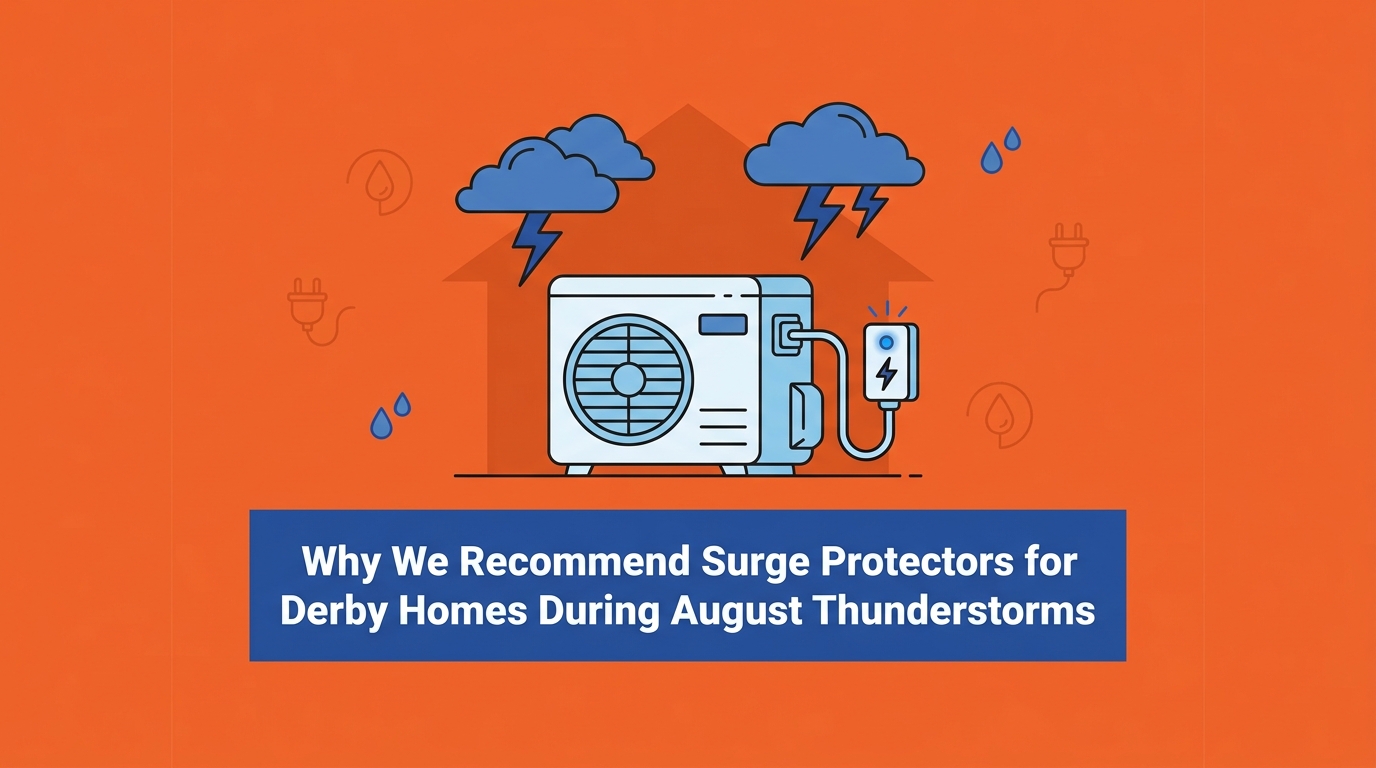

August in Kansas brings a familiar shift: extreme heat peaks just as the afternoon skies darken, which is exactly why we recommend surge protectors for Derby homes during August thunderstorms. Late-summer weather patterns in our region are notorious for severe electrical storms that roll in right after days of triple-digit temperatures. While you might be focused on the heavy rain or high winds, there is an invisible threat traveling through your home's wiring, aiming straight for your most expensive appliance: your air conditioning system.
Before the next storm rolls in, securing professional HVAC services and setting up a preventative maintenance plan can be the difference between a minor power flicker and a major system failure.
During these intense late-summer storms, the local electrical grid experiences immense strain. High demand from thousands of air conditioners running at full capacity, combined with sudden lightning strikes and grid toggling, creates massive instability in the power supply. Homeowners often overlook this invisible danger because the lights might just blink for a second. However, that brief interruption sends a chaotic wave of electricity through your home's circuits.
Modern air conditioners are highly sensitive to these electrical anomalies. Unlike the rugged, simple machines of the past, today's high-efficiency systems act more like large computers. They are packed with delicate microprocessors that manage everything from your fan speed to your compressor cycles. Making proactive surge protection a critical consideration before the storm season peaks is the best way to safeguard these vital electronics. By understanding the unique risks of our regional climate, you can take the necessary steps to protect your comfort and your wallet.
As local Derby HVAC technicians who actively replace fried control boards after these specific storms, we see the aftermath of electrical damage firsthand. Our "boots on the ground" perspective reveals a clear trend: modern HVAC systems with sensitive electronic control boards are failing at higher rates after minor storms than older units ever did. The reason comes down to how air conditioning technology has evolved to meet modern energy efficiency standards.
Older mechanical air conditioners were built with heavy-duty contactors, thick wiring, and basic relays. They could often absorb minor power bumps, voltage drops, and surges without suffering catastrophic failure. If a surge hit, it might trip a breaker or blow a standard fuse, but the core components usually survived.
Today's high-efficiency systems are completely different. To achieve the precise temperature control and low energy consumption we all want, these systems rely on complex electronic control boards. These printed circuit boards contain microscopic pathways and delicate microprocessors. While this technology makes your home incredibly comfortable, it also makes the system extremely fragile when exposed to raw, unregulated electrical spikes.
According to the National Electrical Manufacturers Association (NEMA), modern HVAC electronic components are sensitive to voltage spikes as small as 20% above normal. Standard residential voltage in the United States is 120/240 volts. A 20% spike means that a sudden jump to just 144 or 288 volts can overwhelm the microscopic circuits inside your AC unit.
The silent killer: Damage from these power fluctuations is not always immediate. Even minor, repeated power flickers during a localized storm cause cumulative damage. Each small surge degrades the microscopic pathways on the control board over time. Eventually, the weakened board simply burns out—often on a completely sunny, hot day weeks after the storm actually passed.
• Older Mechanical AC — Primary Components: Heavy relays, mechanical contactors, thick wires — Surge Tolerance: High (Can absorb minor fluctuations) — Typical Failure Mode: Tripped breakers, blown fuses, slow mechanical wear
• Modern High-Efficiency AC — Primary Components: Printed circuit boards, microprocessors, sensors — Surge Tolerance: Very Low (Fails at 20% above normal voltage) — Typical Failure Mode: Fried control boards, corrupted software, immediate shutdown
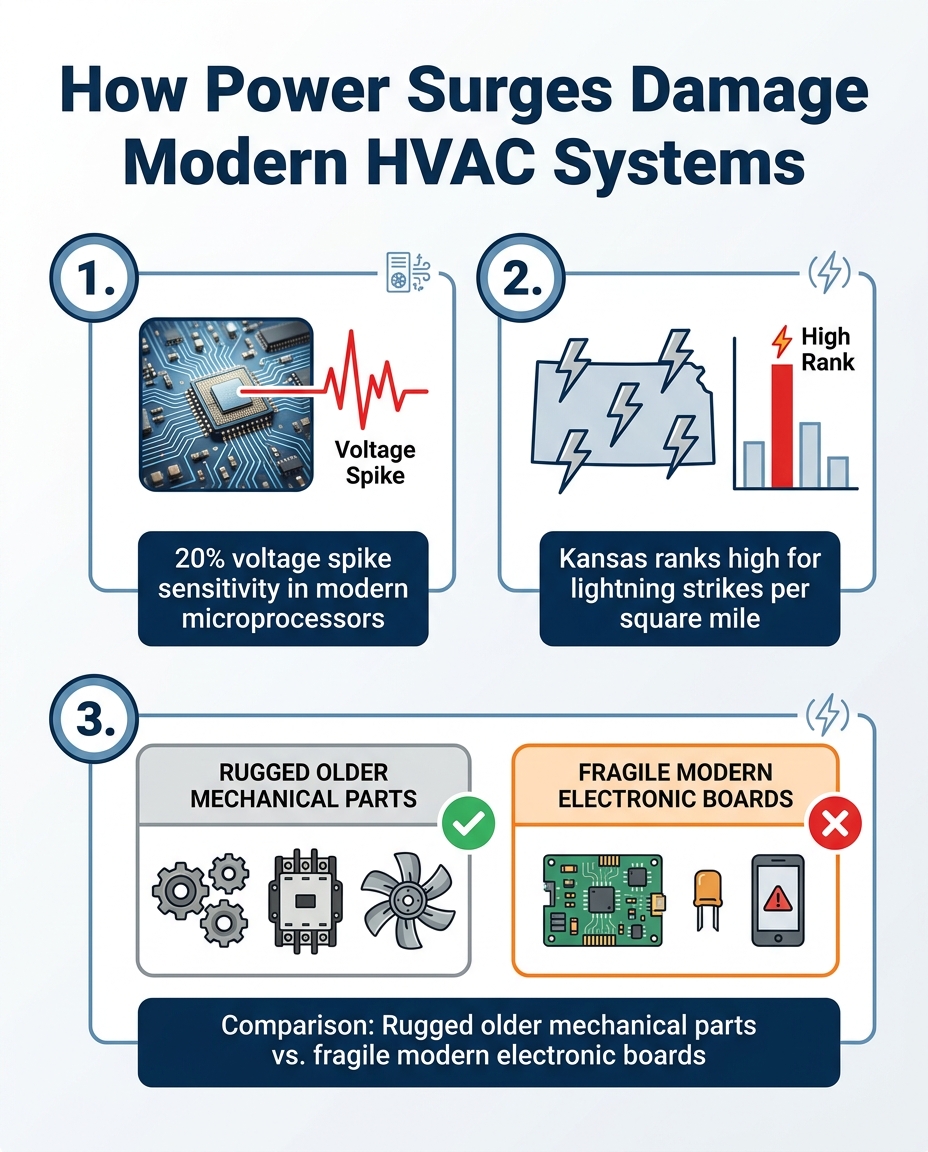
When you hear thunder rattling your windows in Derby KS, it is natural to worry about a direct lightning strike hitting your roof. Kansas consistently ranks high nationally for lightning strikes per square mile, elevating the risk for local properties. However, while direct lightning strikes are devastating and make the evening news, they are relatively rare. The vast majority of power surge damage to HVAC systems actually comes from smaller, far more common grid fluctuations.
During a severe August thunderstorm, tree branches fall on power lines, transformers blow, and lightning strikes utility poles miles away from your house. When neighborhood power is lost and suddenly restored, the massive influx of electricity creates a damaging "micro-surge." This happens because the utility company's grid is trying to instantly push power back into thousands of homes at once. The electricity rushing back into your electrical panel often overshoots the standard 240 volts, sending a dangerous spike directly into your air conditioner's circuitry.
Furthermore, your own home generates internal surges during a storm. When the power drops out and kicks back on, heavy appliances like refrigerators and dryers draw massive amounts of starting current, causing voltage imbalances across your breaker panel. Understanding how Kansas severe weather affects your HVAC system is the first step in preventing catastrophic electrical failure. You cannot control the weather or the utility grid, but you can control what happens when that unpredictable power reaches your equipment.
• Direct Lightning Strikes: Rare, but deliver millions of volts. Typically causes catastrophic damage to the entire home's electrical system.
• Utility Grid Toggling: Very common. Occurs when power goes out and rushes back in, creating a severe overvoltage spike that fries sensitive electronics.
• Internal Power Shifts: Common during brownouts. As voltage drops, motors draw more amperage to keep running, which overheats and damages internal HVAC wiring.
Losing an air conditioner during a sweltering August week creates an immediate comfort and safety crisis for a family. When the extreme heat of late summer combines with high humidity, indoor temperatures can climb to dangerous levels within just a few hours. We see the devastating results of these electrical events every year when the storms roll through.
For example, during a brutal heat wave recently, one local homeowner was left sweltering for almost a week after a severe storm knocked out their air conditioning. Our technicians arrived to diagnose the sudden failure and found the internal components completely fried by a power surge. Because the damage was so extensive and the unit was older, we ultimately had to install an entirely new system to get their home safely cooling again. This is a scenario we work hard to help our neighbors avoid.
Diagnosing and replacing a fried proprietary control board is a complex, time-consuming process. These are not universal parts you can pick up at a local hardware store. Each high-efficiency AC unit requires a specific, manufacturer-coded circuit board. If a widespread storm knocks out dozens of units in the area, local supply houses quickly run out of stock, leaving homes without cooling while parts are sourced and shipped.
In severe cases of electrical damage, the entire system may be compromised, requiring a full replacement. When a surge is powerful enough to arc across the control board, it often damages the compressor motor windings as well. When storm damage destroys an aging unit unexpectedly, we often guide homeowners through financing options for unexpected replacements to help ease the immediate burden. However, preventing the damage in the first place is always the preferable route.
Surge protectors act as a dedicated defense mechanism, intercepting excess voltage before it ever reaches the AC unit. Think of a surge protector as a highly sensitive bouncer standing guard at the electrical entrance to your modern HVAC systems with sensitive electronic control boards. Its only job is to monitor the flow of electricity and stop anything that exceeds the safe limit.
They monitor the electrical current continuously. When a sudden spike travels down the line from the utility grid, the surge protector detects the overvoltage in a fraction of a millisecond. It instantly redirects the harmful, excess electrical energy safely into the ground wire, allowing only the normal, safe amount of voltage to continue on to the air conditioner.
Homeowners must choose between whole-home protection at the breaker panel and point-of-use protection at the HVAC disconnect.
1. Whole-Home Protectors: Installed directly at your main electrical panel. They intercept massive surges coming from the outside utility lines before they enter your home's internal wiring.
2. Point-of-Use Protectors: Installed specifically at the outdoor AC condenser or indoor air handler. They catch smaller, internal surges and any residual voltage that makes it past the main panel.
The best defense: We strongly recommend layered protection. Using both a whole-home device and a dedicated HVAC point-of-use device offers the highest level of security against severe weather, ensuring that if a massive spike overwhelms the first line of defense, the second one catches the rest.
By taking the hit, the surge protector acts as a sacrificial barrier, preserving the expensive microprocessors inside the HVAC cabinet. Surge protectors use components called Metal Oxide Varistors (MOVs). These components are designed to degrade over time as they absorb electrical hits.
Surge protectors are literally designed to fail during a massive surge to save your equipment. It is vastly better to replace a small, inexpensive surge protection device than to replace a fried proprietary control board or an entire compressor. Because they are sacrificial, it is crucial to check the LED indicator lights on the protector after every major storm. If the light is out, the device has done its job, sacrificed itself, and needs to be replaced.
Working with high-voltage HVAC circuitry is inherently dangerous and requires specialized, professional training. Installing a surge protector is absolutely not a weekend DIY project. The electrical panel and the HVAC disconnect box carry enough live current to cause severe injury or worse. Opening these panels exposes you to raw, unregulated utility power.
Furthermore, a surge protector is entirely useless if the home's grounding system is inadequate or improperly wired. The device relies entirely on a clear, low-resistance path to the earth to dump the excess voltage. If your home's ground wire is loose, corroded, or undersized, the surge protector cannot do its job, and the voltage spike will bounce right back into your air conditioner's control board.
Licensed professionals ensure the installation meets all local municipal codes and manufacturer warranty requirements. Many modern HVAC manufacturers require proof of professional installation for both the equipment and any attached protective devices; amateur wiring can instantly void your system's warranty. Our technicians proudly serve Derby and surrounding service areas, ensuring local homes are properly fortified against the weather with safe, code-compliant electrical work.
Don't wait until a sudden power flicker leaves your home without air conditioning in the middle of a late-summer heat wave. The extreme weather in Derby KS is unpredictable, but the way your home's electrical system responds to it doesn't have to be.
Proactive installation of a surge protector offers total peace of mind during unpredictable late-summer weather. You can sleep soundly through the thunder knowing your sensitive electronic control boards are shielded from harm. Reach out to our local team today to evaluate your system's vulnerability and discuss your protection options. We are here to provide clear, professional recommendations so you can protect your investment without the stress of navigating complicated electrical work yourself.
Does my modern AC unit really need a surge protector?
Yes, modern air conditioners absolutely need surge protection. Unlike older mechanical units, today's high-efficiency systems rely on delicate microprocessors and printed circuit boards to operate. These tiny electronic components are highly sensitive and can be easily destroyed by very small voltage spikes that older systems would have ignored.
Can a power surge from an August storm ruin my air conditioner?
A power surge can instantly ruin the electrical components of your air conditioner. When the power grid fluctuates during a severe storm, the sudden rush of returning electricity can fry the system's control board, damage the thermostat wiring, or even melt the windings inside the compressor motor. This often leads to a complete system breakdown right when you need cooling the most.
Will an HVAC surge protector stop a direct lightning strike?
No surge protector can completely stop a direct, localized lightning strike. A direct hit carries millions of volts and will bypass almost any residential defense system. However, the vast majority of storm damage comes from smaller grid fluctuations and indirect strikes miles away, which a high-quality surge protector is perfectly designed to intercept and neutralize.
How do I know if a power surge damaged my HVAC control board?
The most common sign of a fried control board is a completely unresponsive system. You might notice that your thermostat is blank, the outdoor unit won't turn on, or the system repeatedly trips the circuit breaker when it tries to start. You may also smell a faint, acrid odor of burnt plastic near the indoor air handler or outdoor condenser.
What is the difference between a whole-home and point-of-use surge protector?
A whole-home surge protector is installed at your main electrical panel to block large surges coming in from the outside utility lines. A point-of-use surge protector is installed directly at the HVAC unit to catch smaller internal surges and any residual voltage that slips past the main panel. Using both provides a layered defense that offers the best protection for your equipment.


Our A/C stopped working on a Sunday and due to health issues, we needed to find a service company available on a Sunday. I called MJB and left a message on their emergency voice mail. Within 10 minutes Tom Buck called me to hear my description of the symptoms. He was just finishing an appointment in Wichita and would be on his way to my home on the south end of Derby. He arrived within 30 minutes! From start to finish he was the perfect example of what you could ever hope for in an HVAC tech and a human being. His evaluation of our system inside and out was as thorough as I could ever imagine and once he was done with the repair, our system is running as well or better than ever. Well worth the price for the evaluation, parts, and labor. Thank you again Tom for an awesome experience.
Our AC went out during the hottest days of the year, and they were out next day! We have been jerked around by a shoddy home warranty for years. We finally had a chance to pick our own repair people, and MJB came highly recommended. I can see why! I was impressed with the honesty and speed at which they fixed our AC unit!
Our commercial building had a lightening/electrical strike and damaged our 20 ton AC unit. No one could find us a new unit before the end of September. Imagining going all of August and September with no AC in Kansas and working inside near 100 degree temps is less than thrilling. Dale and the team at MJB called around and saved the day. They had us a new unit 5 weeks earlier than other could promise and I now have happy employees. The unit is amazingly quiet, super cold and so much more energy efficient. Thank you for being our super hero!
Came out and installed my new furnace. Was very polite and affordable. They are very acknowledgeable and I highly recommend!
Thank you very much. We had our 1st warm night in 3weeks. MJB took the time and effort to find the real problem. And the employees were kind and thoughtful and explained things very well. I cannot thank you and all of MJB. Will recommend you highly. Thanks again Marjorie Herman Oxford Kansas
We had a new system installed and I was so impressed with how quick they were in come out and install it, in the middle of a hot summer day. They were so friendly & very professional. I had a small problem with a weird sound and they came over immediately and fixed it. Love them!