.avif)





Blogs
Stay updated with our latest blog posts.
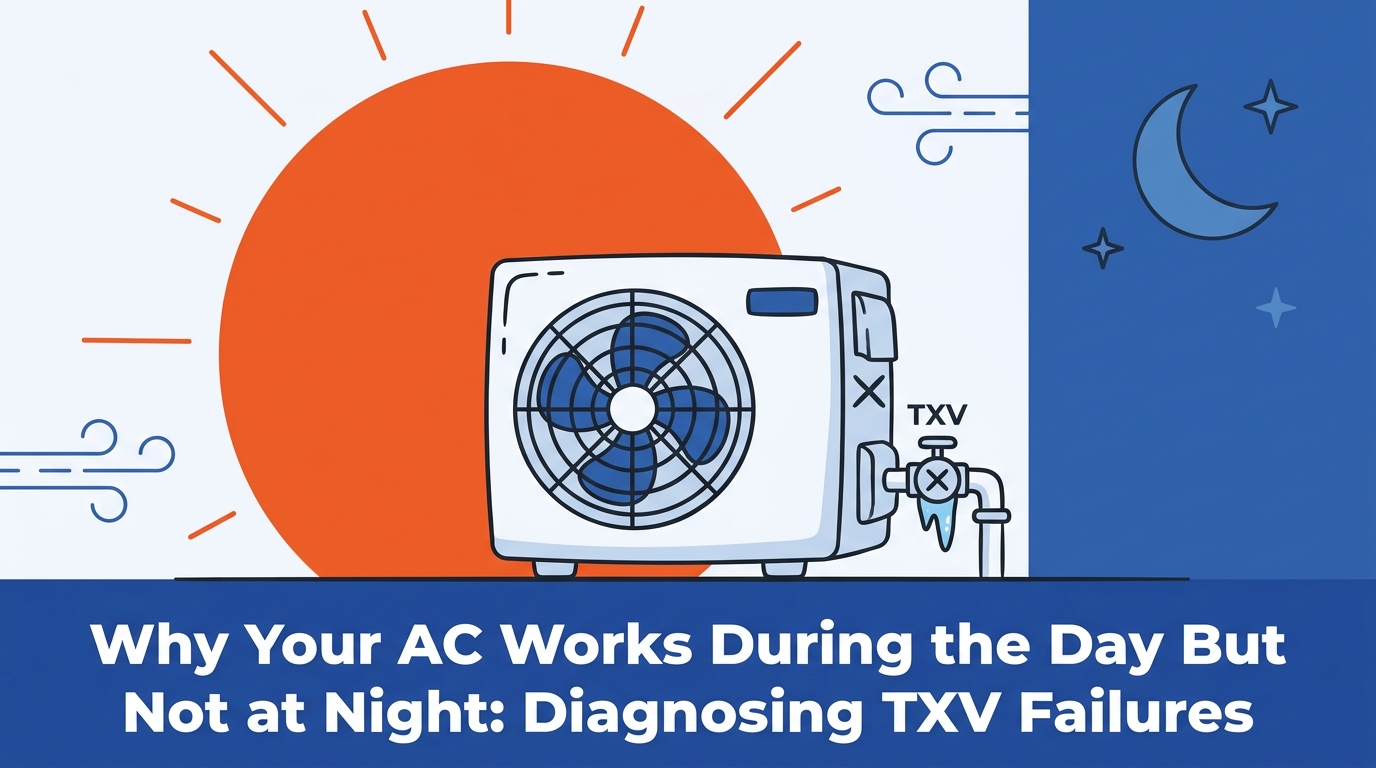

Is your air conditioner actually broken—or just struggling to keep up when the sun goes down? At MJB Heating & Cooling, we know that if you are searching for answers regarding Thermal Expansion Valves: Diagnosing Nighttime Refrigerant Flow Issues, you are likely dealing with one of the most frustrating HVAC puzzles our team sees homeowners face. You might find yourself in a situation where your house stays perfectly cool during the hottest afternoon hours, but suddenly loses its cooling capacity after the sun sets. You adjust the thermostat, check the vents, and wait for cold air, but the house simply will not cool down.
This counter-intuitive behavior is rarely a simple dirty air filter or a tripped breaker. Instead, it points to a mechanical inability within your cooling system to adapt to changing environmental conditions. Your air conditioner is not a static machine; it must constantly adjust to the environment inside and outside your home. When it loses the ability to modulate its cooling effort, you experience comfort issues. Catching this specific anomaly during late August end-of-season cooling is crucial, as ignoring it during the back-to-school transition can lead to severe compressor damage before the season is over.
When your system fails to adapt to temperature shifts, relying on professional HVAC services and a solid preventative HVAC maintenance plan is the best way to restore reliable comfort.
To understand why your air conditioner fails specifically in the dark, you first need to understand the concept of "heat load." In accessible terms, the heat load is the total amount of heat energy your air conditioner must remove from your home to maintain your desired indoor temperature. This load is not constant; it fluctuates wildly throughout a 24-hour cycle.
During the peak of the afternoon, your home absorbs heat from multiple sources. The sun beats down on your roof, solar radiation streams through your windows, and the ambient outdoor air temperature surrounds your exterior walls. Your air conditioner has to work at maximum capacity to absorb this massive influx of heat and pump it outside.
However, the environment changes drastically as the day progresses. In our experience serving this area, when dealing with Derby KS evening temperature drops, the shift is sudden and significant. In the Kansas late-summer climate, our technicians often find that intense daytime heat masks underlying mechanical issues. When the evening hits, rapid ambient temperature drops from the 90s down into the 60s or 70s completely alter the equation. The sun is gone, the outdoor air is cooler, and the total heat load on your home plummets.
As the outdoor temperature and indoor heat load drop, your AC system must throttle down its cooling effort to maintain balance. It needs to absorb less heat because there is less heat available to absorb. If the system cannot throttle down, it will overcool the evaporator coils inside your ductwork. Air conditioning relies on a delicate balance of heat exchange; if there is too much refrigerant flowing and not enough heat to absorb it, the system will rapidly freeze up.
• Solar Radiation — Afternoon (Peak Load): High (Direct sunlight heating the home) — Evening (Low Load): Zero (Sun has set)
• Ambient Temperature — Afternoon (Peak Load): 90°F+ (High heat transfer into the home) — Evening (Low Load): 60°F - 70°F (Minimal heat transfer)
• Required Cooling Capacity — Afternoon (Peak Load): Maximum (100% effort required) — Evening (Low Load): Reduced (System must throttle down)
• Refrigerant Flow Needed — Afternoon (Peak Load): High volume to absorb massive heat — Evening (Low Load): Low volume to prevent coil freezing
The component responsible for managing this delicate balance of refrigerant flow based on the changing heat load is called the Thermal Expansion Valve, or TXV. We often explain the TXV to our customers as the central metering device of your air conditioning system. It acts very much like the throttle pedal in your car, carefully regulating the exact amount of liquid refrigerant that is allowed to enter the indoor evaporator coil.
The TXV operates using a sensing bulb that is strapped to the suction line leaving the indoor coil. This bulb reads the temperature of the refrigerant gas heading back to the compressor. If the gas is warm, the valve knows there is a lot of heat in the house. If the gas is cold, the valve knows the heat load has dropped. Based on these temperature readings, the valve mechanically opens or closes a tiny internal pin to increase or decrease the flow of liquid refrigerant.
During normal operation at a 2 PM peak heat load, the TXV opens wide to allow maximum refrigerant flow. The system needs all the cooling power it can get to combat the intense afternoon sun. But the critical shift happens at night. As the evening cools and you transition to a 10 PM lower heat load, the valve must physically restrict—or close down—the flow of refrigerant. This continuous modulation is what keeps the system running efficiently across drastically different temperatures without freezing the indoor coil into a block of solid ice.
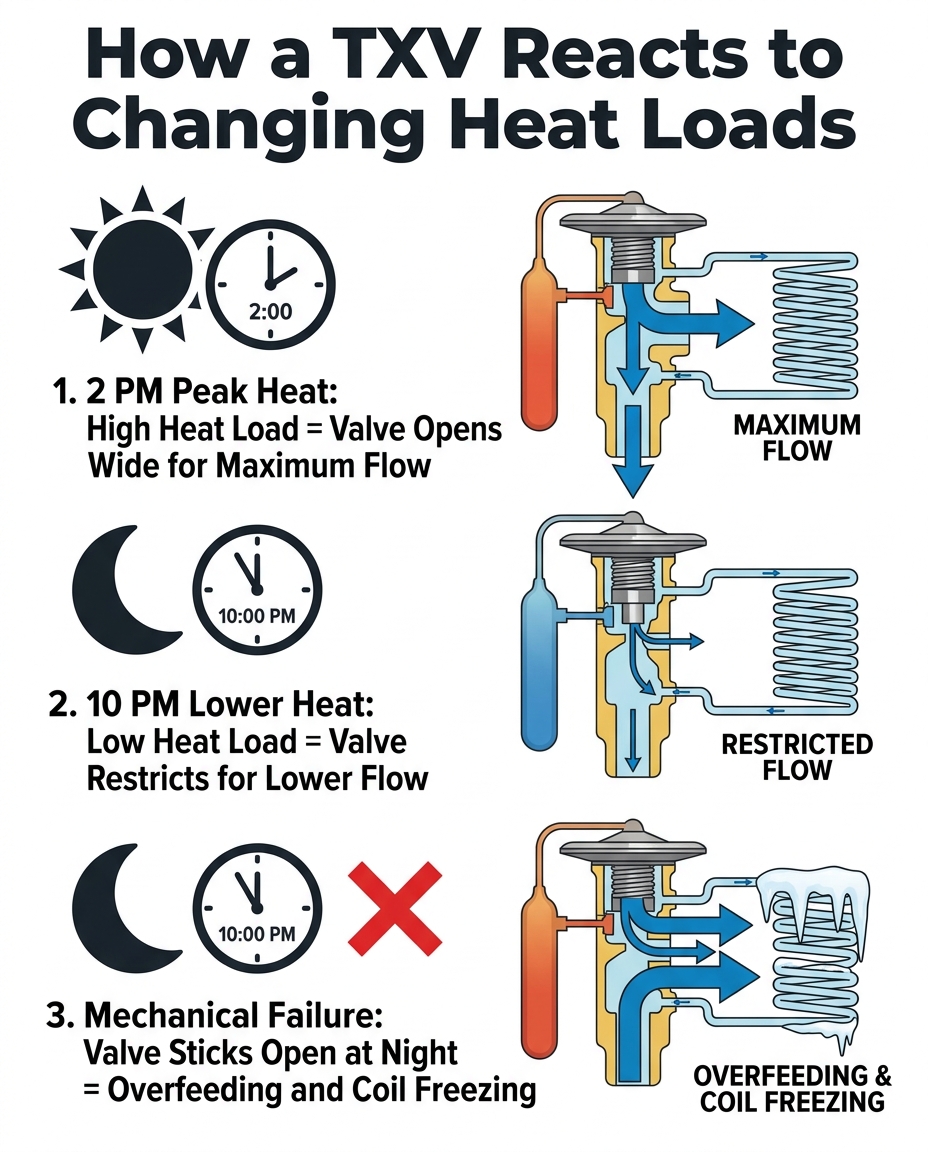

Over our years of diagnosing AC issues, we've found that when a Thermal Expansion Valve fails, it rarely fails in a completely closed position. More often, the internal mechanisms degrade, or microscopic debris in the refrigerant lines causes the valve to mechanically stick in the "wide open" position. This specific failure mode perfectly explains why your system might run flawlessly while the sun is up, only to fail completely in the dark.
During a 2 PM peak heat load, a stuck-open valve is practically unnoticeable. Your home is absorbing so much heat from the afternoon sun that the system actually needs maximum refrigerant flow anyway. The stuck valve is providing exactly what the system requires at that specific moment, creating the illusion that your air conditioner is functioning perfectly.
The real problem begins when the sun goes down. At a 10 PM lower heat load, the stuck valve continues to flood the evaporator coil with a massive volume of liquid refrigerant. Because there is no longer enough heat in the house to boil off all that liquid, the temperature of the evaporator coil drops rapidly below 32°F. The moisture in your indoor air begins to freeze directly onto the cold metal fins.
The cascading failure: Once a thin layer of ice forms, it acts as an insulator, preventing the coil from absorbing any more heat. This causes the coil to get even colder, building thicker layers of ice until the entire unit is encased in a solid block. This restricted airflow results in a complete loss of cooling capacity precisely when you expect the system to easily keep up with the milder nighttime weather. If you find your AC not cooling properly in extreme heat or during sudden temperature drops, a metering device failure is a prime suspect.
• Ice formation: Visible frost or solid ice building up on the copper refrigerant lines outside or on the indoor coil itself.
• Warm air from vents: The system runs continuously, but the air blowing from your registers feels lukewarm or unconditioned at night.
• Water leaks: As the massive block of ice eventually melts during the day, it can overflow the condensate drain pan and leak water into your home.
• Hissing sounds: Unusual hissing or bubbling noises coming from the indoor unit, indicating improper refrigerant expansion.
One of the biggest risks homeowners face with a sticking TXV is improper diagnosis. There is a common, enduring misconception that an air conditioner freezing up or blowing warm air always means the system is low on refrigerant. While a refrigerant leak can certainly cause freezing, our team knows that a metering device failure requires an entirely different approach.
A refrigerant leak means the total volume of chemical cooling agent in your system has dropped below the required threshold. A TXV failure means the system has the correct amount of refrigerant, but the valve is distributing it incorrectly. Treating a metering failure like a leak is a recipe for disaster.
If a technician arrives, sees a frozen coil, assumes a leak, and simply "tops off" the system with more refrigerant without testing the TXV, the results can be catastrophic. Adding more refrigerant to a system with a valve stuck in the wide-open position will severely overcharge the unit. This allows raw, unevaporated liquid refrigerant to flood backward through the suction line directly into the compressor—a phenomenon known as "slugging." Compressors are designed to pump gas, not liquid. Slugging will quickly destroy the internal valves of the compressor, turning a solvable repair into a complete system replacement.
Complex flow issues require methodical testing, not guesswork. Our team recently helped a local homeowner who experienced this firsthand during a late-summer heatwave when their AC was misdiagnosed by another contractor and left them without cooling for almost a week. Once our technicians properly identified and resolved the underlying mechanical issue, the system was back up and running—eventually leading them to trust MJB Heating & Cooling to upgrade them to an entirely new system. Getting the diagnosis right during late August end-of-season cooling is essential to protect the longevity of your equipment.
Because the symptoms of a failed TXV mimic so many other HVAC issues, establishing the exact cause requires certified professional expertise. Diagnosing a TXV is not a matter of simply looking at a gauge; it requires measuring superheat and subcooling simultaneously.
Superheat measures how much the refrigerant gas warms up after it boils in the indoor coil, while subcooling measures how much the liquid refrigerant cools down in the outdoor condenser. Calculating these metrics requires specialized digital manifolds, precise temperature clamps, and advanced training. An expert technician will evaluate these readings to determine exactly how the valve is behaving under different heat loads.
If the valve is confirmed to be faulty, replacing a TXV is strictly licensed professional work. It involves safely recovering the existing refrigerant to comply with EPA regulations, unbrazing the old valve with an oxy-acetylene torch, brazing in a new valve while protecting it from heat damage, installing a new liquid line filter drier to capture any contaminants, and pulling a deep vacuum on the entire system to remove non-condensables and moisture before recharging.
A thorough diagnostic approach takes time. In one recent case involving a complex cooling problem, our own technician Dale took the extra time required to meticulously trace the problem to its source, ensuring it was fixed right the first time rather than just applying a quick patch. At MJB Heating & Cooling, our Daikin Comfort Pro certification serves as proof of the advanced diagnostic capabilities required to accurately identify metering device failures without resorting to guesswork.
A properly diagnosed and replaced TXV restores your system's ability to adapt seamlessly to all temperatures, from the blazing afternoon sun to the cool midnight air. Our professional teams are equipped to handle these complex diagnostics across service areas across the region, ensuring your home remains comfortable regardless of the Derby KS evening temperature drops outside.
Your AC likely has a mechanical issue adapting to changing heat loads. During the day, the intense heat requires maximum refrigerant flow, which masks the problem. At night, when temperatures drop, a faulty component like a stuck Thermal Expansion Valve cannot reduce the flow, causing the system to overcool and freeze up.
If your AC stops cooling specifically at night, it is often due to a frozen indoor evaporator coil. The lack of ambient heat in the evening means your system needs to throttle down its cooling power. If it fails to do so, ice forms on the coils, blocking airflow and preventing cold air from reaching your vents.
When a TXV goes bad, it usually sticks either too far open or too far closed. If it sticks open, it floods the indoor coil with too much refrigerant, leading to freezing and potential compressor damage. If it sticks closed, it starves the coil of refrigerant, resulting in poor cooling performance and an overheated compressor.
Yes, a bad TXV is a leading cause of frozen AC coils. If the valve sticks in the open position, it allows a massive volume of liquid refrigerant into the coil regardless of the actual heat load in the home. This excess liquid drops the coil temperature below freezing, turning airborne moisture into solid ice.
A professional technician differentiates these issues by measuring superheat and subcooling simultaneously. Low refrigerant typically presents with high superheat and low subcooling. A stuck-open TXV, on the other hand, will show very low superheat (indicating liquid flooding the coil) combined with normal or slightly low subcooling, requiring specialized gauges to accurately diagnose.
Understanding Thermal Expansion Valves: Diagnosing Nighttime Refrigerant Flow Issues helps clarify why your cooling system struggles when the sun goes down. A system that cools perfectly at 2 PM but fails at 10 PM requires more than a simple filter change. Resolving this mechanical flow issue demands a professional diagnostic from our experienced crew at MJB Heating & Cooling to ensure your AC can adapt to every temperature shift, giving you the reliable, uninterrupted comfort you deserve.


Our A/C stopped working on a Sunday and due to health issues, we needed to find a service company available on a Sunday. I called MJB and left a message on their emergency voice mail. Within 10 minutes Tom Buck called me to hear my description of the symptoms. He was just finishing an appointment in Wichita and would be on his way to my home on the south end of Derby. He arrived within 30 minutes! From start to finish he was the perfect example of what you could ever hope for in an HVAC tech and a human being. His evaluation of our system inside and out was as thorough as I could ever imagine and once he was done with the repair, our system is running as well or better than ever. Well worth the price for the evaluation, parts, and labor. Thank you again Tom for an awesome experience.
Our AC went out during the hottest days of the year, and they were out next day! We have been jerked around by a shoddy home warranty for years. We finally had a chance to pick our own repair people, and MJB came highly recommended. I can see why! I was impressed with the honesty and speed at which they fixed our AC unit!
Our commercial building had a lightening/electrical strike and damaged our 20 ton AC unit. No one could find us a new unit before the end of September. Imagining going all of August and September with no AC in Kansas and working inside near 100 degree temps is less than thrilling. Dale and the team at MJB called around and saved the day. They had us a new unit 5 weeks earlier than other could promise and I now have happy employees. The unit is amazingly quiet, super cold and so much more energy efficient. Thank you for being our super hero!
Came out and installed my new furnace. Was very polite and affordable. They are very acknowledgeable and I highly recommend!
Thank you very much. We had our 1st warm night in 3weeks. MJB took the time and effort to find the real problem. And the employees were kind and thoughtful and explained things very well. I cannot thank you and all of MJB. Will recommend you highly. Thanks again Marjorie Herman Oxford Kansas
We had a new system installed and I was so impressed with how quick they were in come out and install it, in the middle of a hot summer day. They were so friendly & very professional. I had a small problem with a weird sound and they came over immediately and fixed it. Love them!