


.avif)





Blogs
Stay updated with our latest blog posts.

At MJB Heating & Cooling, our team frequently speaks with Derby facility managers who are struggling with uneven temperatures and spiking energy costs. Understanding exactly when a 20-ton commercial AC makes sense for large Derby facilities is a critical capital decision. Approving a massive commercial rooftop unit requires exact data, not guesswork. We always advise business owners to determine if the building actually requires this immense cooling capacity, or if specific load calculations dictate a different setup to prevent long-term operational issues.
If you are evaluating a replacement, exploring professional commercial HVAC services is the best first step toward protecting your investment.
A 20-ton unit provides approximately 240,000 BTUs (British Thermal Units) of cooling capacity. That is an immense amount of thermal removal power. In our experience, when applied correctly, it keeps sprawling warehouses, packed auditoriums, and heavy manufacturing floors perfectly comfortable. When applied incorrectly, it creates a cascade of mechanical and environmental problems that are incredibly costly to correct.
A pattern we see often is that relying on generic rules of thumb leads to poorly sized systems that struggle during our peak Kansas summer heat. Determining if a facility actually needs this capacity requires looking far beyond the physical footprint of the building. You have to evaluate the thermal dynamics, the internal heat loads, and the building envelope. Guessing at these numbers puts your commercial property at risk of premature equipment failure, poor indoor air quality, and deeply uncomfortable occupants.
In our years of servicing commercial properties across Derby, we've found that many facility managers mistakenly believe that a specific amount of square footage automatically dictates a 20-ton AC unit. The old industry rule of thumb suggested that you need one ton of cooling for every 400 to 500 square feet of commercial space. Under that outdated logic, a 10,000-square-foot building would automatically receive a 20-ton unit. Our technicians can attest that this flat mathematical multiplier is dangerously inaccurate for modern commercial spaces.
Square footage calculations completely ignore the realities of a three-dimensional building. They fail to account for vertical space, ceiling height, and the specific building materials used in construction. A 10,000-square-foot facility with a 10-foot drop ceiling has a drastically different volume of air than a 10,000-square-foot warehouse with 30-foot exposed steel ceilings.
Modern commercial spaces have varied thermal dynamics that a simple floor-plan measurement cannot capture. Because of this, using outdated rules often leads to overestimating the required cooling capacity, resulting in an oversized unit that harms your building's environment. If you want to avoid these costly estimation errors, you should schedule a commercial AC consultation to get accurate, data-driven answers.
• Square Footage Rule — What It Measures: Floor space only (2D) — Accuracy Level: Very Low — Risk of Oversizing: Extremely High
• Volume Rule — What It Measures: Floor space + ceiling height (3D) — Accuracy Level: Low to Moderate — Risk of Oversizing: High
• Manual N Load Calculation — What It Measures: Insulation, windows, occupants, equipment, volume — Accuracy Level: Very High — Risk of Oversizing: Virtually Zero
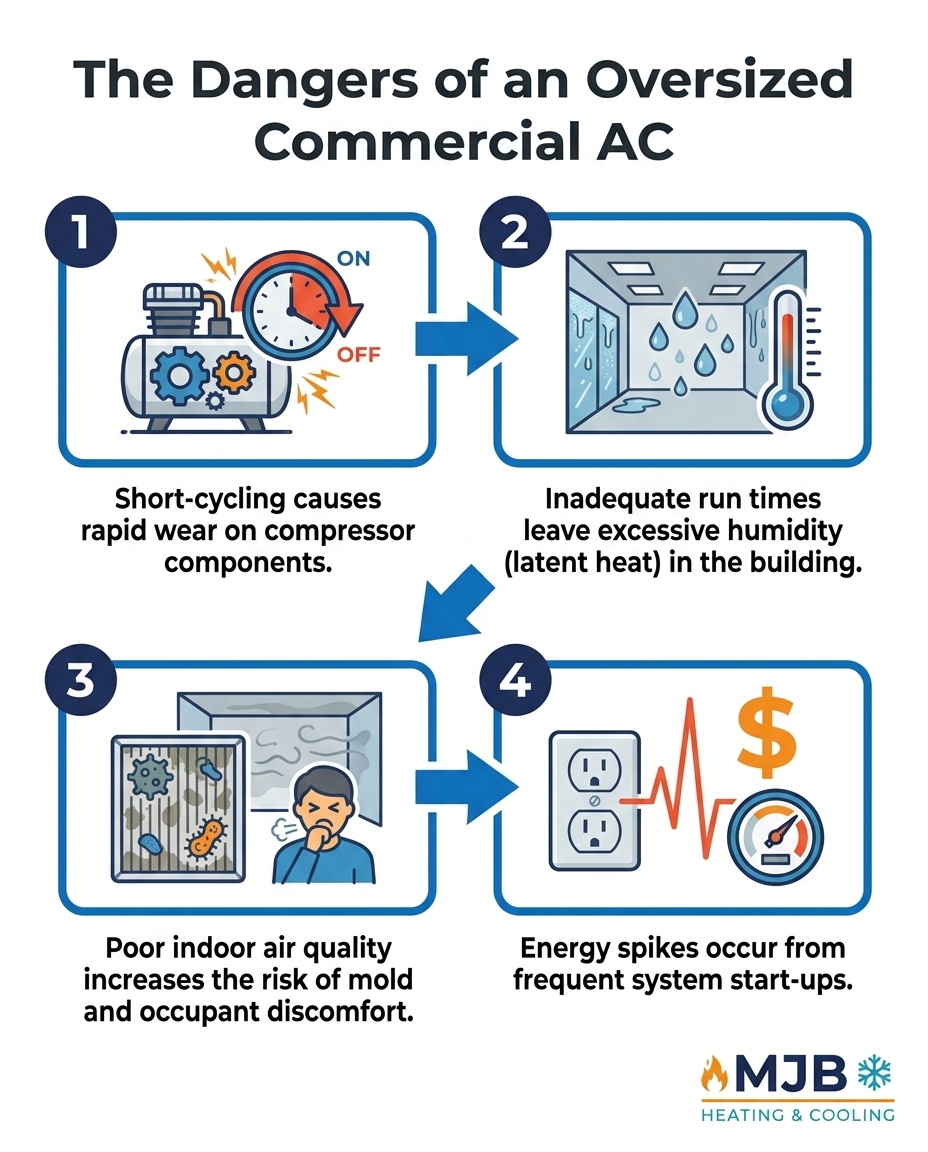
Installing a 240,000 BTU system in a building that only requires 150,000 BTUs is not an "upgrade"—it is a mechanical liability. An oversized 20-ton unit cools the ambient air too quickly, satisfying the thermostat and shutting off before completing a full, efficient cooling cycle. This rapid on-and-off process accelerates wear and tear on heavy commercial compressor components.
During the intense, prolonged July heat that defines our Kansas summer peak loads, our technicians consistently see that humidity control becomes just as critical as raw cooling power. An oversized unit ruins this balance. Because the massive system doesn't run long enough, it fails to remove humidity from the indoor air. Excess indoor humidity leads to poor indoor air quality, a clammy environment for occupants, and a high risk of commercial mold growth. If you are already noticing these symptoms, knowing what to check when your AC struggles in extreme heat can help you identify whether oversizing is the root cause.
We routinely warn our clients that short-cycling is the enemy of commercial HVAC longevity. Every time a 20-ton compressor starts up, it draws a massive spike of electrical current—known as inrush current.
• Mechanical stress: Frequent compressor start-ups put immense strain on contactors, capacitors, and the compressor motor itself. A unit meant to run for 20-minute intervals that instead runs for 5-minute intervals will wear out years before its expected lifespan.
• Energy spikes: Because the system requires so much power to start, turning on and off constantly drives up your commercial energy bills. You pay a premium for the inefficient cycling rather than steady, sustained cooling.
To understand why a short-cycling 20-ton unit is so problematic, you have to understand the difference between sensible heat and latent heat.
• Sensible heat: This is the temperature you can feel and measure with a thermometer. An oversized unit drops the sensible heat very quickly.
• Latent heat: This is the moisture or humidity trapped in the air. Removing latent heat requires the air conditioning system's evaporator coil to remain cold for an extended period, allowing moisture to condense and drain away.
When the unit short-cycles, it never runs long enough to extract that latent heat. The thermostat reads a cool 72 degrees, but the building feels like a damp cave.
To avoid the pitfalls of oversizing, the HVAC industry relies on a strict, scientific protocol. ACCA Manual N is the industry standard used by professionals to calculate exact commercial HVAC loads. This calculation provides the empirical data required to either justify a 20-ton unit or recommend a more efficient alternative.
At MJB Heating & Cooling, our team's strict adherence to precise commercial load calculations ensures local businesses never overspend on unnecessarily massive units. We rely on data, not guesswork, to protect your facility.
A proper Manual N calculation involves several meticulous steps:
1. Measuring the physical dimensions: This includes total volume, ceiling heights, and the layout of distinct thermal zones within the commercial space.
2. Assessing internal heat gains: We calculate the heat generated by overhead commercial lighting, server racks, manufacturing machinery, and computers.
3. Factoring occupant loads: Human bodies generate significant heat. A retail space with 200 customers requires vastly different cooling than a warehouse with five forklift operators.
4. Analyzing ventilation requirements: Commercial spaces must bring in specific volumes of fresh outdoor air to meet building codes, which adds to the cooling load.
The most critical part of a Manual N calculation our technicians perform is evaluating the building envelope—the physical barrier between the conditioned indoor air and the unconditioned outdoor air. This involves assessing solar heat gain through commercial glazing (windows) and roofing materials. A flat, dark-colored roof absorbs massively more heat than a reflective white roof.
Professionals also look at thermal bridging in commercial construction. Steel beams and concrete walls can transfer outdoor heat directly into the building, bypassing insulation. Only by measuring all of these factors can we determine the true cooling load of Derby KS commercial spaces.
While oversizing is a major concern, we absolutely encounter scenarios where a 20-ton commercial AC is the exact right choice. When the ACCA Manual N calculations align, this massive cooling capacity is necessary to maintain a safe, productive environment.
Large, open-span facilities: Warehouses, distribution centers, or manufacturing floors with 30-foot ceilings hold massive volumes of air. Even with moderate insulation, the sheer cubic footage demands significant BTU capacity to maintain a stable temperature.
Expansive solar heat gain: Facilities with expansive, unshaded south-facing windows experience extreme solar heat gain throughout the afternoon. Auto showrooms, modern office lobbies, and large retail storefronts often require 20 tons of cooling just to fight off the greenhouse effect created by their own architecture.
Human beings are essentially 98-degree heat generators. High-occupancy spaces such as auditoriums, large retail centers, commercial gyms, or mega-churches face unique thermal challenges.
Maximum occupancy limits dictate specific ventilation and cooling requirements. The compounding effect of human latent heat generation (sweat and respiration) means the HVAC system has to work twice as hard to dehumidify the air. In a packed commercial gym, a 20-ton unit might be perfectly sized to handle the sudden influx of hundreds of heavily breathing, sweating occupants during peak evening hours.
Our team frequently designs systems for commercial buildings housing equipment that constantly fights against the air conditioning system. Compensating for industrial machinery, commercial-grade lighting, and heavy electronics requires dedicated cooling power.
Facilities housing extensive server rooms, commercial kitchens, or specialized manufacturing equipment generate immense internal heat loads. Maintaining stable temperatures for sensitive inventory or electronics is non-negotiable. If a server room overheats, the business stops. In these high-load environments, 240,000 BTUs is often exactly what the data demands.
Once we have verified that a 20-ton unit is the correct size for your facility, protecting that capital investment becomes the next priority. Even a perfectly sized, highly efficient commercial system will lose efficiency rapidly if neglected.
We always advise our commercial clients that routine inspections of heavy-duty belts, blower motors, and massive condenser coils are critical for large-tonnage systems. A 20-ton unit moves a tremendous amount of air, which means it also pulls in a tremendous amount of dust, pollen, and debris. If the condenser coils become caked in dirt, the system cannot release heat outdoors. This forces the compressor to work harder, consume excess energy, and run hotter than its design limits allow.
Proactive care prevents the system from overworking. Consistent upkeep ensures the unit continues to meet the facility's exact load requirements year after year, preventing unexpected breakdowns that halt business operations. Securing a professional commercial AC maintenance plan is the most reliable way to guarantee your massive 240,000 BTU system operates at peak performance for its entire lifespan.
How many square feet does a 20 ton AC cool?
There is no exact square footage a 20-ton AC cools, as it depends entirely on the building's thermal load. Relying on outdated rules of thumb might suggest it cools 8,000 square feet, but a modern, well-insulated warehouse might stretch that to 12,000 square feet. Professional load calculations are required to determine the true coverage area for your specific facility.
What happens if a commercial AC is oversized?
An oversized commercial AC will cool the space too quickly and shut off before removing humidity. This process, known as short-cycling, leads to a clammy indoor environment, poor air quality, and potential mold growth. It also causes severe mechanical wear on the compressor and spikes in energy consumption.
How do you calculate commercial HVAC load?
Professionals calculate commercial HVAC load using the ACCA Manual N protocol. This involves measuring the building envelope, insulation levels, window orientation, internal heat from equipment, and maximum human occupancy. These variables are entered into specialized software to determine the exact BTU requirements.
Why is humidity control important for commercial buildings?
Humidity control is critical for maintaining indoor air quality and preventing mold growth. Excess moisture makes the air feel warmer than the thermostat reads, leading occupants to constantly lower the temperature setting. Proper humidity removal protects building materials, sensitive inventory, and the health of the people inside.
What is the difference between sensible and latent heat in commercial HVAC?
Sensible heat refers to the actual temperature change you can feel and measure with a thermometer. Latent heat refers to the moisture or humidity present in the air. A properly sized commercial HVAC system must run long enough to manage both, lowering the temperature while simultaneously extracting moisture.
A 20-ton commercial rooftop unit is an incredibly powerful tool, but it only delivers value when precisely matched to your building's thermal load. Approving a massive installation based on a square-footage guess is a risk no property manager should take. Verifying your quote with accurate, data-driven Manual N calculations is the best way to protect your capital investment and ensure your building operates efficiently.
Professional guidance ensures long-term efficiency, superior indoor air quality, and reliable performance through the toughest summer months. When you need a clear breakdown of the load calculations and building requirements used to justify your next system, reach out to an expert serving Derby and surrounding service areas to get the exact data your facility demands.


Our A/C stopped working on a Sunday and due to health issues, we needed to find a service company available on a Sunday. I called MJB and left a message on their emergency voice mail. Within 10 minutes Tom Buck called me to hear my description of the symptoms. He was just finishing an appointment in Wichita and would be on his way to my home on the south end of Derby. He arrived within 30 minutes! From start to finish he was the perfect example of what you could ever hope for in an HVAC tech and a human being. His evaluation of our system inside and out was as thorough as I could ever imagine and once he was done with the repair, our system is running as well or better than ever. Well worth the price for the evaluation, parts, and labor. Thank you again Tom for an awesome experience.
Our AC went out during the hottest days of the year, and they were out next day! We have been jerked around by a shoddy home warranty for years. We finally had a chance to pick our own repair people, and MJB came highly recommended. I can see why! I was impressed with the honesty and speed at which they fixed our AC unit!
Our commercial building had a lightening/electrical strike and damaged our 20 ton AC unit. No one could find us a new unit before the end of September. Imagining going all of August and September with no AC in Kansas and working inside near 100 degree temps is less than thrilling. Dale and the team at MJB called around and saved the day. They had us a new unit 5 weeks earlier than other could promise and I now have happy employees. The unit is amazingly quiet, super cold and so much more energy efficient. Thank you for being our super hero!
Came out and installed my new furnace. Was very polite and affordable. They are very acknowledgeable and I highly recommend!
Thank you very much. We had our 1st warm night in 3weeks. MJB took the time and effort to find the real problem. And the employees were kind and thoughtful and explained things very well. I cannot thank you and all of MJB. Will recommend you highly. Thanks again Marjorie Herman Oxford Kansas
We had a new system installed and I was so impressed with how quick they were in come out and install it, in the middle of a hot summer day. They were so friendly & very professional. I had a small problem with a weird sound and they came over immediately and fixed it. Love them!


