


.avif)





Blogs
Stay updated with our latest blog posts.

Diagnosing a Tripped AC Breaker During Peak Kansas Heat is a stressful scenario, especially when the forecast warns of another string of 100-degree summer afternoons and your air conditioner has been running continuously just to keep your home livable. Suddenly, the airflow stops, the vents go quiet, and the house begins to warm up immediately. When you check your main electrical panel, you find the culprit: the dedicated breaker for your outdoor compressor has flipped to the "off" position. You are now standing at a critical decision point. Is it safe to simply flip the switch back on and hope for the best, or does this sudden shutdown indicate a severe overheating issue that requires professional intervention?
A tripped breaker is an active safety mechanism, not a nuisance. It is designed to stop the flow of electricity when your system pulls a dangerous amount of power. During the compounding thermal load of July weather, when AC units run nearly continuously, the strain on your equipment reaches its absolute peak. Before you make your next move, understanding the physics behind the problem can help you decide whether to reset the system or reach out for professional HVAC services and contact our AC repair team.
The Problem: To understand why your breaker tripped, you have to look at the basic physics of how your air conditioner moves heat. Your AC does not actually create cold air; it absorbs heat from inside your house and pumps it outside. This process relies on a chemical refrigerant traveling through a closed loop, changing from a liquid to a gas and back again.
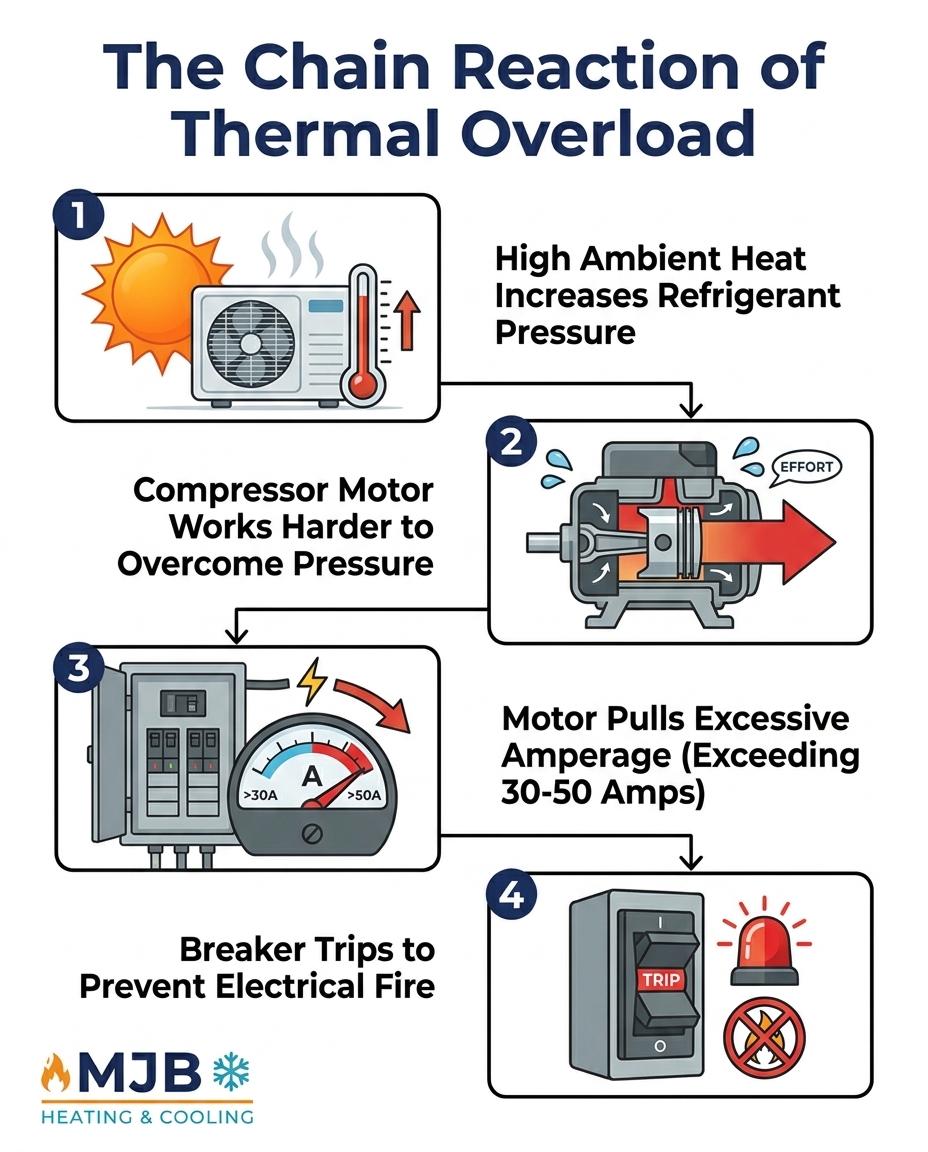
The Cause: The outdoor unit, specifically the compressor, acts as the heart of this system. It pressurizes the refrigerant gas so that it can release the absorbed heat into the outdoor air. However, there is a direct scientific relationship between temperature and pressure, often referred to in physics as Boyle's Law and Gay-Lussac's Law. As the outdoor ambient temperature rises, the pressure of the refrigerant inside the coils increases dramatically.
When the outdoor temperature spikes, the compressor motor is forced to work exponentially harder to compress that high-pressure refrigerant. Mechanical strain directly translates to electrical strain. As the motor struggles against the immense pressure, it requires more and more electricity to keep spinning. This results in an excessive amp draw from your electrical panel.
The Solution: Standard residential air conditioning breakers are typically sized between 30 and 50 amps. When the compressor pulls more amperage than the breaker is rated for, the breaker trips to cut the power. Recognizing this sequence of events is the first step in knowing what to check when your AC stops cooling in extreme heat.
The correlation between the thermometer outside and the electricity flowing through your wires is absolute. When the system can no longer shed heat effectively into the already-hot outdoor air, thermal overload occurs. The compressor motor begins to overheat, the internal electrical windings lose their efficiency, and the amperage required to keep the system running skyrockets.
• 80°F (Mild Summer Day) — Refrigerant Pressure: Normal / Baseline — Compressor Workload: Standard Operation — Electrical Amp Draw: Normal (Well below breaker limit)
• 90°F (Hot Afternoon) — Refrigerant Pressure: Elevated — Compressor Workload: Moderate Strain — Electrical Amp Draw: Elevated (Approaching upper limits)
• 100°F+ (Extreme Heat Wave) — Refrigerant Pressure: Critically High — Compressor Workload: Severe Mechanical Strain — Electrical Amp Draw: Excessive Amp Draw (Breaker trips)
This table illustrates why a system that works perfectly fine in May can suddenly fail in late July. The mechanical components simply cannot overcome the physical resistance created by the extreme heat.
A vital safety net: It is easy to view a tripped breaker as an annoyance, especially when your house is rapidly heating up. However, you need to reframe this event. Circuit breakers are highly sensitive safety devices designed to detect when a component is pulling more electricity than the physical wiring can safely handle. They are the primary defense mechanism protecting your home from catastrophic electrical events.
The mechanics of the trip: Inside a standard breaker, there is a bimetallic strip. As electricity flows through it, the strip naturally warms up. During a healthy, normal electrical draw, the heat is minimal, and the strip remains stable. But during an excessive amp draw, the surge of electricity causes the strip to heat up rapidly and bend. When it bends far enough, it physically unlatches the internal spring mechanism, snapping the switch to the "off" position and breaking the electrical circuit.
The dangers of continuous high amperage: If that breaker did not trip, the excessive current would continue to flow through the wires connecting your electrical panel to the outdoor unit. High amperage generates immense heat. Within minutes, this heat can melt the plastic insulation surrounding the wires. Once the insulation melts, bare wires can touch, leading to massive sparks, electrical arcing, and potentially a devastating house fire.
A successful intervention: When you find that breaker in the tripped position, it means the safety device worked exactly as engineered. It detected a dangerous anomaly and shut down the power before the wiring could melt. A healthy system draws a steady, predictable amount of power. An excessive amp draw is a bright red flag indicating that the compressor is in severe distress.
Extreme heat is often the primary catalyst, but it rarely works alone. In our years of experience providing emergency AC repairs at MJB Heating & Cooling, our team typically sees secondary mechanical issues combine with high temperatures to guarantee an electrical overload. Sustained extreme temperatures in this specific region create an environment where older compressors cannot physically cool down between cycles. When you live in Derby KS, these compounding factors are incredibly common during the peak of summer.
1. Aging HVAC Components: As air conditioners age, their internal parts naturally wear down. Bearings lose their lubrication, valves become less efficient, and electrical windings degrade. An older compressor naturally draws more power just to perform its basic functions, leaving it highly vulnerable when a heatwave pushes it to the limit.
2. Failing Run Capacitors: The run capacitor acts like a continuous battery boost for your compressor motor. It stores electrical energy and feeds it to the motor to keep it spinning smoothly. Extreme heat causes the chemical fluid inside the capacitor to break down or bulge. When the capacitor fails, the compressor struggles to run, pulling massive amounts of amperage until the breaker trips.
3. Dirty Condenser Coils: The metal fins on the outside of your AC unit are designed to release heat. If they are caked in dirt, dust, lawn clippings, or cottonwood seeds, they act like a thick winter blanket. The heat becomes trapped inside the unit, accelerating thermal overload and forcing the system to work twice as hard.
4. Continuous Short Cycling: When a system turns on and off too rapidly, or runs continuously without ever taking a break, the compressor never gets a chance to cool down. The internal temperature of the motor continues to climb until the thermal overload switch engages or the main breaker trips.
Addressing these secondary issues before the heat hits is exactly why staying on a routine AC maintenance plan is so highly recommended for homeowners.
The Problem: When faced with a hot house and a tripped breaker, the immediate temptation is to just flip the switch back to "on." You might assume it was a temporary power surge or a brief glitch. However, repeatedly resetting a tripped breaker is one of the most dangerous actions a homeowner can take.
The Cause: The HVAC industry generally recognizes the "One Reset Rule." It is acceptable to reset a tripped breaker exactly once. This allows you to rule out a random, fluke power surge from the local utility grid. If the system starts up and runs normally for the rest of the day, you can monitor it. But if the breaker trips a second time—whether immediately or ten minutes later—you have confirmed a hard failure. Forcing electricity into a seized, overheated, or grounded compressor causes severe mechanical and electrical damage.
The Solution: You must stop resetting the breaker. Every time you force a reset during those 100-degree Kansas summer afternoons, you degrade the internal mechanisms of the breaker itself. The bimetallic strip weakens, and the internal contacts can actually weld shut from the intense heat of the electrical arc. If the breaker welds shut, it loses its ability to trip, sending unchecked voltage straight to the unit. Furthermore, forcing a seized compressor to run can cause the internal electrical terminals to blow out, permanently killing the unit and requiring a total replacement. Leave the switch off and call for help.
Guesswork has no place in high-voltage electrical troubleshooting. When a breaker repeatedly trips, the root cause could be anything from a relatively inexpensive run capacitor to a completely destroyed compressor motor. Finding out which one it is requires a professional, safety-first diagnostic approach that relies on hard data and specialized testing equipment.
What professionals actually measure:
• Amp draw under load: Technicians use clamp-on multimeters to measure the exact amperage the compressor is pulling during startup and while running. This tells them instantly if the motor is failing.
• Capacitor microfarads: Using specialized meters, professionals test the exact electrical storage capacity of the run and start capacitors to see if they have degraded below the manufacturer's safe threshold.
• Electrical integrity tracing: The diagnostic process involves tracing the voltage from the main breaker panel, through the outdoor disconnect box, and into the contactor and compressor terminals to find shorts or degraded wiring.
• Refrigerant pressure checks: Gauges are applied to ensure the system is not overcharged or fighting a restriction in the refrigerant line, which would cause high head pressure and excessive amp draw.
At MJB Heating & Cooling, our professional, safety-first diagnostic expertise ensures that we measure the complete electrical integrity of your system to protect your home from hazards. We don't just guess and swap parts; we find the root cause of the overload to prevent expensive compressor replacements and ensure your family's safety. Electrical troubleshooting on high-voltage 240V systems must always be left to licensed professionals. If you need assistance, we serve multiple local service areas with rapid response times.
Hot days increase the refrigerant pressure inside your system, requiring more mechanical effort and a higher electrical draw to function. As the outdoor temperature climbs, the compressor motor has to work exponentially harder to pump the refrigerant. If the system is older, dirty, or struggling with a weak capacitor, this added strain pushes the electrical demand past the breaker's safety limit.
Resetting it once is generally safe to rule out a temporary power surge or a grid fluctuation. However, resetting it multiple times is a severe fire and equipment hazard. If the breaker trips a second time, it is doing so to protect your home from an active electrical short or a seized motor, and it must be left off.
When a compressor overheats, the internal thermal overload switch may trip to shut down the motor, or it may pull too many amps and trip the main breaker at your electrical panel. Continuous overheating breaks down the protective insulation on the internal copper windings, which eventually leads to a grounded electrical short and permanent motor failure.
Yes, a weak or failing capacitor forces the compressor to struggle during startup, pulling excessive amperage until the breaker trips. The capacitor acts as a battery boost that gives the motor the torque it needs to overcome high refrigerant pressure. Without that boost, the motor stalls, overheats, and overloads the circuit.
If you reset the breaker once and it trips a second time, you should leave the AC off completely until a professional can diagnose the electrical fault. During 100-degree Kansas summer afternoons, leaving the power off is the only way to ensure the compressor does not sustain permanent, irreversible damage from repeated electrical surges.
Understanding the physics of heat, pressure, and amperage empowers you to make safe, informed decisions when your air conditioner suddenly shuts down. A tripped breaker is your home's way of telling you that the system is under extreme duress and needs immediate attention. Ignoring the warning signs or repeatedly forcing the system to run will only escalate a repairable issue into a catastrophic equipment failure.
If you are dealing with a breaker that refuses to stay on in Derby KS, leaving the switch off is the best way to protect your investment from permanent damage. Do not risk your safety or the lifespan of your compressor by guessing at the problem. Reach out for a professional electrical and mechanical diagnosis to safely restore your cooling, and contact our AC repair team today.


Our A/C stopped working on a Sunday and due to health issues, we needed to find a service company available on a Sunday. I called MJB and left a message on their emergency voice mail. Within 10 minutes Tom Buck called me to hear my description of the symptoms. He was just finishing an appointment in Wichita and would be on his way to my home on the south end of Derby. He arrived within 30 minutes! From start to finish he was the perfect example of what you could ever hope for in an HVAC tech and a human being. His evaluation of our system inside and out was as thorough as I could ever imagine and once he was done with the repair, our system is running as well or better than ever. Well worth the price for the evaluation, parts, and labor. Thank you again Tom for an awesome experience.
Our AC went out during the hottest days of the year, and they were out next day! We have been jerked around by a shoddy home warranty for years. We finally had a chance to pick our own repair people, and MJB came highly recommended. I can see why! I was impressed with the honesty and speed at which they fixed our AC unit!
Our commercial building had a lightening/electrical strike and damaged our 20 ton AC unit. No one could find us a new unit before the end of September. Imagining going all of August and September with no AC in Kansas and working inside near 100 degree temps is less than thrilling. Dale and the team at MJB called around and saved the day. They had us a new unit 5 weeks earlier than other could promise and I now have happy employees. The unit is amazingly quiet, super cold and so much more energy efficient. Thank you for being our super hero!
Came out and installed my new furnace. Was very polite and affordable. They are very acknowledgeable and I highly recommend!
Thank you very much. We had our 1st warm night in 3weeks. MJB took the time and effort to find the real problem. And the employees were kind and thoughtful and explained things very well. I cannot thank you and all of MJB. Will recommend you highly. Thanks again Marjorie Herman Oxford Kansas
We had a new system installed and I was so impressed with how quick they were in come out and install it, in the middle of a hot summer day. They were so friendly & very professional. I had a small problem with a weird sound and they came over immediately and fixed it. Love them!


