


.avif)





Blogs
Stay updated with our latest blog posts.

When looking at how Derby's hard water affects your condensate drain lines, our team at MJB Heating & Cooling often finds that the most surprising factor for homeowners is the sheer volume of water involved. A typical central air conditioner can produce 5 to 20 gallons of condensation per day during high humidity. That is a massive amount of water constantly flowing through a narrow PVC pipe in your attic, basement, or utility closet. Most homeowners assume this condensation is pure, distilled water simply dripping away harmlessly. However, our field experience with local municipal water chemistry paints a very different picture.
Derby KS municipal water contains elevated levels of calcium and magnesium, classifying it as hard water. While your air conditioner extracts moisture from the indoor air, that air also carries microscopic dust particles, trace minerals, and residue from your home's environment—including aerosolized particles from your local water supply. As this moisture collects on your evaporator coil and drips into the drain pan, it creates a highly concentrated mineral soup. Over time, these minerals settle and bond to the plastic interior of your drain line. Standard DIY clearing methods are completely ineffective against this specific type of hardened mineral buildup. If you are tired of dealing with recurring clogs and sudden system shutdowns, it is time to trust our professional HVAC services to handle the root cause of your drainage issues.
The concrete problem: Municipal hard water scale interacts directly with your HVAC condensation, leading to stubborn drain line clogs and float switch trips that disrupt your comfort. Recognizing that standard home remedies will not dissolve this calcium buildup is the first step toward a permanent solution. You need scale-specific preventive maintenance to keep your system running reliably.
The local climate plays a massive role in how quickly mineral deposits form inside your air conditioning system. During the peak summer cooling season here in Derby, our technicians see continuous AC operation act as a powerful multiplier for rapid scale buildup. Hot, humid July summers force your air conditioner to run longer cycles, extracting massive amounts of moisture from your indoor air just to make the house feel comfortable.
When the system runs non-stop, it rarely gets a chance to dry out. The constant flow of water mixed with trace minerals creates the perfect environment for calcification. If you are noticing your AC not cooling properly in extreme heat, a restricted drain line might be causing the system to short-cycle or shut down entirely as a safety precaution.
To understand the scale of the problem, we always tell our customers to look at the sheer volume of water moving through the drain pan daily. When indoor humidity levels rise above 50%, your evaporator coil works overtime. The moisture in the air condenses on the freezing cold copper coils, drips into the primary drain pan, and funnels out through the condensate line.
• Continuous flow: On a 100°F day, the condensation never stops dripping.
• Lack of evaporation: High ambient humidity prevents natural evaporation inside the pan, forcing every single drop of water to travel through the narrow PVC exit pipe.
• Debris accumulation: More water means more airborne dust and trace minerals are washed into the pan, creating a thicker sludge.
As the air conditioner cycles off periodically, small amounts of water are left sitting in the drain pan and the trap of the condensate line. When this water eventually evaporates into the hot ambient air of an attic or utility closet, it leaves behind highly concentrated calcium and magnesium deposits.
This process is exactly like boiling a pot of hard water dry on your stove. You are left with a chalky white residue bonded to the metal. Inside your PVC drain line, this evaporation creates a crust-like barrier rather than a soft, easily flushable sludge. Every time the system cycles on and off, another microscopic layer of calcium is added to the pipe walls, slowly choking off the water flow.
When an AC drain line clogs, the internet is full of generic advice blaming algae. While algae is certainly a common issue in warm, dark, and damp environments, we find that it is often merely a secondary symptom in hard water areas. Understanding the difference between organic growth and mineral calcification is critical for properly maintaining your system.
This is exactly why our firsthand field experience at MJB Heating & Cooling makes a massive difference. We routinely arrive at homes where generic, out-of-town blogs advised treating for algae, but as our technicians know, diagnosing a calcium blockage requires a deep understanding of Derby's specific municipal water profile. If a technician treats a heavily calcified line merely for algae, the primary blockage remains completely untouched.
Standard HVAC advice assumes a soft water environment where dust and airborne spores are the only contaminants entering the drain pan. In those scenarios, algae creates a soft, slimy blockage that is relatively easy to flush away. However, treating for algae will not solve a calcium blockage.
Mineral scale actually accelerates organic growth. The white crust of calcium creates a rough, porous surface inside the otherwise smooth PVC pipe. This rough texture gives algae spores the perfect surface to grip onto and multiply. You end up with a compounded problem: a narrowed pipe caused by calcium, topped with a sticky layer of algae.
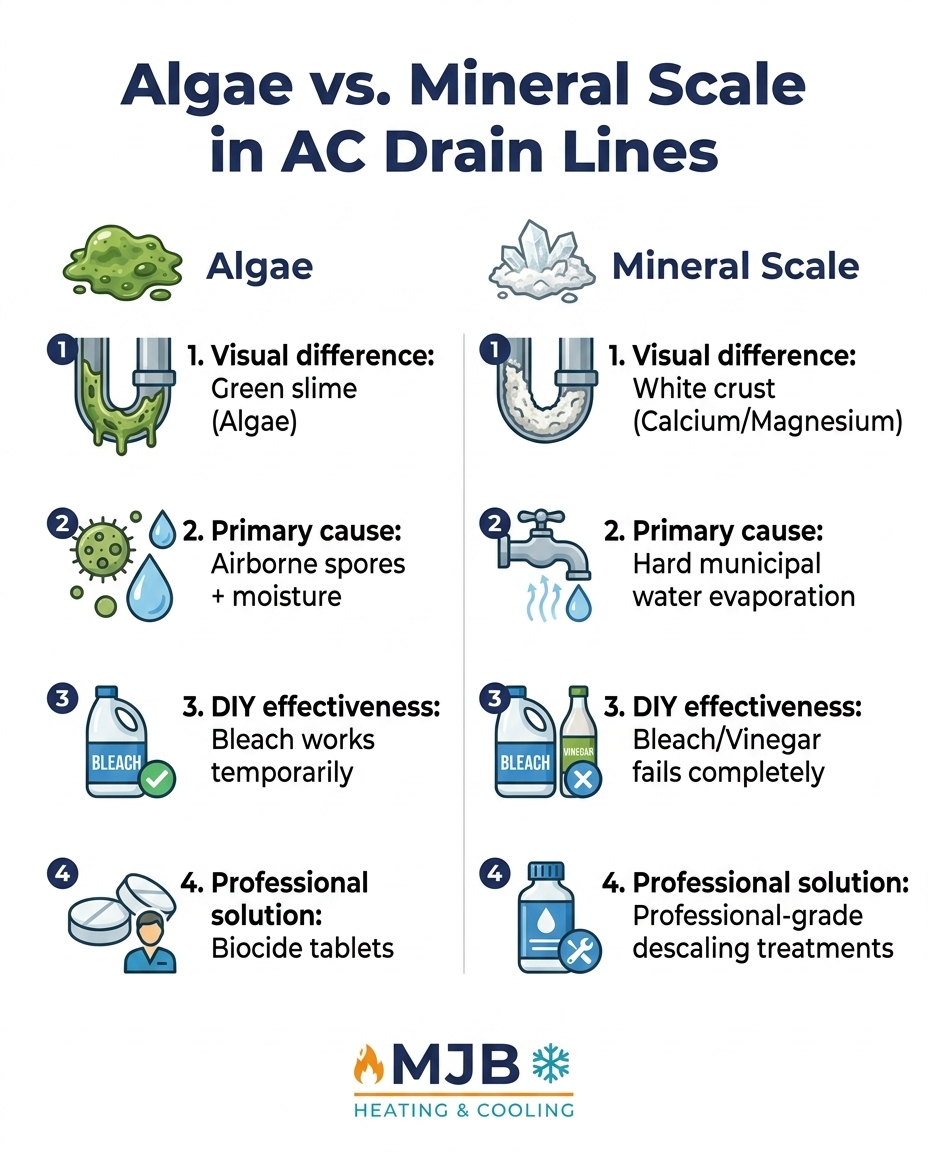
• Visual Appearance — Algae Growth (Organic): Green, black, or brown slime — Mineral Scale (Inorganic): Chalky white, yellow, or gray crust
• Texture — Algae Growth (Organic): Soft, slippery, and gelatinous — Mineral Scale (Inorganic): Hard, brittle, and bonded to surfaces
• Primary Cause — Algae Growth (Organic): Airborne spores + stagnant water — Mineral Scale (Inorganic): Hard municipal water evaporation
• DIY Treatment Result — Algae Growth (Organic): Temporarily cleared by bleach — Mineral Scale (Inorganic): Completely unaffected by bleach
• Professional Solution — Algae Growth (Organic): EPA-registered biocides — Mineral Scale (Inorganic): Professional-grade descaling treatments
In our experience repairing systems across Derby, understanding exactly how a hard water clog forms helps explain why your air conditioner suddenly stops working on the hottest days of July. The process is slow and insidious, often taking months or years of peak summer cooling season operation to reach a critical failure point. The narrowing of the pipe is just the beginning of the mechanical issues.
Your air conditioning system is equipped with safety mechanisms designed to prevent catastrophic water damage to your home. When mineral scale restricts the flow of water, these safety devices are forced to intervene, leading to frustrating and sudden loss of cooling.
The standard condensate drain line is made of 3/4-inch PVC pipe. While the interior is smooth when manufactured, our crews rarely see it stay that way for long.
1. Initial bonding: Microscopic calcium particles settle out of the standing water in the drain trap and bond to the bottom of the plastic pipe.
2. Layering effect: Each time the system cycles, new water flows over the existing calcium, leaving behind another microscopic layer as it evaporates.
3. Restriction: Over time, the 3/4-inch opening is reduced to 1/2-inch, then 1/4-inch, severely restricting how fast water can exit the system.
4. Total blockage: Eventually, a piece of dust or a small clump of algae catches on the jagged calcium edge, creating a dam that completely blocks the pipe.
When the PVC pipe is blocked, the 5 to 20 gallons of daily condensation have nowhere to go. The water begins to back up into the primary drain pan located under your indoor evaporator coil. This is where the float switch comes into play.
The safety mechanism: A float switch is a small device mounted on the edge of the drain pan. It works exactly like the bobber in a toilet tank. As the water level in the pan rises due to the blockage, the float lifts. Once it reaches a certain height, it triggers a switch that cuts the low-voltage power to your thermostat, instantly shutting down the outdoor compressor.
This shutdown prevents the pan from overflowing and destroying your ceiling or floors. However, it also leaves you without air conditioning. The frustration occurs when homeowners notice the system is off, check the pan, see a little water, and manually reset the switch or vacuum out a small amount of liquid. Because the heavy mineral scale is still blocking the pipe, the pan simply fills up again in a few hours, causing the float switch to trip repeatedly.
When faced with a clogged drain line, most homeowners turn to search engines for a quick fix. The most common advice you will find is to pour a cup of bleach or vinegar down the access pipe. While this might work in areas with very soft water, our team knows it is a recipe for ongoing frustration in Derby KS.
You have to look at the chemistry of the blockage. Standard household cleaners are simply not formulated to break down heavy mineral deposits. Relying on them gives you a false sense of security, leaving the actual restriction completely untouched. This is a frustrating pattern our repair crews see almost daily across our local service areas: well-meaning homeowners treating the wrong problem with the wrong chemicals.
Let's break down exactly why these common DIY methods fail against municipal hard water scale.
• Bleach does nothing to calcium: Bleach is a highly alkaline substance (high pH). Calcium and magnesium deposits require an acidic solution to dissolve. Pouring bleach on mineral scale is chemically useless; it will kill any algae sitting on top of the scale, but the hard rock-like blockage will remain fully intact.
• Vinegar is too weak: White vinegar is a mild acid (acetic acid). While it can dissolve very thin, fresh water spots on a drinking glass, it is nowhere near strong enough to eat through months or years of thick, baked-on calcium inside a PVC pipe. It would take days of soaking to make a dent, which is impossible in a flowing drain line.
• High-pressure air risks: Some homeowners try to blow the clog out with an air compressor. Because calcium bonds directly to the plastic, hitting a solid calcified blockage with 100 PSI of compressed air often cracks the PVC pipe at the joints, turning a simple clog into a major plumbing leak inside your walls.
• Harsh chemical dangers: Pouring liquid plumber or heavy-duty drain cleaners into an AC line can produce toxic fumes that are immediately circulated through your home's ductwork. Furthermore, these caustic chemicals can eat away at the thin copper of your evaporator coil, causing catastrophic refrigerant leaks.
The most effective way to handle hard water scale is to shift your mindset from reactive clearing to proactive prevention. Waiting for the float switch to trip on a 100-degree day means you are already dealing with an emergency. By addressing the mineral buildup before it chokes off the pipe, you ensure uninterrupted comfort throughout the peak summer cooling season.
This requires moving beyond basic filter changes and implementing scale-specific preventive measures. Professional condensate pan treatments are designed to target mineral buildup specifically, altering the chemistry of the standing water so calcium cannot bond to the plastic pipes.
Routine maintenance is the ultimate defense against unexpected summer breakdowns. When you invest in our routine HVAC maintenance plan, you are getting a level of deep cleaning that DIY methods simply cannot match.
Here is what our team's professional, scale-focused maintenance visits include regarding your condensate system:
1. Professional-grade descaling: Our technicians use specialized, safe acidic solutions that are specifically formulated to dissolve calcium and magnesium without damaging PVC pipes or copper coils.
2. High-volume flushing: Once the chemical breaks down the scale, the line is flushed with a high volume of water to push all the loose debris out of the system completely.
3. Preventive treatments: Time-release pan treatments are placed in the primary drain pan. These are not generic bleach tablets; they are specialized formulas that prevent minerals from crystallizing in the water over the next several months.
4. Float switch testing: The safety mechanisms are manually tested to ensure they will actually shut the system down if a backup occurs, protecting your home from catastrophic water damage.
Understanding the exact mechanism of hard water scale in your AC allows you to make informed decisions about your home's upkeep. By implementing actionable, locally relevant prevention steps with MJB Heating & Cooling, you can eliminate the frustration of recurring clogs and ensure your air conditioner drains flawlessly all summer long.
Yes, hard water is a primary cause of stubborn AC drain line clogs in areas with high mineral content. As condensation mixes with airborne dust and trace minerals from your environment, it forms a concentrated solution. When this water evaporates inside the drain pan and PVC pipe, it leaves behind hard calcium and magnesium deposits that slowly choke off the water flow.
Bleach only kills organic growth like algae, but it is chemically incapable of dissolving hard water scale. If your local water supply is hard—as we frequently see in Derby—pouring bleach down the line may clear out the green slime, but the underlying rock-hard calcium blockage remains intact. Because the pipe is still physically restricted by minerals, the pan will continue to back up and clog repeatedly.
The white crust in your AC drain pan is calcification, primarily made up of calcium and magnesium deposits. It forms when condensation evaporates and leaves behind concentrated minerals. Over time, this crust builds up, hardens, and flakes off, eventually migrating into the drain line where it creates severe, hard-to-remove blockages.
To safely dissolve calcium in an AC drain pipe, you must use professional-grade, HVAC-safe descaling solutions. Household vinegar is generally too weak to break down thick buildup, and harsh chemical drain cleaners can permanently damage your evaporator coil or melt the PVC joints. Our licensed technicians apply the correct chemical balance to dissolve the scale without harming your equipment.
Your AC float switch trips repeatedly in the summer because high humidity causes the system to produce massive amounts of condensation that cannot drain properly due to a partial blockage. The switch is a safety device that shuts off the AC to prevent water from overflowing the pan and damaging your home. If you reset the switch without clearing the underlying mineral scale in the pipe, the pan simply fills up and trips the switch again.
Generic AC maintenance often overlooks municipal water chemistry, focusing only on basic tasks like changing filters and checking refrigerant levels. However, comprehensive local maintenance specifically accounts for regional water hardness by including specialized pan treatments and professional descaling. Addressing the specific mineral makeup of your local environment is crucial for preventing unexpected summer breakdowns.


Our A/C stopped working on a Sunday and due to health issues, we needed to find a service company available on a Sunday. I called MJB and left a message on their emergency voice mail. Within 10 minutes Tom Buck called me to hear my description of the symptoms. He was just finishing an appointment in Wichita and would be on his way to my home on the south end of Derby. He arrived within 30 minutes! From start to finish he was the perfect example of what you could ever hope for in an HVAC tech and a human being. His evaluation of our system inside and out was as thorough as I could ever imagine and once he was done with the repair, our system is running as well or better than ever. Well worth the price for the evaluation, parts, and labor. Thank you again Tom for an awesome experience.
Our AC went out during the hottest days of the year, and they were out next day! We have been jerked around by a shoddy home warranty for years. We finally had a chance to pick our own repair people, and MJB came highly recommended. I can see why! I was impressed with the honesty and speed at which they fixed our AC unit!
Our commercial building had a lightening/electrical strike and damaged our 20 ton AC unit. No one could find us a new unit before the end of September. Imagining going all of August and September with no AC in Kansas and working inside near 100 degree temps is less than thrilling. Dale and the team at MJB called around and saved the day. They had us a new unit 5 weeks earlier than other could promise and I now have happy employees. The unit is amazingly quiet, super cold and so much more energy efficient. Thank you for being our super hero!
Came out and installed my new furnace. Was very polite and affordable. They are very acknowledgeable and I highly recommend!
Thank you very much. We had our 1st warm night in 3weeks. MJB took the time and effort to find the real problem. And the employees were kind and thoughtful and explained things very well. I cannot thank you and all of MJB. Will recommend you highly. Thanks again Marjorie Herman Oxford Kansas
We had a new system installed and I was so impressed with how quick they were in come out and install it, in the middle of a hot summer day. They were so friendly & very professional. I had a small problem with a weird sound and they came over immediately and fixed it. Love them!


