


.avif)





Blogs
Stay updated with our latest blog posts.

You wake up sweating at 2 a.m., noticing the unmistakable silence of a failed air conditioner, and you immediately wonder, "What Constitutes a True Midnight AC Emergency in Andover?" That sudden realization that your cooling system has stopped working brings an instant wave of anxiety. You find yourself staring at a blank thermostat or listening to a strange humming noise, debating whether you need to pick up the phone right now or if the problem can wait until the sun comes up. During peak summer nights, that decision feels even heavier as the indoor temperature slowly begins to climb.
For reliable HVAC services or an immediate 24-hour AC repair dispatch, we are here to help you navigate this exact situation.
Not every system breakdown requires an emergency response, but certain conditions absolutely demand immediate professional intervention. The line between a mere inconvenience and a true health hazard is not always obvious to the untrained eye. Many homeowners panic and request after-hours service for minor issues, while others try to tough out dangerously high temperatures that put their families at risk. Understanding objective triage criteria helps you make safe, cost-effective decisions when your equipment fails.
Accessing professional help in the middle of the night requires knowing your home's actual risk level. A sudden failure creates a stressful environment, but applying a calm, protocol-driven approach removes the guesswork. By evaluating specific environmental and mechanical factors, you can accurately determine if your situation warrants waking up a technician or if you can safely hold out for a standard morning appointment.
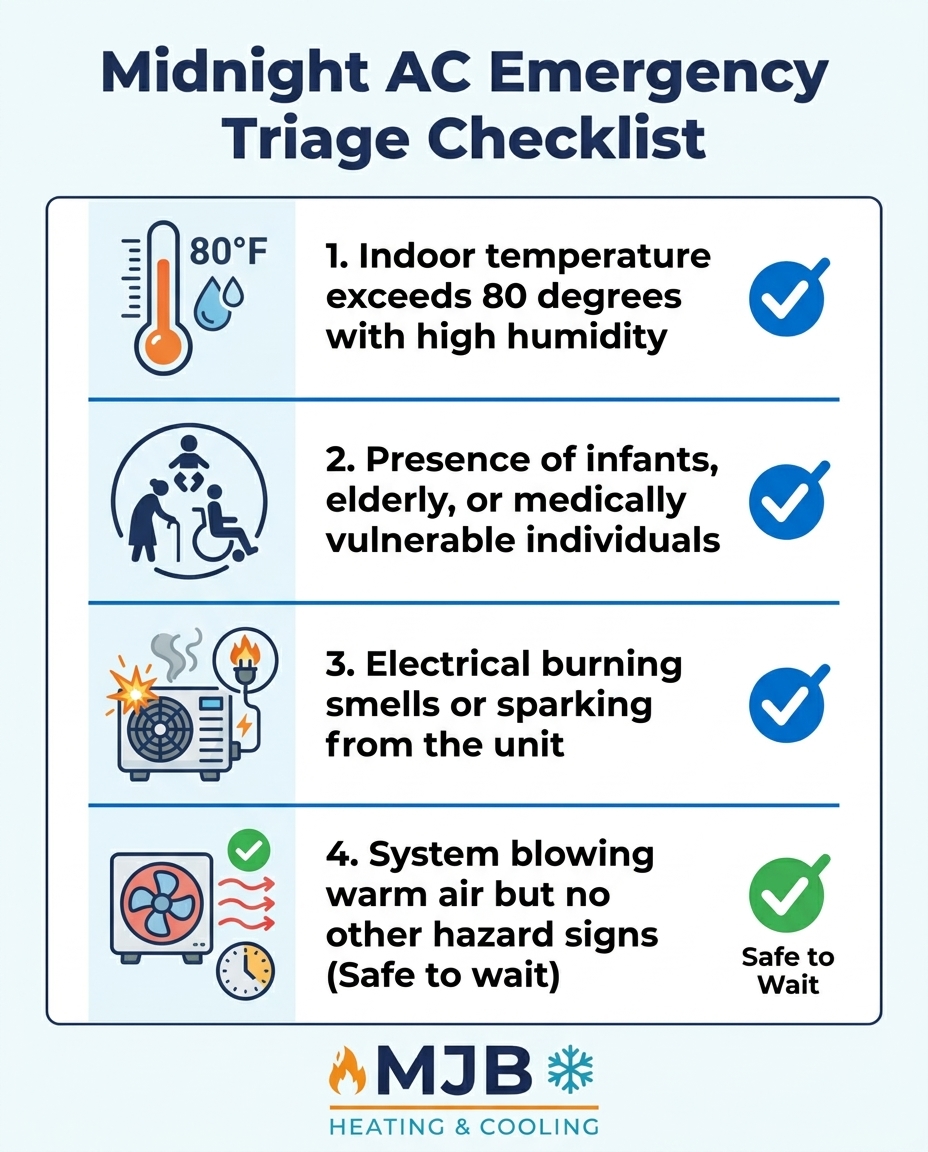
Indoor temperatures exceeding 80 degrees pose increasing risks as the hours pass, especially when the sun rises the following morning. The Environmental Protection Agency (EPA) and the Centers for Disease Control and Prevention (CDC) highlight that stagnant, hot indoor air can quickly affect physical well-being. A house that feels slightly warm at midnight can easily become a dangerous environment by dawn if the cooling system remains offline. Monitoring your thermostat's actual reading versus its set point is step one in the objective triage process.
Kansas summer climate data shows elevated overnight heat indexes, meaning high humidity prevents natural nighttime cooling in a home without AC. In many dry climates, opening a window at night allows the house to cool off naturally. However, during peak summer nights in our region, the outside air remains thick and warm. This prevents your home's structure from shedding the heat it absorbed during the day, causing indoor temperatures to remain dangerously high even when the sun goes down.
Humidity traps heat in the home, accelerating the rise in indoor temperature and dramatically altering how that heat affects the human body. Your air conditioner performs two critical jobs: it lowers the temperature, and it removes moisture from the air. A broken AC stops dehumidifying immediately, which is often the first noticeable sign of failure. Long before the thermostat registers a significant temperature spike, the air in your home will start to feel heavy, sticky, and uncomfortable.
High indoor humidity prevents natural body cooling. The human body regulates its internal temperature through the evaporation of sweat. When the indoor air is already saturated with moisture, sweat cannot evaporate efficiently. This makes an 80-degree indoor environment with high humidity feel significantly hotter and more oppressive than an 80-degree environment with dry air.
• Comfortable — Temperature Reading: 72°F - 76°F — Humidity Level: 30% - 50% — Health Risk Assessment: Safe. System is operating normally.
• Uncomfortable — Temperature Reading: 77°F - 79°F — Humidity Level: 50% - 60% — Health Risk Assessment: Monitor closely. Safe to wait for normal hours.
• Hazardous — Temperature Reading: 80°F+ — Humidity Level: Over 60% — Health Risk Assessment: High risk. Emergency dispatch recommended.
Relying on hard data rather than panic ensures you make the right call. If your indoor temperature is creeping past 80 degrees and the humidity is making it difficult to breathe comfortably, the situation is shifting from a nuisance to a legitimate emergency.
The definition of an emergency changes instantly if vulnerable individuals live in the home. A healthy adult might be able to tolerate a hot, uncomfortable night with the help of a few fans, but certain populations lack the physiological ability to regulate their body heat effectively. When determining if you need immediate service in Andover, the people inside the house are just as important as the numbers on the thermostat.
• Infants and Toddlers: Young children cannot regulate their body temperature as efficiently as adults. They are highly susceptible to heat rash, dehydration, and heat exhaustion. If a baby is in the home during a midnight failure, the threshold for an emergency drops significantly.
• Elderly Residents: Older adults are at a much higher risk for heat-related complications. Aging affects the body's ability to sweat and cool down, making seniors particularly vulnerable to sudden spikes in indoor temperatures.
• Individuals with Medical Conditions: People dealing with cardiovascular issues, respiratory problems like asthma, or autoimmune diseases must avoid extreme heat exposure. High humidity can exacerbate breathing difficulties.
• Medication Sensitivities: Certain prescription medications, including some blood pressure drugs, diuretics, and psychiatric medications, impair the body's ability to handle heat. If anyone in the household takes these medications, a broken AC becomes a critical health concern.
If any of these vulnerable populations are present during a failure, immediate dispatch is warranted regardless of whether the indoor temperature has fully breached the 80-degree mark. Protecting the health and safety of your family always takes precedence over waiting for normal business hours.
An AC emergency isn't always just about the heat; electrical issues pose severe safety risks that require immediate intervention. Your cooling system draws a massive amount of electricity, and when components fail, they can create dangerous electrical shorts. Understanding why your AC stops working at night can help identify if the root cause is a simple mechanical hiccup or a dangerous electrical hazard.
The Problem: You notice a harsh, acrid smell coming from your vents, or you hear loud popping and sparking noises originating from the outdoor condenser or indoor air handler. Sometimes, the system will repeatedly trip the circuit breaker, plunging the house into darkness.
The Cause: These symptoms strongly indicate melting wire insulation, a failing blower motor, or a shorted-out capacitor. When electrical components overheat, they emit a distinct "fishy" or burning plastic odor. Repeatedly resetting a tripped breaker forces electricity back into a compromised circuit, which can lead to catastrophic equipment failure or an electrical fire.
The Solution: If these signs occur, the system must be shut down at the main breaker immediately. Do not attempt to inspect the wiring, remove access panels, or reset the breaker again. Electrical burning smells, sparking, or smoke coming from vents or the unit require immediate attention from a licensed professional. This is a non-negotiable emergency during peak summer nights, and a technician must secure the system before it is safe to operate again.
Even if the issue isn't strictly electrical, continuing to run a severely malfunctioning system can destroy it. For example, if you hear metal-on-metal grinding noises, the compressor or fan motor is likely destroying itself. Turning the system off prevents a relatively minor repair from escalating into a complete system replacement. When mechanical red flags appear, cutting the power and calling for emergency triage is the safest course of action.
A trustworthy HVAC provider evaluates the situation objectively rather than automatically rolling a truck at midnight just to collect an emergency fee. We believe in providing a transparent dispatch protocol that prioritizes your actual needs. When you call us in the middle of the night, our first goal is to determine if you actually need us right then, or if we can save you money by scheduling a priority visit for the next morning.
The triage process involves asking specific questions about your current indoor temperature, the presence of vulnerable residents, and the exact symptoms your unit is displaying. We will ask if you smell smoke, if the breaker is tripping, and how quickly the house is heating up. This transparent assessment is designed to protect homeowners from unnecessary premium after-hours expenses. If it is safe to wait, we will tell you exactly how to stay comfortable until the sun comes up.
Many companies use fear-based tactics to convince stressed homeowners that every strange noise requires an immediate, expensive midnight visit. We take a different approach. Residents across the Andover service area rely on this honest evaluation to make informed decisions. By educating you on what constitutes a true emergency, we build a foundation of trust. You deserve to know that when we recommend an after-hours dispatch, it is because your safety or the integrity of your home is genuinely at risk.
If the triage assessment determines it is safe to wait, you need a solid plan to keep your home tolerable until morning. During peak summer nights, managing the indoor environment requires proactive steps to mitigate heat buildup.
1. Turn the thermostat to "off": If the system is blowing warm air or making strange noises, shut it off completely at the thermostat. Leaving a struggling system running will not cool your home and will likely cause further mechanical damage, such as a frozen evaporator coil or a burned-out compressor.
2. Utilize ceiling fans and portable fans: Fans do not lower the temperature of the room, but they do cool the people in it. The wind-chill effect evaporates sweat from your skin, making you feel several degrees cooler. Ensure ceiling fans are set to rotate counterclockwise to push air straight down.
3. Keep interior doors open: Promote cross-ventilation by keeping bedroom and hallway doors wide open. Closed doors trap heat in isolated areas, especially on upper floors. Allowing air to circulate freely prevents hot spots from forming in the house.
4. Call to get on the morning schedule immediately: Do not wait until 8:00 a.m. to call. Leave a message or speak to the answering service right away to secure a priority spot for normal business hours. The earlier you are on the board, the faster a technician will arrive the next day.
If you have portable box fans, place them strategically. Point one fan out a window on the warmer side of the house to exhaust hot air, and place another fan in a window on the cooler side to draw in relatively cooler night air. While Kansas humidity makes this less effective than in dry climates, any air movement is better than stagnant air.
No homeowner should have to guess whether their midnight AC failure is a true emergency. The stress of a sudden breakdown is bad enough without the added burden of uncertainty. By evaluating the indoor temperature, checking the humidity levels, and considering the health vulnerabilities of your household, you can make a confident, objective choice.
When in doubt, speaking directly with an expert provides clarity and reassurance. We are committed to giving Andover residents honest advice and prompt service when it matters most. Reach out for a professional assessment of your situation to ensure your home remains safe, and rely on our 24-hour AC repair dispatch when you need immediate protection from the heat.
What is considered an AC emergency?
An AC emergency is typically defined by conditions that pose a severe health or safety risk. This includes indoor temperatures rising above 80 degrees with high humidity, the presence of vulnerable individuals like infants or the elderly, or electrical hazards such as burning smells and sparking. If these factors are present, immediate professional intervention is required.
When should I call for 24-hour AC repair?
You should call for 24-hour repair if your system failure creates an unsafe environment that cannot wait until morning. Call immediately if you suspect an electrical fire, if a medically vulnerable person is in the home during a severe heat wave, or if the indoor temperature becomes dangerously oppressive. If the issue is minor and the house remains comfortable, it is usually safe to wait.
Is it safe to sleep in a hot house?
Sleeping in a hot house is generally safe for healthy adults as long as the temperature remains below 80 degrees and air is circulating. However, it becomes unsafe if the indoor temperature climbs excessively, humidity prevents sweat evaporation, or if the individuals sleeping have health conditions that impair heat regulation. Always use fans to maintain airflow.
How hot is too hot in a house?
Most health organizations suggest that indoor temperatures exceeding 80 degrees, especially when combined with high humidity, cross the threshold into unsafe territory. At this level, the body struggles to cool itself efficiently, leading to poor sleep, dehydration, and a higher risk of heat exhaustion for vulnerable populations.
Should I turn off my AC if it is blowing warm air?
Yes, you should immediately turn your AC off at the thermostat if it is blowing warm air. Continuing to run a malfunctioning system forces the compressor to work harder, which can cause severe mechanical damage or lead to a complete system breakdown. Shutting it off protects the equipment until a technician can diagnose the root cause.
Can high indoor humidity make a broken AC situation worse?
Absolutely, high indoor humidity dramatically increases the perceived temperature in your home. Because a broken AC stops removing moisture from the air, the rising humidity prevents your sweat from evaporating, making a 78-degree room feel suffocating and significantly increasing the risk of heat-related illness.


Our A/C stopped working on a Sunday and due to health issues, we needed to find a service company available on a Sunday. I called MJB and left a message on their emergency voice mail. Within 10 minutes Tom Buck called me to hear my description of the symptoms. He was just finishing an appointment in Wichita and would be on his way to my home on the south end of Derby. He arrived within 30 minutes! From start to finish he was the perfect example of what you could ever hope for in an HVAC tech and a human being. His evaluation of our system inside and out was as thorough as I could ever imagine and once he was done with the repair, our system is running as well or better than ever. Well worth the price for the evaluation, parts, and labor. Thank you again Tom for an awesome experience.
Our AC went out during the hottest days of the year, and they were out next day! We have been jerked around by a shoddy home warranty for years. We finally had a chance to pick our own repair people, and MJB came highly recommended. I can see why! I was impressed with the honesty and speed at which they fixed our AC unit!
Our commercial building had a lightening/electrical strike and damaged our 20 ton AC unit. No one could find us a new unit before the end of September. Imagining going all of August and September with no AC in Kansas and working inside near 100 degree temps is less than thrilling. Dale and the team at MJB called around and saved the day. They had us a new unit 5 weeks earlier than other could promise and I now have happy employees. The unit is amazingly quiet, super cold and so much more energy efficient. Thank you for being our super hero!
Came out and installed my new furnace. Was very polite and affordable. They are very acknowledgeable and I highly recommend!
Thank you very much. We had our 1st warm night in 3weeks. MJB took the time and effort to find the real problem. And the employees were kind and thoughtful and explained things very well. I cannot thank you and all of MJB. Will recommend you highly. Thanks again Marjorie Herman Oxford Kansas
We had a new system installed and I was so impressed with how quick they were in come out and install it, in the middle of a hot summer day. They were so friendly & very professional. I had a small problem with a weird sound and they came over immediately and fixed it. Love them!


