.avif)





Blogs
Stay updated with our latest blog posts.
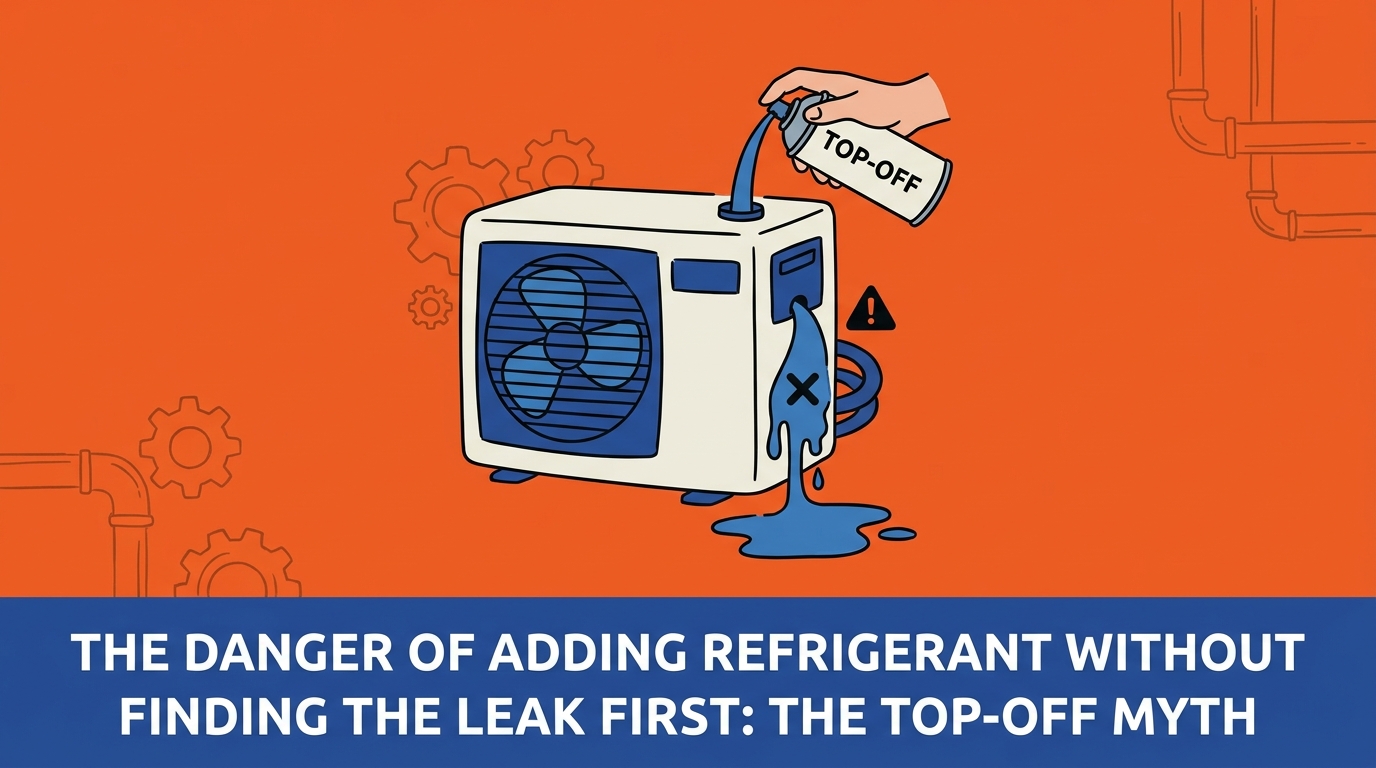

A common myth among homeowners is that air conditioners naturally consume their cooling charge over time, but the danger of adding refrigerant without finding the leak first is that you are treating a mechanical failure like an empty gas tank. When your vents start blowing lukewarm air in the middle of a late August cooling demand, the frustration is immediate. The house feels sticky, you cannot get comfortable, and your first instinct is to ask a technician for a quick "Freon fill-up" so you can just get through the rest of the season. It sounds like a cheap, easy fix. However, treating your central air system like a vehicle that just needs a quick top-off at the gas station is a fundamental misunderstanding of how the equipment actually works.
When the high-90s August heat hits Derby, KS, a struggling air conditioner feels like an absolute emergency. At MJB Heating & Cooling, our dispatch board lights up with calls from homeowners asking for a quick top-off just to get through the back-to-school transition. The extreme temperatures make you want to take shortcuts. You face a critical decision point: do you pay for a temporary top-off, or do you authorize a proper leak search and repair? Choosing the temporary route might give you a few days of cold air, but it sets the stage for a catastrophic system failure. If you want to bypass the band-aids and get to the root of the problem, relying on professional HVAC services and scheduling routine AC maintenance is the smartest way to protect your home.
Many homeowners misinterpret the warning signs of a leak as normal wear and tear. Here is a quick breakdown of what our team typically sees in the field versus what is actually happening inside your unit:
• Vents blowing room-temperature air — What It Usually Means: The system lacks the pressure needed to absorb heat from your home.
• Ice forming on the indoor copper lines — What It Usually Means: The evaporator coil is freezing over due to a severe pressure drop.
• The outdoor unit running non-stop — What It Usually Means: The compressor is overworking to compensate for the missing charge.
• A faint hissing sound near the indoor unit — What It Usually Means: Gas is actively escaping from a physical hole in the copper tubing.
The Problem: Many people believe that air conditioners slowly burn off their cooling gas over several years, leading to the assumption that a system simply needs to be "recharged" periodically. This misconception leads homeowners to repeatedly pay for gas that will just disappear again.
The Cause: Central air conditioners are sealed, closed-loop systems. The chemical agent inside never gets consumed, burned off, or naturally depleted over time. It simply travels back and forth between the indoor and outdoor units, absorbing heat from inside your house and releasing it outside. Because it is a closed loop, the exact amount of gas that was put into the machine on the day it was manufactured should remain inside the machine on the day it is retired.
The Solution: If your levels are low, there is a 100% certainty of a physical leak somewhere in the system. Often, this happens in a highly vulnerable component like a porous evaporator coil, where microscopic holes develop due to chemical corrosion. Adding more gas without fixing the hole is exactly like pouring water into a cracked bucket. It will just leak out again. We recently helped a local homeowner who reached out during the late summer heat when their system needed a recharge. Instead of just blindly adding gas, our technicians performed thorough testing, recharged the system correctly, and clearly explained the diagnostic process so the homeowner understood the mechanical reality of their equipment.
The compressor is the absolute heart of your cooling system. Located in the outdoor unit, this heavy-duty motor is responsible for pumping the cooling agent through the copper lines, creating the pressure differences necessary to move heat out of your house. What most homeowners do not realize is that the compressor relies entirely on a very specific volume of returning gas to keep its own internal motor cool. When you operate an air conditioner with a low charge, you are starving the compressor of its primary cooling mechanism.
As the volume drops, the pressure dynamics inside the system change drastically. The compressor has to work twice as hard to pump a reduced amount of gas, causing it to overheat rapidly. In our experience servicing residential cooling systems throughout Derby, we constantly see how intense late summer heatwaves drastically increase these operating pressures, exacerbating existing micro-leaks and putting immediate, fatal strain on the system. When you combine an overworked, overheating motor with extreme late August cooling demand, there is zero margin for error. The internal windings of the motor will eventually burn out.
When a compressor dies from overheating, it is rarely a simple fix. In most cases, a burnt-out compressor requires a complete replacement of the outdoor unit, and sometimes the indoor unit as well, depending on the age of the equipment. The financial burden of replacing a dead compressor far exceeds the cost of finding and patching a leak early on. This is why resolving refrigerant leak issues immediately is the only way to protect the core components of your HVAC system.
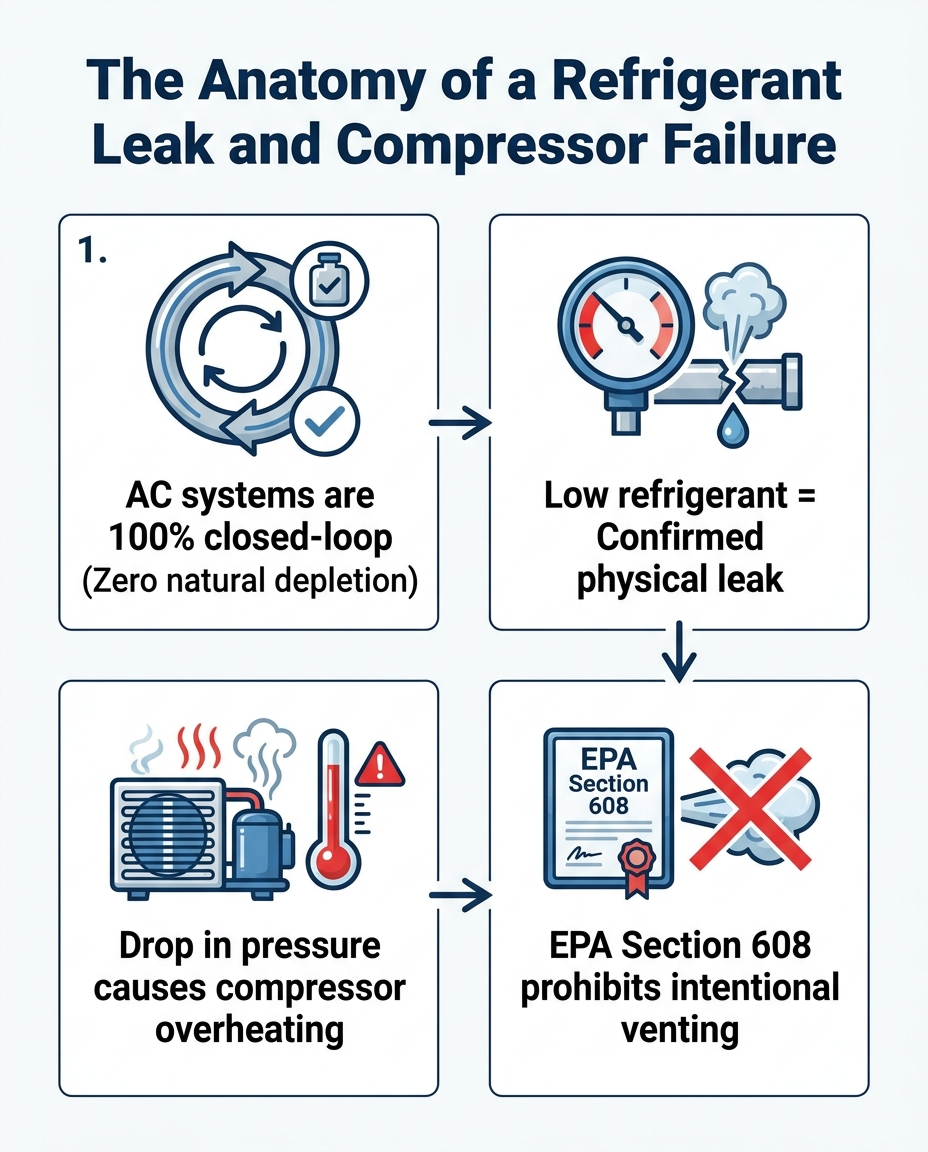
Beyond the mechanical damage to your own equipment, ignoring a physical leak carries significant environmental and legal consequences. The chemicals used to cool your home are highly regulated because of their impact on the atmosphere. Whether your older system uses legacy gases or your newer system uses modern blends, allowing these chemicals to escape into the air is an environmental hazard.
Section 608 of the EPA Clean Air Act strictly regulates the handling, recovery, and intentional venting of these cooling agents. While a homeowner is not directly fined if their system breaks, a technician who knowingly adds gas to a system with a massive, unpatched hole is violating federal regulations. Taking a "top-off only" approach is essentially paying to pollute. The new gas you just paid for will inevitably leak out through the porous evaporator coil and drift into the atmosphere.
Treating proper leak repair as a priority is both a legal compliance issue for the technicians and an environmental responsibility for the homeowner. When you choose to find and fix the hole instead of just ignoring it, you ensure that your system operates cleanly and responsibly for the rest of its lifespan.
Finding a microscopic hole in hundreds of feet of copper tubing is not a guessing game. It requires specialized tools, extensive training, and a methodical approach. Because these systems operate under high pressure, locating the exact point of failure is a precise, scientific procedure. Homeowners should never attempt DIY repairs or use over-the-counter sealants, as these will permanently destroy the internal valves of the system. Here is how licensed professionals track down the problem:
1. Electronic Sniffing: Technicians use highly sensitive electronic leak detectors that are calibrated to sense the specific chemical makeup of the cooling gas. By slowly sweeping this wand over the copper lines and joints, they can detect even microscopic amounts of escaping gas.
2. UV Dye Injection: For leaks that are incredibly small or hidden deep within the unit, technicians can inject a specialized, system-safe ultraviolet dye into the lines. After the system runs for a few days, the technician returns with special UV glasses and a blacklight to visually identify exactly where the dye has seeped out.
3. Nitrogen Pressure Testing: Once the remaining gas is safely recovered, the system is pressurized with dry nitrogen. Nitrogen is safe for the environment and allows the technician to listen for hissing sounds or watch pressure gauges to confirm the system is holding tight.
4. Component Isolation: If the leak is difficult to pinpoint, technicians will isolate different sections of the system. By separating the indoor porous evaporator coil from the outdoor condenser, they can determine exactly which half of the system is failing.
Our team recently responded to a family who had spent almost a week without AC in the intense late summer heat before reaching out; our initial diagnostic work successfully located the failure point, and eventually, a full new system was installed to ensure reliable cooling. This level of thorough diagnostic work is standard across all of our local service areas.
The false economy of a cheap top-off is one of the most expensive traps a homeowner can fall into. When you pay for gas without fixing the hole, you are entering a frustrating cycle. You might pay for a recharge in June, only to find the system blowing warm air again by the time late August cooling demand peaks. Over a few seasons, the amount of money wasted on repeated top-offs easily exceeds the cost of a permanent repair.
A permanent fix does more than just stop the cycle; it restores the energy efficiency of your equipment. An undercharged air conditioner has to run significantly longer to cool the house, which drives up your monthly utility bills. By sealing the leak and charging the system to the manufacturer's exact specifications, your unit will cycle off faster, saving you money every single month. Furthermore, our team at MJB Heating & Cooling refuses to perform band-aid top-offs because we have learned over years of local service that prioritizing honest diagnostics and permanent repairs protects your equipment and your wallet from premature failure.
We understand that a permanent repair can sometimes be an unexpected investment. When a major component needs to be replaced, exploring HVAC financing options can make the process manageable, allowing you to fix the problem correctly the first time without breaking your monthly budget.
If your AC keeps losing its charge, it means there is a physical hole or crack somewhere in the copper lines or coils. Air conditioners are closed-loop systems that never consume or burn off their cooling agents naturally. The continued loss of pressure is a direct symptom of a mechanical failure that requires a professional leak search to locate and repair.
While an AC might technically turn on with a leak, running it in this condition is highly destructive. Low pressure causes the indoor coil to freeze into a block of ice and forces the outdoor compressor to overheat. Operating the system while it is starved of its cooling agent will eventually cause the compressor motor to burn out entirely.
Under EPA Section 608 regulations, it is a violation for technicians to knowingly vent regulated cooling agents into the atmosphere. While topping off a system with a known, massive leak is heavily restricted, professional technicians are required to recommend and perform leak repairs to comply with environmental laws and protect the atmosphere.
When the system runs low, it loses its ability to absorb heat, resulting in vents that blow room-temperature air. The pressure drop alters the entire dynamic of the system, causing the indoor coil to freeze over and the outdoor compressor to run continuously. This constant strain leads to massive energy bills and eventual catastrophic equipment failure.
Professionals use a combination of advanced tools to pinpoint the exact location of the failure. They start with electronic sniffers that detect the chemical makeup of the gas, use UV dye and specialized lights for hard-to-find micro-leaks, and utilize dry nitrogen pressure testing to confirm the integrity of the copper lines before finalizing any repair.
Understanding the danger of adding refrigerant without finding the leak first is the key to extending the life of your air conditioner. By recognizing that your system does not "use up" its charge, you can avoid the costly trap of temporary fixes. A clear, mechanical approach to finding and repairing leaks ensures that your compressor stays protected, giving you reliable, efficient cooling for years to come.


Our A/C stopped working on a Sunday and due to health issues, we needed to find a service company available on a Sunday. I called MJB and left a message on their emergency voice mail. Within 10 minutes Tom Buck called me to hear my description of the symptoms. He was just finishing an appointment in Wichita and would be on his way to my home on the south end of Derby. He arrived within 30 minutes! From start to finish he was the perfect example of what you could ever hope for in an HVAC tech and a human being. His evaluation of our system inside and out was as thorough as I could ever imagine and once he was done with the repair, our system is running as well or better than ever. Well worth the price for the evaluation, parts, and labor. Thank you again Tom for an awesome experience.
Our AC went out during the hottest days of the year, and they were out next day! We have been jerked around by a shoddy home warranty for years. We finally had a chance to pick our own repair people, and MJB came highly recommended. I can see why! I was impressed with the honesty and speed at which they fixed our AC unit!
Our commercial building had a lightening/electrical strike and damaged our 20 ton AC unit. No one could find us a new unit before the end of September. Imagining going all of August and September with no AC in Kansas and working inside near 100 degree temps is less than thrilling. Dale and the team at MJB called around and saved the day. They had us a new unit 5 weeks earlier than other could promise and I now have happy employees. The unit is amazingly quiet, super cold and so much more energy efficient. Thank you for being our super hero!
Came out and installed my new furnace. Was very polite and affordable. They are very acknowledgeable and I highly recommend!
Thank you very much. We had our 1st warm night in 3weeks. MJB took the time and effort to find the real problem. And the employees were kind and thoughtful and explained things very well. I cannot thank you and all of MJB. Will recommend you highly. Thanks again Marjorie Herman Oxford Kansas
We had a new system installed and I was so impressed with how quick they were in come out and install it, in the middle of a hot summer day. They were so friendly & very professional. I had a small problem with a weird sound and they came over immediately and fixed it. Love them!