


.avif)





Blogs
Stay updated with our latest blog posts.
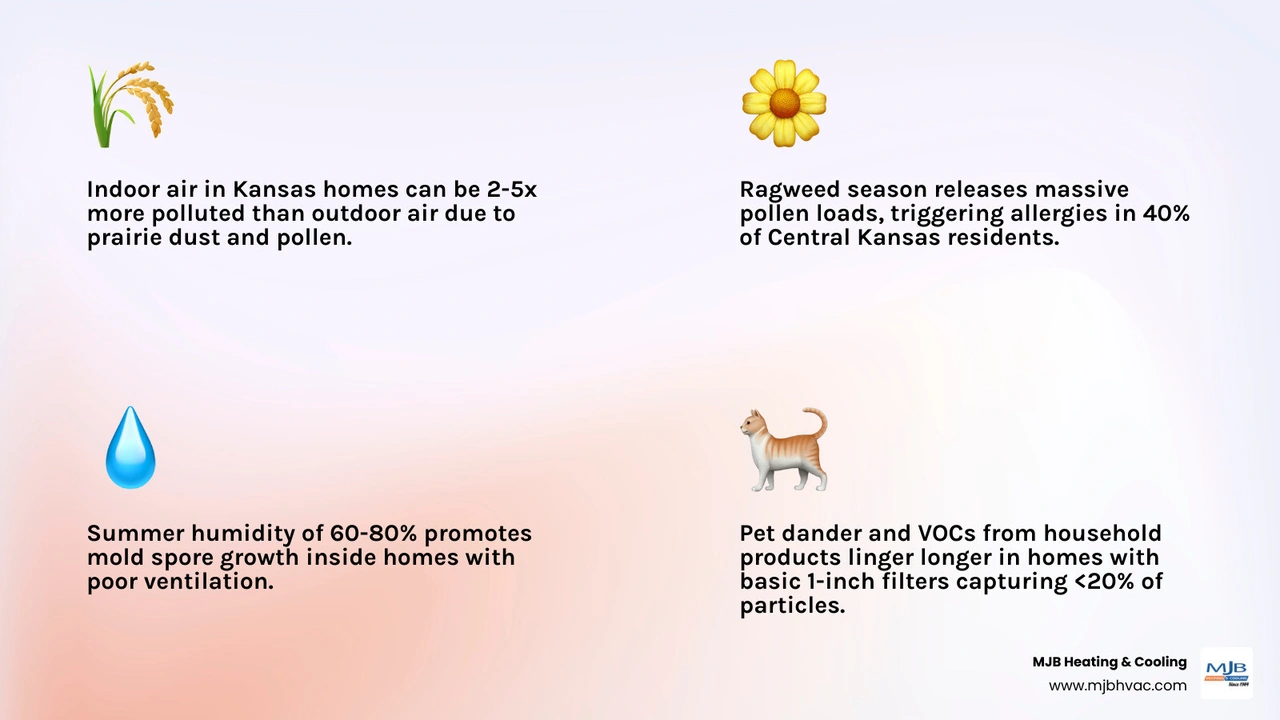
When it comes to air purification options for Kansas homes, most homeowners are surprised to learn that the air inside their house can be anywhere from two to five times more polluted than the air outside — according to the EPA. In Central Kansas, that problem gets worse. Prairie dust, agricultural pollen, ragweed season, and summer humidity levels that regularly climb between 60 and 80 percent all combine to create a serious indoor air quality challenge that standard furnace filters simply aren't built to handle. In fact, those basic one-inch filters catch less than 20 percent of airborne particles.
Here's a quick overview of the main air purification options available for Kansas homes:
| System Type | Best For | Key Benefit |
|---|---|---|
| HEPA / Media Filters | Dust, pollen, dander, smoke | Captures 99.97% of particles ≥0.3 microns |
| UV Germicidal Lights | Mold, bacteria, viruses | Disrupts DNA of microorganisms in ductwork |
| Activated Carbon Filters | Odors, VOCs, chemicals | Adsorbs gases standard filters miss |
| Bipolar Ionization | Fine particles, allergens | Clumps particles so they fall or get filtered |
| Whole-Home HEPA Systems | Whole-house coverage | Integrates with HVAC for every room |
| Portable Air Purifiers | Single-room use | Lower upfront cost, limited coverage |
Whether you're dealing with allergy flare-ups, musty basement smells, or just wondering why your surfaces are always dusty no matter how often you clean, this guide breaks down exactly what your options are — and how to choose the right one for your home and HVAC setup.

Living in the Wichita metro area means dealing with a unique environmental cocktail. Our geography puts us right in the path of prairie dust from the surrounding plains and agricultural runoff during the planting and harvest seasons. If you've ever noticed your car covered in a fine yellow film in the spring, imagine what that’s doing to your lungs when it makes its way inside.
In Central Kansas, we face a "perfect storm" of air quality triggers. Every September, regions like Wichita and Derby rank among the highest in the nation for ragweed pollen counts. When you combine that with summer humidity that feeds mold growth in dark, cool ductwork, it’s no wonder so many of our neighbors struggle with respiratory issues. Understanding how indoor air quality affects your health is the first step toward reclaiming your home’s comfort.
Beyond the natural allergens, we also have to consider Volatile Organic Compounds (VOCs). These are gases emitted from common household items like paints, cleaning supplies, and even new furniture. In a tightly sealed, energy-efficient home in Andover or Maize, these pollutants have nowhere to go, circulating through your vents over and over again.
When exploring air purification options for Kansas homes, the first big decision is whether to go with a whole-home system or a fleet of portable units. While a portable air purifier you buy at a big-box store might seem convenient, it’s often like trying to cool a whole house with a single desk fan.
Whole-home systems are integrated directly into your existing HVAC ductwork. This means every time your fan runs, the air in every single room—from the basement to the upstairs bedrooms—is being treated. Portable units, on the other hand, only clean the air in a small radius around the device. To get the same coverage as a whole-home system, you’d need a unit in every room, which means multiple filters to change, multiple plugs taking up space, and a lot of extra noise.
| Feature | Whole-Home Systems | Portable Air Purifiers |
|---|---|---|
| Coverage Area | Entire house (every room with a vent) | Single room or small area |
| Integration | Hidden inside HVAC ductwork | Visible floor units with cords |
| Maintenance | Service every 6–12 months | Filter changes every 2–3 months |
| Noise Level | Virtually silent (operates with HVAC) | Can be loud on high settings |
| Effectiveness | High; treats air at the source | Variable; depends on placement |
For many, the question is: is a whole house air purifier worth it? If you value quiet operation, lower long-term maintenance, and comprehensive protection for your family, the answer is usually a resounding yes.
Not all air purifiers work the same way. In fact, we often recommend a "layered" approach because different technologies target different pollutants. When we install these systems in homes across Goddard or Park City, we first look at the "engineering" of your air. This includes checking the static pressure of your system.
Adding a high-efficiency filter is great, but if it’s too restrictive, it can strain your blower motor and lead to expensive repairs. We make sure your system has the blower capacity to handle advanced filtration and that your ductwork is properly sealed with mastic to prevent "dirty" air from being sucked in from the attic or crawlspace. Understanding how your HVAC system affects the air you breathe helps ensure we find a solution that protects both your health and your equipment.
If your primary concern is dust, pet dander, or smoke from regional agricultural burns, mechanical filtration is your best friend. Standard filters are rated on the MERV (Minimum Efficiency Reporting Value) scale. While most homes use a MERV 8 filter, upgrading to a MERV 13-16 media filter can trap over 99% of airborne particles down to submicron sizes.
For the ultimate protection, True HEPA (High-Efficiency Particulate Air) systems are the gold standard. These are designed to capture 99.97% of particles as small as 0.3 microns—that’s about 300 times smaller than a human hair! This level of filtration is particularly effective for those in whole house air purification Andover KS who suffer from severe asthma or allergies. You can learn more about how air purification removes allergens, dust, and pollutants to see which MERV rating fits your lifestyle.
Filters are great at catching "stuff," but what about living organisms like bacteria and viruses? That’s where UV lights and ionization come in.
Systems like the REME HALO use advanced oxidation technology to send out ionized hydroperoxides—a process that occurs naturally in the earth's atmosphere. This technology doesn't just wait for the air to pass through a filter; it actively "seeks out" pollutants in the air and on surfaces. It causes microscopic particles to clump together (ionization), making them heavy enough to fall out of the air or large enough to be caught by your filter.
UV germicidal lights, usually installed near the AC evaporator coil, use UV-C light to scramble the DNA of mold and viruses, preventing them from reproducing. This is a game-changer for whole house air purification Haysville KS residents dealing with musty odors or damp basements. Because air purification eliminates summer allergens and biological growth, it also keeps your HVAC coils cleaner, which can actually improve the efficiency and lifespan of your air conditioner.
How do you know if you actually need to look into air purification options for Kansas homes? Sometimes the signs are obvious, and other times they’re subtle.
Whether you're looking for ways air purification removes indoor pollutants or exploring how ways ductless AC improves indoor air for a specific room or addition, there is always a solution to stop the sneezing.
One of the biggest benefits of a whole-home system is the simplified maintenance. Instead of cleaning a tiny pre-filter on a portable unit every two weeks, most whole-home media filters only need to be replaced every 6 to 12 months, depending on your home’s dust load.
For UV systems, the maintenance is even easier. UV-C bulbs typically have a lifecycle of 12 to 24 months. We usually recommend timing these replacements with your annual HVAC tune-up. During these visits, we can perform system diagnostics to ensure the air purifier is drawing the correct voltage and that the airflow is still balanced. Keeping your system maintained ensures that the "hospital-grade" protection you invested in continues to perform at its peak for years to come.
For most systems, an annual check-up is perfect. Media filters (the thick, accordion-style ones) usually last 6 to 12 months. If you have pets or live near a dirt road in a place like Towanda or Mulvane, you might want to check them every 4 to 6 months. UV bulbs generally need replacement every year or two to maintain their germicidal strength.
Yes, but you need the right "tool" for the job. Standard dust filters won't do much for smells. For odor control, we recommend systems that include activated carbon or advanced oxidation (like the REME HALO). These technologies adsorb or neutralize the molecules that cause odors, rather than just masking them with scents.
Most whole-home air purifiers are incredibly energy-efficient. Many use less electricity than a standard 60-watt light bulb. In fact, by keeping your HVAC coils free of mold and dust buildup, a purifier can actually help your system run more efficiently, potentially saving you money on your cooling costs over time.
At MJB Heating & Cooling, we’ve been a part of the Central Kansas community since 1984. As a family-owned business founded right here in Derby, KS, we understand the local climate and the specific air quality challenges our neighbors face. We pride ourselves on quality workmanship and an honest business approach—we won't sell you a system you don't need, but we will help you find the one that makes your home a healthier place to live.
From Wichita and Andover to El Dorado and Winfield, we are here to help you breathe easier. If you’re ready to explore whole house air purification Derby KS or need an assessment for your home in any of our surrounding service areas, we’re just a phone call away. Let’s clear the air and get your home back to being the sanctuary it should be.
When it comes to air purification options for Kansas homes, most homeowners are surprised to learn that the air inside their house can be anywhere from two to five times more polluted than the air outside — according to the EPA. In Central Kansas, that problem gets worse. Prairie dust, agricultural pollen, ragweed season, and summer humidity levels that regularly climb between 60 and 80 percent all combine to create a serious indoor air quality challenge that standard furnace filters simply aren't built to handle. In fact, those basic one-inch filters catch less than 20 percent of airborne particles.
Here's a quick overview of the main air purification options available for Kansas homes:
| System Type | Best For | Key Benefit |
|---|---|---|
| HEPA / Media Filters | Dust, pollen, dander, smoke | Captures 99.97% of particles ≥0.3 microns |
| UV Germicidal Lights | Mold, bacteria, viruses | Disrupts DNA of microorganisms in ductwork |
| Activated Carbon Filters | Odors, VOCs, chemicals | Adsorbs gases standard filters miss |
| Bipolar Ionization | Fine particles, allergens | Clumps particles so they fall or get filtered |
| Whole-Home HEPA Systems | Whole-house coverage | Integrates with HVAC for every room |
| Portable Air Purifiers | Single-room use | Lower upfront cost, limited coverage |
Whether you're dealing with allergy flare-ups, musty basement smells, or just wondering why your surfaces are always dusty no matter how often you clean, this guide breaks down exactly what your options are — and how to choose the right one for your home and HVAC setup.
Living in the Wichita metro area means dealing with a unique environmental cocktail. Our geography puts us right in the path of prairie dust from the surrounding plains and agricultural runoff during the planting and harvest seasons. If you've ever noticed your car covered in a fine yellow film in the spring, imagine what that’s doing to your lungs when it makes its way inside.
In Central Kansas, we face a "perfect storm" of air quality triggers. Every September, regions like Wichita and Derby rank among the highest in the nation for ragweed pollen counts. When you combine that with summer humidity that feeds mold growth in dark, cool ductwork, it’s no wonder so many of our neighbors struggle with respiratory issues. Understanding how indoor air quality affects your health is the first step toward reclaiming your home’s comfort.
Beyond the natural allergens, we also have to consider Volatile Organic Compounds (VOCs). These are gases emitted from common household items like paints, cleaning supplies, and even new furniture. In a tightly sealed, energy-efficient home in Andover or Maize, these pollutants have nowhere to go, circulating through your vents over and over again.
When exploring air purification options for Kansas homes, the first big decision is whether to go with a whole-home system or a fleet of portable units. While a portable air purifier you buy at a big-box store might seem convenient, it’s often like trying to cool a whole house with a single desk fan.
Whole-home systems are integrated directly into your existing HVAC ductwork. This means every time your fan runs, the air in every single room—from the basement to the upstairs bedrooms—is being treated. Portable units, on the other hand, only clean the air in a small radius around the device. To get the same coverage as a whole-home system, you’d need a unit in every room, which means multiple filters to change, multiple plugs taking up space, and a lot of extra noise.
| Feature | Whole-Home Systems | Portable Air Purifiers |
|---|---|---|
| Coverage Area | Entire house (every room with a vent) | Single room or small area |
| Integration | Hidden inside HVAC ductwork | Visible floor units with cords |
| Maintenance | Service every 6–12 months | Filter changes every 2–3 months |
| Noise Level | Virtually silent (operates with HVAC) | Can be loud on high settings |
| Effectiveness | High; treats air at the source | Variable; depends on placement |
For many, the question is: is a whole house air purifier worth it? If you value quiet operation, lower long-term maintenance, and comprehensive protection for your family, the answer is usually a resounding yes.
Not all air purifiers work the same way. In fact, we often recommend a "layered" approach because different technologies target different pollutants. When we install these systems in homes across Goddard or Park City, we first look at the "engineering" of your air. This includes checking the static pressure of your system.
Adding a high-efficiency filter is great, but if it’s too restrictive, it can strain your blower motor and lead to expensive repairs. We make sure your system has the blower capacity to handle advanced filtration and that your ductwork is properly sealed with mastic to prevent "dirty" air from being sucked in from the attic or crawlspace. Understanding how your HVAC system affects the air you breathe helps ensure we find a solution that protects both your health and your equipment.
If your primary concern is dust, pet dander, or smoke from regional agricultural burns, mechanical filtration is your best friend. Standard filters are rated on the MERV (Minimum Efficiency Reporting Value) scale. While most homes use a MERV 8 filter, upgrading to a MERV 13-16 media filter can trap over 99% of airborne particles down to submicron sizes.
For the ultimate protection, True HEPA (High-Efficiency Particulate Air) systems are the gold standard. These are designed to capture 99.97% of particles as small as 0.3 microns—that’s about 300 times smaller than a human hair! This level of filtration is particularly effective for those in whole house air purification Andover KS who suffer from severe asthma or allergies. You can learn more about how air purification removes allergens, dust, and pollutants to see which MERV rating fits your lifestyle.
Filters are great at catching "stuff," but what about living organisms like bacteria and viruses? That’s where UV lights and ionization come in.
Systems like the REME HALO use advanced oxidation technology to send out ionized hydroperoxides—a process that occurs naturally in the earth's atmosphere. This technology doesn't just wait for the air to pass through a filter; it actively "seeks out" pollutants in the air and on surfaces. It causes microscopic particles to clump together (ionization), making them heavy enough to fall out of the air or large enough to be caught by your filter.
UV germicidal lights, usually installed near the AC evaporator coil, use UV-C light to scramble the DNA of mold and viruses, preventing them from reproducing. This is a game-changer for whole house air purification Haysville KS residents dealing with musty odors or damp basements. Because air purification eliminates summer allergens and biological growth, it also keeps your HVAC coils cleaner, which can actually improve the efficiency and lifespan of your air conditioner.
How do you know if you actually need to look into air purification options for Kansas homes? Sometimes the signs are obvious, and other times they’re subtle.
Whether you're looking for ways air purification removes indoor pollutants or exploring how ways ductless AC improves indoor air for a specific room or addition, there is always a solution to stop the sneezing.
One of the biggest benefits of a whole-home system is the simplified maintenance. Instead of cleaning a tiny pre-filter on a portable unit every two weeks, most whole-home media filters only need to be replaced every 6 to 12 months, depending on your home’s dust load.
For UV systems, the maintenance is even easier. UV-C bulbs typically have a lifecycle of 12 to 24 months. We usually recommend timing these replacements with your annual HVAC tune-up. During these visits, we can perform system diagnostics to ensure the air purifier is drawing the correct voltage and that the airflow is still balanced. Keeping your system maintained ensures that the "hospital-grade" protection you invested in continues to perform at its peak for years to come.
For most systems, an annual check-up is perfect. Media filters (the thick, accordion-style ones) usually last 6 to 12 months. If you have pets or live near a dirt road in a place like Towanda or Mulvane, you might want to check them every 4 to 6 months. UV bulbs generally need replacement every year or two to maintain their germicidal strength.
Yes, but you need the right "tool" for the job. Standard dust filters won't do much for smells. For odor control, we recommend systems that include activated carbon or advanced oxidation (like the REME HALO). These technologies adsorb or neutralize the molecules that cause odors, rather than just masking them with scents.
Most whole-home air purifiers are incredibly energy-efficient. Many use less electricity than a standard 60-watt light bulb. In fact, by keeping your HVAC coils free of mold and dust buildup, a purifier can actually help your system run more efficiently, potentially saving you money on your cooling costs over time.
At MJB Heating & Cooling, we’ve been a part of the Central Kansas community since 1984. As a family-owned business founded right here in Derby, KS, we understand the local climate and the specific air quality challenges our neighbors face. We pride ourselves on quality workmanship and an honest business approach—we won't sell you a system you don't need, but we will help you find the one that makes your home a healthier place to live.
From Wichita and Andover to El Dorado and Winfield, we are here to help you breathe easier. If you’re ready to explore whole house air purification Derby KS or need an assessment for your home in any of our surrounding service areas, we’re just a phone call away. Let’s clear the air and get your home back to being the sanctuary it should be.
When it comes to air purification options for Kansas homes, most homeowners are surprised to learn that the air inside their house can be anywhere from two to five times more polluted than the air outside — according to the EPA. In Central Kansas, that problem gets worse. Prairie dust, agricultural pollen, ragweed season, and summer humidity levels that regularly climb between 60 and 80 percent all combine to create a serious indoor air quality challenge that standard furnace filters simply aren't built to handle. In fact, those basic one-inch filters catch less than 20 percent of airborne particles.
Here's a quick overview of the main air purification options available for Kansas homes:
| System Type | Best For | Key Benefit |
|---|---|---|
| HEPA / Media Filters | Dust, pollen, dander, smoke | Captures 99.97% of particles ≥0.3 microns |
| UV Germicidal Lights | Mold, bacteria, viruses | Disrupts DNA of microorganisms in ductwork |
| Activated Carbon Filters | Odors, VOCs, chemicals | Adsorbs gases standard filters miss |
| Bipolar Ionization | Fine particles, allergens | Clumps particles so they fall or get filtered |
| Whole-Home HEPA Systems | Whole-house coverage | Integrates with HVAC for every room |
| Portable Air Purifiers | Single-room use | Lower upfront cost, limited coverage |
Whether you're dealing with allergy flare-ups, musty basement smells, or just wondering why your surfaces are always dusty no matter how often you clean, this guide breaks down exactly what your options are — and how to choose the right one for your home and HVAC setup.
Living in the Wichita metro area means dealing with a unique environmental cocktail. Our geography puts us right in the path of prairie dust from the surrounding plains and agricultural runoff during the planting and harvest seasons. If you've ever noticed your car covered in a fine yellow film in the spring, imagine what that’s doing to your lungs when it makes its way inside.
In Central Kansas, we face a "perfect storm" of air quality triggers. Every September, regions like Wichita and Derby rank among the highest in the nation for ragweed pollen counts. When you combine that with summer humidity that feeds mold growth in dark, cool ductwork, it’s no wonder so many of our neighbors struggle with respiratory issues. Understanding how indoor air quality affects your health is the first step toward reclaiming your home’s comfort.
Beyond the natural allergens, we also have to consider Volatile Organic Compounds (VOCs). These are gases emitted from common household items like paints, cleaning supplies, and even new furniture. In a tightly sealed, energy-efficient home in Andover or Maize, these pollutants have nowhere to go, circulating through your vents over and over again.
When exploring air purification options for Kansas homes, the first big decision is whether to go with a whole-home system or a fleet of portable units. While a portable air purifier you buy at a big-box store might seem convenient, it’s often like trying to cool a whole house with a single desk fan.
Whole-home systems are integrated directly into your existing HVAC ductwork. This means every time your fan runs, the air in every single room—from the basement to the upstairs bedrooms—is being treated. Portable units, on the other hand, only clean the air in a small radius around the device. To get the same coverage as a whole-home system, you’d need a unit in every room, which means multiple filters to change, multiple plugs taking up space, and a lot of extra noise.
| Feature | Whole-Home Systems | Portable Air Purifiers |
|---|---|---|
| Coverage Area | Entire house (every room with a vent) | Single room or small area |
| Integration | Hidden inside HVAC ductwork | Visible floor units with cords |
| Maintenance | Service every 6–12 months | Filter changes every 2–3 months |
| Noise Level | Virtually silent (operates with HVAC) | Can be loud on high settings |
| Effectiveness | High; treats air at the source | Variable; depends on placement |
For many, the question is: is a whole house air purifier worth it? If you value quiet operation, lower long-term maintenance, and comprehensive protection for your family, the answer is usually a resounding yes.
Not all air purifiers work the same way. In fact, we often recommend a "layered" approach because different technologies target different pollutants. When we install these systems in homes across Goddard or Park City, we first look at the "engineering" of your air. This includes checking the static pressure of your system.
Adding a high-efficiency filter is great, but if it’s too restrictive, it can strain your blower motor and lead to expensive repairs. We make sure your system has the blower capacity to handle advanced filtration and that your ductwork is properly sealed with mastic to prevent "dirty" air from being sucked in from the attic or crawlspace. Understanding how your HVAC system affects the air you breathe helps ensure we find a solution that protects both your health and your equipment.
If your primary concern is dust, pet dander, or smoke from regional agricultural burns, mechanical filtration is your best friend. Standard filters are rated on the MERV (Minimum Efficiency Reporting Value) scale. While most homes use a MERV 8 filter, upgrading to a MERV 13-16 media filter can trap over 99% of airborne particles down to submicron sizes.
For the ultimate protection, True HEPA (High-Efficiency Particulate Air) systems are the gold standard. These are designed to capture 99.97% of particles as small as 0.3 microns—that’s about 300 times smaller than a human hair! This level of filtration is particularly effective for those in whole house air purification Andover KS who suffer from severe asthma or allergies. You can learn more about how air purification removes allergens, dust, and pollutants to see which MERV rating fits your lifestyle.
Filters are great at catching "stuff," but what about living organisms like bacteria and viruses? That’s where UV lights and ionization come in.
Systems like the REME HALO use advanced oxidation technology to send out ionized hydroperoxides—a process that occurs naturally in the earth's atmosphere. This technology doesn't just wait for the air to pass through a filter; it actively "seeks out" pollutants in the air and on surfaces. It causes microscopic particles to clump together (ionization), making them heavy enough to fall out of the air or large enough to be caught by your filter.
UV germicidal lights, usually installed near the AC evaporator coil, use UV-C light to scramble the DNA of mold and viruses, preventing them from reproducing. This is a game-changer for whole house air purification Haysville KS residents dealing with musty odors or damp basements. Because air purification eliminates summer allergens and biological growth, it also keeps your HVAC coils cleaner, which can actually improve the efficiency and lifespan of your air conditioner.
How do you know if you actually need to look into air purification options for Kansas homes? Sometimes the signs are obvious, and other times they’re subtle.
Whether you're looking for ways air purification removes indoor pollutants or exploring how ways ductless AC improves indoor air for a specific room or addition, there is always a solution to stop the sneezing.
One of the biggest benefits of a whole-home system is the simplified maintenance. Instead of cleaning a tiny pre-filter on a portable unit every two weeks, most whole-home media filters only need to be replaced every 6 to 12 months, depending on your home’s dust load.
For UV systems, the maintenance is even easier. UV-C bulbs typically have a lifecycle of 12 to 24 months. We usually recommend timing these replacements with your annual HVAC tune-up. During these visits, we can perform system diagnostics to ensure the air purifier is drawing the correct voltage and that the airflow is still balanced. Keeping your system maintained ensures that the "hospital-grade" protection you invested in continues to perform at its peak for years to come.
For most systems, an annual check-up is perfect. Media filters (the thick, accordion-style ones) usually last 6 to 12 months. If you have pets or live near a dirt road in a place like Towanda or Mulvane, you might want to check them every 4 to 6 months. UV bulbs generally need replacement every year or two to maintain their germicidal strength.
Yes, but you need the right "tool" for the job. Standard dust filters won't do much for smells. For odor control, we recommend systems that include activated carbon or advanced oxidation (like the REME HALO). These technologies adsorb or neutralize the molecules that cause odors, rather than just masking them with scents.
Most whole-home air purifiers are incredibly energy-efficient. Many use less electricity than a standard 60-watt light bulb. In fact, by keeping your HVAC coils free of mold and dust buildup, a purifier can actually help your system run more efficiently, potentially saving you money on your cooling costs over time.
At MJB Heating & Cooling, we’ve been a part of the Central Kansas community since 1984. As a family-owned business founded right here in Derby, KS, we understand the local climate and the specific air quality challenges our neighbors face. We pride ourselves on quality workmanship and an honest business approach—we won't sell you a system you don't need, but we will help you find the one that makes your home a healthier place to live.
From Wichita and Andover to El Dorado and Winfield, we are here to help you breathe easier. If you’re ready to explore whole house air purification Derby KS or need an assessment for your home in any of our surrounding service areas, we’re just a phone call away. Let’s clear the air and get your home back to being the sanctuary it should be.

When it comes to air purification options for Kansas homes, most homeowners are surprised to learn that the air inside their house can be anywhere from two to five times more polluted than the air outside — according to the EPA. In Central Kansas, that problem gets worse. Prairie dust, agricultural pollen, ragweed season, and summer humidity levels that regularly climb between 60 and 80 percent all combine to create a serious indoor air quality challenge that standard furnace filters simply aren't built to handle. In fact, those basic one-inch filters catch less than 20 percent of airborne particles.
Here's a quick overview of the main air purification options available for Kansas homes:
| System Type | Best For | Key Benefit |
|---|---|---|
| HEPA / Media Filters | Dust, pollen, dander, smoke | Captures 99.97% of particles ≥0.3 microns |
| UV Germicidal Lights | Mold, bacteria, viruses | Disrupts DNA of microorganisms in ductwork |
| Activated Carbon Filters | Odors, VOCs, chemicals | Adsorbs gases standard filters miss |
| Bipolar Ionization | Fine particles, allergens | Clumps particles so they fall or get filtered |
| Whole-Home HEPA Systems | Whole-house coverage | Integrates with HVAC for every room |
| Portable Air Purifiers | Single-room use | Lower upfront cost, limited coverage |
Whether you're dealing with allergy flare-ups, musty basement smells, or just wondering why your surfaces are always dusty no matter how often you clean, this guide breaks down exactly what your options are — and how to choose the right one for your home and HVAC setup.
Living in the Wichita metro area means dealing with a unique environmental cocktail. Our geography puts us right in the path of prairie dust from the surrounding plains and agricultural runoff during the planting and harvest seasons. If you've ever noticed your car covered in a fine yellow film in the spring, imagine what that’s doing to your lungs when it makes its way inside.
In Central Kansas, we face a "perfect storm" of air quality triggers. Every September, regions like Wichita and Derby rank among the highest in the nation for ragweed pollen counts. When you combine that with summer humidity that feeds mold growth in dark, cool ductwork, it’s no wonder so many of our neighbors struggle with respiratory issues. Understanding how indoor air quality affects your health is the first step toward reclaiming your home’s comfort.
Beyond the natural allergens, we also have to consider Volatile Organic Compounds (VOCs). These are gases emitted from common household items like paints, cleaning supplies, and even new furniture. In a tightly sealed, energy-efficient home in Andover or Maize, these pollutants have nowhere to go, circulating through your vents over and over again.
When exploring air purification options for Kansas homes, the first big decision is whether to go with a whole-home system or a fleet of portable units. While a portable air purifier you buy at a big-box store might seem convenient, it’s often like trying to cool a whole house with a single desk fan.
Whole-home systems are integrated directly into your existing HVAC ductwork. This means every time your fan runs, the air in every single room—from the basement to the upstairs bedrooms—is being treated. Portable units, on the other hand, only clean the air in a small radius around the device. To get the same coverage as a whole-home system, you’d need a unit in every room, which means multiple filters to change, multiple plugs taking up space, and a lot of extra noise.
| Feature | Whole-Home Systems | Portable Air Purifiers |
|---|---|---|
| Coverage Area | Entire house (every room with a vent) | Single room or small area |
| Integration | Hidden inside HVAC ductwork | Visible floor units with cords |
| Maintenance | Service every 6–12 months | Filter changes every 2–3 months |
| Noise Level | Virtually silent (operates with HVAC) | Can be loud on high settings |
| Effectiveness | High; treats air at the source | Variable; depends on placement |
For many, the question is: is a whole house air purifier worth it? If you value quiet operation, lower long-term maintenance, and comprehensive protection for your family, the answer is usually a resounding yes.
Not all air purifiers work the same way. In fact, we often recommend a "layered" approach because different technologies target different pollutants. When we install these systems in homes across Goddard or Park City, we first look at the "engineering" of your air. This includes checking the static pressure of your system.
Adding a high-efficiency filter is great, but if it’s too restrictive, it can strain your blower motor and lead to expensive repairs. We make sure your system has the blower capacity to handle advanced filtration and that your ductwork is properly sealed with mastic to prevent "dirty" air from being sucked in from the attic or crawlspace. Understanding how your HVAC system affects the air you breathe helps ensure we find a solution that protects both your health and your equipment.
If your primary concern is dust, pet dander, or smoke from regional agricultural burns, mechanical filtration is your best friend. Standard filters are rated on the MERV (Minimum Efficiency Reporting Value) scale. While most homes use a MERV 8 filter, upgrading to a MERV 13-16 media filter can trap over 99% of airborne particles down to submicron sizes.
For the ultimate protection, True HEPA (High-Efficiency Particulate Air) systems are the gold standard. These are designed to capture 99.97% of particles as small as 0.3 microns—that’s about 300 times smaller than a human hair! This level of filtration is particularly effective for those in whole house air purification Andover KS who suffer from severe asthma or allergies. You can learn more about how air purification removes allergens, dust, and pollutants to see which MERV rating fits your lifestyle.
Filters are great at catching "stuff," but what about living organisms like bacteria and viruses? That’s where UV lights and ionization come in.
Systems like the REME HALO use advanced oxidation technology to send out ionized hydroperoxides—a process that occurs naturally in the earth's atmosphere. This technology doesn't just wait for the air to pass through a filter; it actively "seeks out" pollutants in the air and on surfaces. It causes microscopic particles to clump together (ionization), making them heavy enough to fall out of the air or large enough to be caught by your filter.
UV germicidal lights, usually installed near the AC evaporator coil, use UV-C light to scramble the DNA of mold and viruses, preventing them from reproducing. This is a game-changer for whole house air purification Haysville KS residents dealing with musty odors or damp basements. Because air purification eliminates summer allergens and biological growth, it also keeps your HVAC coils cleaner, which can actually improve the efficiency and lifespan of your air conditioner.
How do you know if you actually need to look into air purification options for Kansas homes? Sometimes the signs are obvious, and other times they’re subtle.
Whether you're looking for ways air purification removes indoor pollutants or exploring how ways ductless AC improves indoor air for a specific room or addition, there is always a solution to stop the sneezing.
One of the biggest benefits of a whole-home system is the simplified maintenance. Instead of cleaning a tiny pre-filter on a portable unit every two weeks, most whole-home media filters only need to be replaced every 6 to 12 months, depending on your home’s dust load.
For UV systems, the maintenance is even easier. UV-C bulbs typically have a lifecycle of 12 to 24 months. We usually recommend timing these replacements with your annual HVAC tune-up. During these visits, we can perform system diagnostics to ensure the air purifier is drawing the correct voltage and that the airflow is still balanced. Keeping your system maintained ensures that the "hospital-grade" protection you invested in continues to perform at its peak for years to come.
For most systems, an annual check-up is perfect. Media filters (the thick, accordion-style ones) usually last 6 to 12 months. If you have pets or live near a dirt road in a place like Towanda or Mulvane, you might want to check them every 4 to 6 months. UV bulbs generally need replacement every year or two to maintain their germicidal strength.
Yes, but you need the right "tool" for the job. Standard dust filters won't do much for smells. For odor control, we recommend systems that include activated carbon or advanced oxidation (like the REME HALO). These technologies adsorb or neutralize the molecules that cause odors, rather than just masking them with scents.
Most whole-home air purifiers are incredibly energy-efficient. Many use less electricity than a standard 60-watt light bulb. In fact, by keeping your HVAC coils free of mold and dust buildup, a purifier can actually help your system run more efficiently, potentially saving you money on your cooling costs over time.
At MJB Heating & Cooling, we’ve been a part of the Central Kansas community since 1984. As a family-owned business founded right here in Derby, KS, we understand the local climate and the specific air quality challenges our neighbors face. We pride ourselves on quality workmanship and an honest business approach—we won't sell you a system you don't need, but we will help you find the one that makes your home a healthier place to live.
From Wichita and Andover to El Dorado and Winfield, we are here to help you breathe easier. If you’re ready to explore whole house air purification Derby KS or need an assessment for your home in any of our surrounding service areas, we’re just a phone call away. Let’s clear the air and get your home back to being the sanctuary it should be.
When it comes to air purification options for Kansas homes, most homeowners are surprised to learn that the air inside their house can be anywhere from two to five times more polluted than the air outside — according to the EPA. In Central Kansas, that problem gets worse. Prairie dust, agricultural pollen, ragweed season, and summer humidity levels that regularly climb between 60 and 80 percent all combine to create a serious indoor air quality challenge that standard furnace filters simply aren't built to handle. In fact, those basic one-inch filters catch less than 20 percent of airborne particles.
Here's a quick overview of the main air purification options available for Kansas homes:
| System Type | Best For | Key Benefit |
|---|---|---|
| HEPA / Media Filters | Dust, pollen, dander, smoke | Captures 99.97% of particles ≥0.3 microns |
| UV Germicidal Lights | Mold, bacteria, viruses | Disrupts DNA of microorganisms in ductwork |
| Activated Carbon Filters | Odors, VOCs, chemicals | Adsorbs gases standard filters miss |
| Bipolar Ionization | Fine particles, allergens | Clumps particles so they fall or get filtered |
| Whole-Home HEPA Systems | Whole-house coverage | Integrates with HVAC for every room |
| Portable Air Purifiers | Single-room use | Lower upfront cost, limited coverage |
Whether you're dealing with allergy flare-ups, musty basement smells, or just wondering why your surfaces are always dusty no matter how often you clean, this guide breaks down exactly what your options are — and how to choose the right one for your home and HVAC setup.
Living in the Wichita metro area means dealing with a unique environmental cocktail. Our geography puts us right in the path of prairie dust from the surrounding plains and agricultural runoff during the planting and harvest seasons. If you've ever noticed your car covered in a fine yellow film in the spring, imagine what that’s doing to your lungs when it makes its way inside.
In Central Kansas, we face a "perfect storm" of air quality triggers. Every September, regions like Wichita and Derby rank among the highest in the nation for ragweed pollen counts. When you combine that with summer humidity that feeds mold growth in dark, cool ductwork, it’s no wonder so many of our neighbors struggle with respiratory issues. Understanding how indoor air quality affects your health is the first step toward reclaiming your home’s comfort.
Beyond the natural allergens, we also have to consider Volatile Organic Compounds (VOCs). These are gases emitted from common household items like paints, cleaning supplies, and even new furniture. In a tightly sealed, energy-efficient home in Andover or Maize, these pollutants have nowhere to go, circulating through your vents over and over again.
When exploring air purification options for Kansas homes, the first big decision is whether to go with a whole-home system or a fleet of portable units. While a portable air purifier you buy at a big-box store might seem convenient, it’s often like trying to cool a whole house with a single desk fan.
Whole-home systems are integrated directly into your existing HVAC ductwork. This means every time your fan runs, the air in every single room—from the basement to the upstairs bedrooms—is being treated. Portable units, on the other hand, only clean the air in a small radius around the device. To get the same coverage as a whole-home system, you’d need a unit in every room, which means multiple filters to change, multiple plugs taking up space, and a lot of extra noise.
| Feature | Whole-Home Systems | Portable Air Purifiers |
|---|---|---|
| Coverage Area | Entire house (every room with a vent) | Single room or small area |
| Integration | Hidden inside HVAC ductwork | Visible floor units with cords |
| Maintenance | Service every 6–12 months | Filter changes every 2–3 months |
| Noise Level | Virtually silent (operates with HVAC) | Can be loud on high settings |
| Effectiveness | High; treats air at the source | Variable; depends on placement |
For many, the question is: is a whole house air purifier worth it? If you value quiet operation, lower long-term maintenance, and comprehensive protection for your family, the answer is usually a resounding yes.
Not all air purifiers work the same way. In fact, we often recommend a "layered" approach because different technologies target different pollutants. When we install these systems in homes across Goddard or Park City, we first look at the "engineering" of your air. This includes checking the static pressure of your system.
Adding a high-efficiency filter is great, but if it’s too restrictive, it can strain your blower motor and lead to expensive repairs. We make sure your system has the blower capacity to handle advanced filtration and that your ductwork is properly sealed with mastic to prevent "dirty" air from being sucked in from the attic or crawlspace. Understanding how your HVAC system affects the air you breathe helps ensure we find a solution that protects both your health and your equipment.
If your primary concern is dust, pet dander, or smoke from regional agricultural burns, mechanical filtration is your best friend. Standard filters are rated on the MERV (Minimum Efficiency Reporting Value) scale. While most homes use a MERV 8 filter, upgrading to a MERV 13-16 media filter can trap over 99% of airborne particles down to submicron sizes.
For the ultimate protection, True HEPA (High-Efficiency Particulate Air) systems are the gold standard. These are designed to capture 99.97% of particles as small as 0.3 microns—that’s about 300 times smaller than a human hair! This level of filtration is particularly effective for those in whole house air purification Andover KS who suffer from severe asthma or allergies. You can learn more about how air purification removes allergens, dust, and pollutants to see which MERV rating fits your lifestyle.
Filters are great at catching "stuff," but what about living organisms like bacteria and viruses? That’s where UV lights and ionization come in.
Systems like the REME HALO use advanced oxidation technology to send out ionized hydroperoxides—a process that occurs naturally in the earth's atmosphere. This technology doesn't just wait for the air to pass through a filter; it actively "seeks out" pollutants in the air and on surfaces. It causes microscopic particles to clump together (ionization), making them heavy enough to fall out of the air or large enough to be caught by your filter.
UV germicidal lights, usually installed near the AC evaporator coil, use UV-C light to scramble the DNA of mold and viruses, preventing them from reproducing. This is a game-changer for whole house air purification Haysville KS residents dealing with musty odors or damp basements. Because air purification eliminates summer allergens and biological growth, it also keeps your HVAC coils cleaner, which can actually improve the efficiency and lifespan of your air conditioner.
How do you know if you actually need to look into air purification options for Kansas homes? Sometimes the signs are obvious, and other times they’re subtle.
Whether you're looking for ways air purification removes indoor pollutants or exploring how ways ductless AC improves indoor air for a specific room or addition, there is always a solution to stop the sneezing.
One of the biggest benefits of a whole-home system is the simplified maintenance. Instead of cleaning a tiny pre-filter on a portable unit every two weeks, most whole-home media filters only need to be replaced every 6 to 12 months, depending on your home’s dust load.
For UV systems, the maintenance is even easier. UV-C bulbs typically have a lifecycle of 12 to 24 months. We usually recommend timing these replacements with your annual HVAC tune-up. During these visits, we can perform system diagnostics to ensure the air purifier is drawing the correct voltage and that the airflow is still balanced. Keeping your system maintained ensures that the "hospital-grade" protection you invested in continues to perform at its peak for years to come.
For most systems, an annual check-up is perfect. Media filters (the thick, accordion-style ones) usually last 6 to 12 months. If you have pets or live near a dirt road in a place like Towanda or Mulvane, you might want to check them every 4 to 6 months. UV bulbs generally need replacement every year or two to maintain their germicidal strength.
Yes, but you need the right "tool" for the job. Standard dust filters won't do much for smells. For odor control, we recommend systems that include activated carbon or advanced oxidation (like the REME HALO). These technologies adsorb or neutralize the molecules that cause odors, rather than just masking them with scents.
Most whole-home air purifiers are incredibly energy-efficient. Many use less electricity than a standard 60-watt light bulb. In fact, by keeping your HVAC coils free of mold and dust buildup, a purifier can actually help your system run more efficiently, potentially saving you money on your cooling costs over time.
At MJB Heating & Cooling, we’ve been a part of the Central Kansas community since 1984. As a family-owned business founded right here in Derby, KS, we understand the local climate and the specific air quality challenges our neighbors face. We pride ourselves on quality workmanship and an honest business approach—we won't sell you a system you don't need, but we will help you find the one that makes your home a healthier place to live.
From Wichita and Andover to El Dorado and Winfield, we are here to help you breathe easier. If you’re ready to explore whole house air purification Derby KS or need an assessment for your home in any of our surrounding service areas, we’re just a phone call away. Let’s clear the air and get your home back to being the sanctuary it should be.


Our A/C stopped working on a Sunday and due to health issues, we needed to find a service company available on a Sunday. I called MJB and left a message on their emergency voice mail. Within 10 minutes Tom Buck called me to hear my description of the symptoms. He was just finishing an appointment in Wichita and would be on his way to my home on the south end of Derby. He arrived within 30 minutes! From start to finish he was the perfect example of what you could ever hope for in an HVAC tech and a human being. His evaluation of our system inside and out was as thorough as I could ever imagine and once he was done with the repair, our system is running as well or better than ever. Well worth the price for the evaluation, parts, and labor. Thank you again Tom for an awesome experience.
Our AC went out during the hottest days of the year, and they were out next day! We have been jerked around by a shoddy home warranty for years. We finally had a chance to pick our own repair people, and MJB came highly recommended. I can see why! I was impressed with the honesty and speed at which they fixed our AC unit!
Our commercial building had a lightening/electrical strike and damaged our 20 ton AC unit. No one could find us a new unit before the end of September. Imagining going all of August and September with no AC in Kansas and working inside near 100 degree temps is less than thrilling. Dale and the team at MJB called around and saved the day. They had us a new unit 5 weeks earlier than other could promise and I now have happy employees. The unit is amazingly quiet, super cold and so much more energy efficient. Thank you for being our super hero!
Came out and installed my new furnace. Was very polite and affordable. They are very acknowledgeable and I highly recommend!
Thank you very much. We had our 1st warm night in 3weeks. MJB took the time and effort to find the real problem. And the employees were kind and thoughtful and explained things very well. I cannot thank you and all of MJB. Will recommend you highly. Thanks again Marjorie Herman Oxford Kansas
We had a new system installed and I was so impressed with how quick they were in come out and install it, in the middle of a hot summer day. They were so friendly & very professional. I had a small problem with a weird sound and they came over immediately and fixed it. Love them!


