


.avif)





Blogs
Stay updated with our latest blog posts.
Understanding why choosing a certified Daikin installer matters comes down to one simple truth: the equipment you buy is only as good as the professional who installs it.
Quick answer — here's what certified Daikin installation delivers:
Most homeowners in the Wichita metro area focus on choosing the right equipment. That makes sense. But here's the thing — two identical Daikin systems installed in two identical homes can perform very differently depending on how they are installed. One might run quietly and efficiently for years. The other might short-cycle, spike your utility bills, and create avoidable performance problems early on.
Central Kansas throws a lot at your HVAC system. Brutal summer heat, sub-zero winter blasts, and humidity swings all demand precision installation — not guesswork. A certified Daikin installation process brings manufacturer-backed standards, the right tools, and a systematic approach that protects your investment from day one.
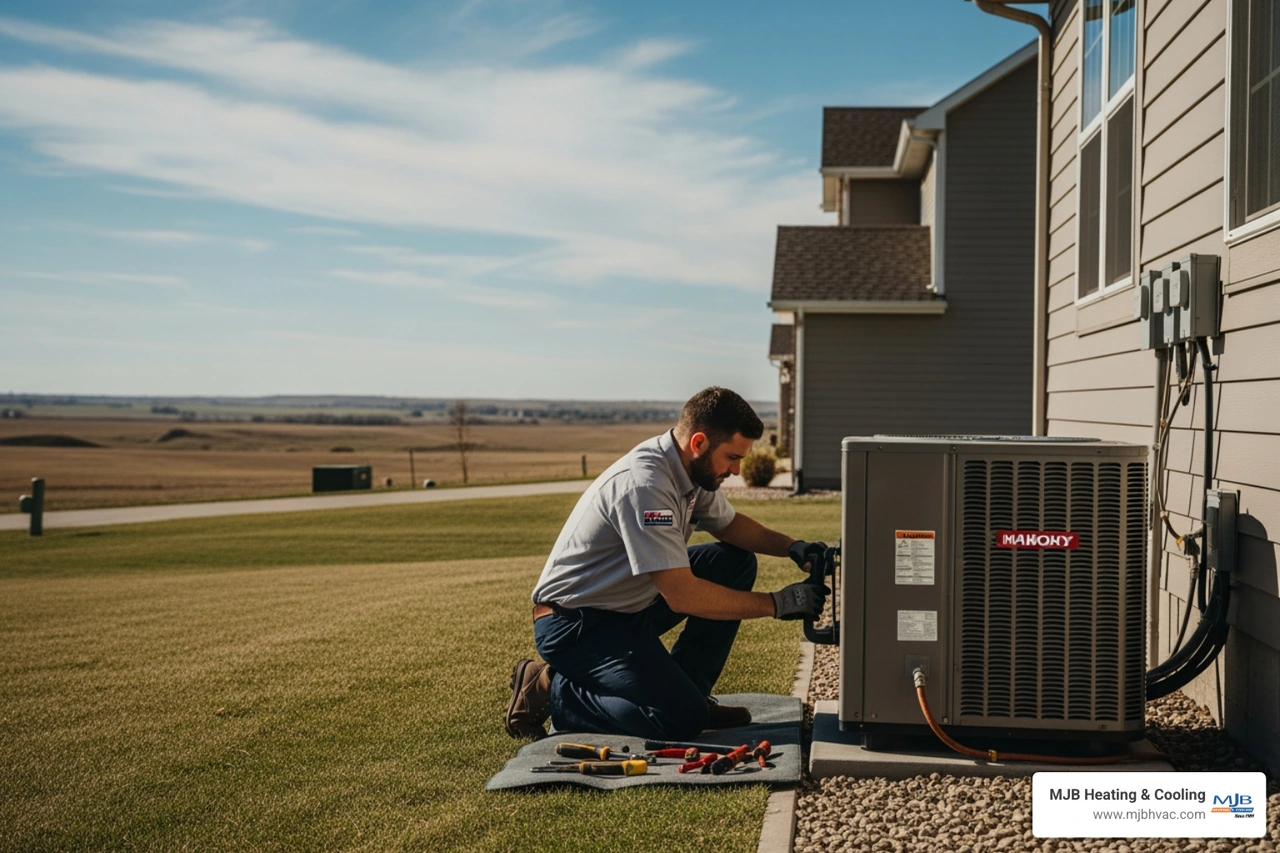
When homeowners ask what Daikin certification actually means, the simplest answer is this: it means the installer has been specifically prepared to work on Daikin equipment instead of treating it like a generic box with wires and refrigerant.
That matters more than ever in 2026. Modern Daikin systems use inverter technology, smart controls, communicating components, and advanced sensors that need precise setup. If any part of that setup is off, the whole system can underperform. The unit may still turn on, sure, but "it runs" and "it runs correctly" are very different things.
Certified Daikin installers are trained around manufacturer standards, installation procedures, commissioning steps, and troubleshooting methods for these systems. Research also shows Daikin operates 116 training centers across Europe and North America, which reflects how seriously the brand takes field performance. That factory-backed approach helps bridge the gap between a high-quality unit and high-quality comfort inside your home.
For Wichita-area homeowners, that translates into real-world benefits:
It also helps explain why we talk so much about process. Good installation is not just hanging equipment on a wall or pad and calling it a day. It includes evaluating the home, matching the equipment to the load, checking airflow, charging refrigerant correctly, testing controls, and documenting the final commissioning.
If you want to better understand how Daikin efficiency ratings connect to real home performance, take a look at Discover Energy Savings With Daikins Hspf Rating Insights.
Another point homeowners often overlook is that Daikin's quality culture starts at the factory. Daikin Europe facilities have held ISO 9001 quality management certification since 1993, and ISO 14001 efforts at manufacturing sites have contributed to a 78% reduction in volatile organic compounds. While that is factory data, it supports a larger point: the brand puts structure and standards behind how products are built and supported. Certified installation extends that mindset into the home.
A high-efficiency system only delivers high efficiency when it is sized, installed, and commissioned correctly. That is the heart of why choosing a certified Daikin installer matters.
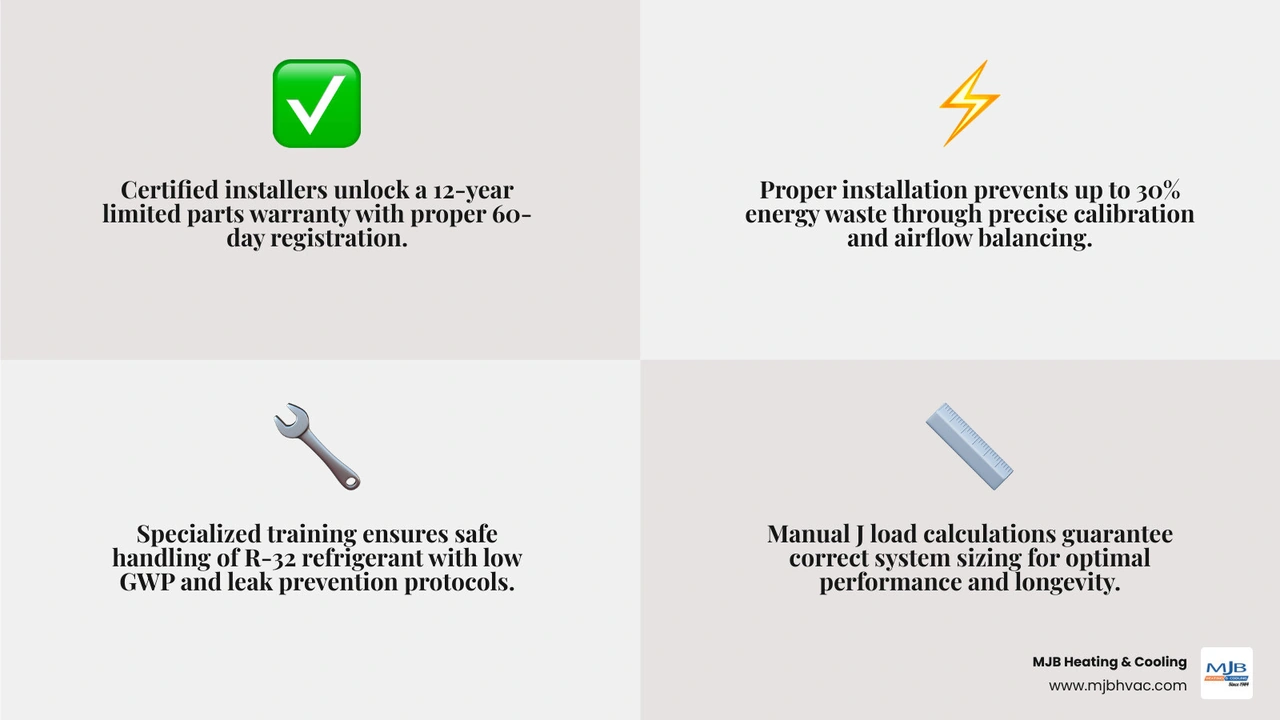
One of the biggest differences is system sizing. Certified professionals are far more likely to perform a real Manual J load calculation instead of relying on rough square-foot rules. In Central Kansas, that matters because homes in Wichita, Derby, Andover, Haysville, Augusta, and surrounding communities deal with extreme temperature swings, sun exposure differences, insulation variations, and humidity loads. A room over a garage does not behave like a shaded bedroom, and your HVAC design should know that.
Proper sizing helps avoid two common problems:
Certified installers also look beyond the equipment itself. They check airflow, static pressure, duct condition, and air distribution. Even the best heat pump or air conditioner can disappoint if the ductwork is restrictive, leaking, or poorly balanced. A professional commissioning process should include verifying that the system can actually move air the way Daikin intended.
This is where the energy impact gets serious. Research shows a poorly installed system can use up to 30% more energy than one that was correctly commissioned by a certified professional. That is a huge penalty for installation shortcuts.
Certified installation supports performance in several ways:
Some factory-backed programs also use digital commissioning records through a portal, creating a kind of installation record or "birth certificate" for the system. That documentation helps confirm the unit was set up correctly from the start and can make future support more straightforward.
Warranty language can feel like it was written by lawyers powered by strong coffee, but the homeowner takeaway is simple: installation quality affects warranty protection.
With qualifying certified installation, homeowners may unlock an industry-leading 12-year limited parts warranty when the system is registered within the required 60-day window. That is a major benefit, but only if the details are handled correctly. Registration deadlines matter. Documentation matters. Model and serial information matters. Commissioning records matter.
A certified Daikin installer is more likely to know:
If the system is not installed or documented properly, you may lose out on valuable coverage. That is one of those things homeowners often do not discover until years later, usually at the worst possible time. Like during a Kansas cold snap. Because furnaces and heat pumps have a weird sense of timing.
There is also a practical long-term benefit: when equipment has been installed to manufacturer standards and documented correctly, future service tends to be more straightforward. The system history is clearer, the setup is more predictable, and support processes are smoother.
Modern HVAC systems increasingly rely on refrigerants that require updated tools, procedures, and safety awareness. For homeowners, the important names to know are R-32 and R-290.
R-32 is a lower-GWP refrigerant used in newer systems, and research notes a GWP of 675. Lower-GWP options are an important part of where the industry is going, but they are not something to handle casually. These refrigerants require correct gauges, charging procedures, evacuation practices, leak prevention, and safety protocols.
Certified Daikin installers are more likely to be familiar with:
Moisture-free line preparation is especially important. If refrigerant lines are not evacuated properly, moisture can remain in the system, leading to acid formation, internal damage, and compressor problems. That is the kind of invisible mistake that can shorten equipment life long before anything dramatic happens.
In other words, modern refrigerants reward precision and punish shortcuts.
A lot of HVAC problems blamed on "bad equipment" are really installation mistakes wearing a fake mustache.
Here are some of the most common issues non-certified or inexperienced installers may create:
Short-cycling is a big one. When a system is oversized or poorly configured, it turns on and off too often. That wastes energy, increases wear, and often leaves the home feeling clammy because humidity removal suffers.
Placement matters too. Outdoor units need proper clearance and airflow. Indoor components need to be level and positioned for serviceability, drainage, and sound control. A technically working install can still be a bad install if it rattles, drains poorly, or blasts one room while starving another.
Certified installers also pay more attention to the "invisible" details:
These details matter in Wichita and throughout Central Kansas because our climate pushes systems hard. A small setup error that might go unnoticed in mild weather can become a major comfort problem during 100-degree summer afternoons or sub-zero winter mornings.
If certification matters, how do you verify it without turning your kitchen table into a detective agency?
Start with the basics:
For homeowners in Wichita, Derby, Andover, Augusta, Haysville, Mulvane, Bel Aire, Park City, Valley Center, Goddard, Newton, Hutchinson, El Dorado, and surrounding Central Kansas communities, local experience matters too. An installer should understand the demands our climate places on heat pumps, air conditioners, furnaces, and ductless systems.
At MJB Heating & Cooling, we have served the Wichita metro area since 1984 with a simple focus: quality workmanship and honest service. As a family-owned company founded in Derby, we believe homeowners deserve clear answers, careful installation, and long-term comfort they can count on.
Here is a simple comparison homeowners can use when evaluating contractors:
| What to Look For | Certified Daikin Professional | General Handyman or Unverified Installer |
|---|---|---|
| Manufacturer-specific knowledge | Yes | Not always |
| Manual J sizing process | Expected | Often skipped |
| Proper commissioning | Standard practice | May be limited |
| Modern refrigerant procedures | Up to date | May use outdated methods |
| Warranty registration guidance | Typically provided | Often unclear |
| Access to factory-backed support | Yes | Limited |
| Local HVAC licensing and insurance verification | Should be available | Must be checked carefully |
The goal is not to make the process complicated. It is to make sure your new system gets the setup it needs to perform the way it was designed to.
The best first step is to use the official Daikin dealer locator. You can also ask the contractor directly for current credentials and whether they hold Daikin Comfort Pro status where applicable. Beyond manufacturer listings, verify that the company is properly licensed and insured for HVAC work in Kansas and check reviews for patterns of professionalism, communication, and follow-up.
A trustworthy contractor should not be bothered by these questions. Honestly, they should expect them.
Yes, it can. Certification itself does not magically lower bills, but the installation practices that come with certified work absolutely affect energy use.
A properly installed system is more likely to have:
Those factors help the system run efficiently instead of fighting itself. Since research shows poor installation can waste up to 30% more energy, installation quality can have a very real effect on utility use over time.
Several things can go wrong, and some are not obvious right away.
Possible issues include:
Sometimes the system will seem "good enough" at first, then problems show up after a season or two. That delayed trouble is part of what makes poor installation so frustrating. The mistake happened on day one, but the homeowner pays for it later.
Choosing the right installer is one of the most important decisions you can make for your HVAC system. The best equipment in the world cannot overcome poor sizing, sloppy commissioning, or outdated refrigerant practices.
That is the real answer to why choosing a certified Daikin installer matters: it protects comfort, efficiency, warranty coverage, and long-term reliability all at once.
For homeowners across Wichita and the surrounding Central Kansas communities, professional installation is not an extra. It is the foundation of dependable heating and cooling through every scorching summer day and every bitter winter night.
If you want to keep learning about how Daikin efficiency translates into real savings at home, read Discover Energy Savings With Daikins Hspf Rating Insights.
Understanding why choosing a certified Daikin installer matters comes down to one simple truth: the equipment you buy is only as good as the professional who installs it.
Quick answer — here's what certified Daikin installation delivers:
Most homeowners in the Wichita metro area focus on choosing the right equipment. That makes sense. But here's the thing — two identical Daikin systems installed in two identical homes can perform very differently depending on how they are installed. One might run quietly and efficiently for years. The other might short-cycle, spike your utility bills, and create avoidable performance problems early on.
Central Kansas throws a lot at your HVAC system. Brutal summer heat, sub-zero winter blasts, and humidity swings all demand precision installation — not guesswork. A certified Daikin installation process brings manufacturer-backed standards, the right tools, and a systematic approach that protects your investment from day one.
When homeowners ask what Daikin certification actually means, the simplest answer is this: it means the installer has been specifically prepared to work on Daikin equipment instead of treating it like a generic box with wires and refrigerant.
That matters more than ever in 2026. Modern Daikin systems use inverter technology, smart controls, communicating components, and advanced sensors that need precise setup. If any part of that setup is off, the whole system can underperform. The unit may still turn on, sure, but "it runs" and "it runs correctly" are very different things.
Certified Daikin installers are trained around manufacturer standards, installation procedures, commissioning steps, and troubleshooting methods for these systems. Research also shows Daikin operates 116 training centers across Europe and North America, which reflects how seriously the brand takes field performance. That factory-backed approach helps bridge the gap between a high-quality unit and high-quality comfort inside your home.
For Wichita-area homeowners, that translates into real-world benefits:
It also helps explain why we talk so much about process. Good installation is not just hanging equipment on a wall or pad and calling it a day. It includes evaluating the home, matching the equipment to the load, checking airflow, charging refrigerant correctly, testing controls, and documenting the final commissioning.
If you want to better understand how Daikin efficiency ratings connect to real home performance, take a look at Discover Energy Savings With Daikins Hspf Rating Insights.
Another point homeowners often overlook is that Daikin's quality culture starts at the factory. Daikin Europe facilities have held ISO 9001 quality management certification since 1993, and ISO 14001 efforts at manufacturing sites have contributed to a 78% reduction in volatile organic compounds. While that is factory data, it supports a larger point: the brand puts structure and standards behind how products are built and supported. Certified installation extends that mindset into the home.
A high-efficiency system only delivers high efficiency when it is sized, installed, and commissioned correctly. That is the heart of why choosing a certified Daikin installer matters.
One of the biggest differences is system sizing. Certified professionals are far more likely to perform a real Manual J load calculation instead of relying on rough square-foot rules. In Central Kansas, that matters because homes in Wichita, Derby, Andover, Haysville, Augusta, and surrounding communities deal with extreme temperature swings, sun exposure differences, insulation variations, and humidity loads. A room over a garage does not behave like a shaded bedroom, and your HVAC design should know that.
Proper sizing helps avoid two common problems:
Certified installers also look beyond the equipment itself. They check airflow, static pressure, duct condition, and air distribution. Even the best heat pump or air conditioner can disappoint if the ductwork is restrictive, leaking, or poorly balanced. A professional commissioning process should include verifying that the system can actually move air the way Daikin intended.
This is where the energy impact gets serious. Research shows a poorly installed system can use up to 30% more energy than one that was correctly commissioned by a certified professional. That is a huge penalty for installation shortcuts.
Certified installation supports performance in several ways:
Some factory-backed programs also use digital commissioning records through a portal, creating a kind of installation record or "birth certificate" for the system. That documentation helps confirm the unit was set up correctly from the start and can make future support more straightforward.
Warranty language can feel like it was written by lawyers powered by strong coffee, but the homeowner takeaway is simple: installation quality affects warranty protection.
With qualifying certified installation, homeowners may unlock an industry-leading 12-year limited parts warranty when the system is registered within the required 60-day window. That is a major benefit, but only if the details are handled correctly. Registration deadlines matter. Documentation matters. Model and serial information matters. Commissioning records matter.
A certified Daikin installer is more likely to know:
If the system is not installed or documented properly, you may lose out on valuable coverage. That is one of those things homeowners often do not discover until years later, usually at the worst possible time. Like during a Kansas cold snap. Because furnaces and heat pumps have a weird sense of timing.
There is also a practical long-term benefit: when equipment has been installed to manufacturer standards and documented correctly, future service tends to be more straightforward. The system history is clearer, the setup is more predictable, and support processes are smoother.
Modern HVAC systems increasingly rely on refrigerants that require updated tools, procedures, and safety awareness. For homeowners, the important names to know are R-32 and R-290.
R-32 is a lower-GWP refrigerant used in newer systems, and research notes a GWP of 675. Lower-GWP options are an important part of where the industry is going, but they are not something to handle casually. These refrigerants require correct gauges, charging procedures, evacuation practices, leak prevention, and safety protocols.
Certified Daikin installers are more likely to be familiar with:
Moisture-free line preparation is especially important. If refrigerant lines are not evacuated properly, moisture can remain in the system, leading to acid formation, internal damage, and compressor problems. That is the kind of invisible mistake that can shorten equipment life long before anything dramatic happens.
In other words, modern refrigerants reward precision and punish shortcuts.
A lot of HVAC problems blamed on "bad equipment" are really installation mistakes wearing a fake mustache.
Here are some of the most common issues non-certified or inexperienced installers may create:
Short-cycling is a big one. When a system is oversized or poorly configured, it turns on and off too often. That wastes energy, increases wear, and often leaves the home feeling clammy because humidity removal suffers.
Placement matters too. Outdoor units need proper clearance and airflow. Indoor components need to be level and positioned for serviceability, drainage, and sound control. A technically working install can still be a bad install if it rattles, drains poorly, or blasts one room while starving another.
Certified installers also pay more attention to the "invisible" details:
These details matter in Wichita and throughout Central Kansas because our climate pushes systems hard. A small setup error that might go unnoticed in mild weather can become a major comfort problem during 100-degree summer afternoons or sub-zero winter mornings.
If certification matters, how do you verify it without turning your kitchen table into a detective agency?
Start with the basics:
For homeowners in Wichita, Derby, Andover, Augusta, Haysville, Mulvane, Bel Aire, Park City, Valley Center, Goddard, Newton, Hutchinson, El Dorado, and surrounding Central Kansas communities, local experience matters too. An installer should understand the demands our climate places on heat pumps, air conditioners, furnaces, and ductless systems.
At MJB Heating & Cooling, we have served the Wichita metro area since 1984 with a simple focus: quality workmanship and honest service. As a family-owned company founded in Derby, we believe homeowners deserve clear answers, careful installation, and long-term comfort they can count on.
Here is a simple comparison homeowners can use when evaluating contractors:
| What to Look For | Certified Daikin Professional | General Handyman or Unverified Installer |
|---|---|---|
| Manufacturer-specific knowledge | Yes | Not always |
| Manual J sizing process | Expected | Often skipped |
| Proper commissioning | Standard practice | May be limited |
| Modern refrigerant procedures | Up to date | May use outdated methods |
| Warranty registration guidance | Typically provided | Often unclear |
| Access to factory-backed support | Yes | Limited |
| Local HVAC licensing and insurance verification | Should be available | Must be checked carefully |
The goal is not to make the process complicated. It is to make sure your new system gets the setup it needs to perform the way it was designed to.
The best first step is to use the official Daikin dealer locator. You can also ask the contractor directly for current credentials and whether they hold Daikin Comfort Pro status where applicable. Beyond manufacturer listings, verify that the company is properly licensed and insured for HVAC work in Kansas and check reviews for patterns of professionalism, communication, and follow-up.
A trustworthy contractor should not be bothered by these questions. Honestly, they should expect them.
Yes, it can. Certification itself does not magically lower bills, but the installation practices that come with certified work absolutely affect energy use.
A properly installed system is more likely to have:
Those factors help the system run efficiently instead of fighting itself. Since research shows poor installation can waste up to 30% more energy, installation quality can have a very real effect on utility use over time.
Several things can go wrong, and some are not obvious right away.
Possible issues include:
Sometimes the system will seem "good enough" at first, then problems show up after a season or two. That delayed trouble is part of what makes poor installation so frustrating. The mistake happened on day one, but the homeowner pays for it later.
Choosing the right installer is one of the most important decisions you can make for your HVAC system. The best equipment in the world cannot overcome poor sizing, sloppy commissioning, or outdated refrigerant practices.
That is the real answer to why choosing a certified Daikin installer matters: it protects comfort, efficiency, warranty coverage, and long-term reliability all at once.
For homeowners across Wichita and the surrounding Central Kansas communities, professional installation is not an extra. It is the foundation of dependable heating and cooling through every scorching summer day and every bitter winter night.
If you want to keep learning about how Daikin efficiency translates into real savings at home, read Discover Energy Savings With Daikins Hspf Rating Insights.
Understanding why choosing a certified Daikin installer matters comes down to one simple truth: the equipment you buy is only as good as the professional who installs it.
Quick answer — here's what certified Daikin installation delivers:
Most homeowners in the Wichita metro area focus on choosing the right equipment. That makes sense. But here's the thing — two identical Daikin systems installed in two identical homes can perform very differently depending on how they are installed. One might run quietly and efficiently for years. The other might short-cycle, spike your utility bills, and create avoidable performance problems early on.
Central Kansas throws a lot at your HVAC system. Brutal summer heat, sub-zero winter blasts, and humidity swings all demand precision installation — not guesswork. A certified Daikin installation process brings manufacturer-backed standards, the right tools, and a systematic approach that protects your investment from day one.
When homeowners ask what Daikin certification actually means, the simplest answer is this: it means the installer has been specifically prepared to work on Daikin equipment instead of treating it like a generic box with wires and refrigerant.
That matters more than ever in 2026. Modern Daikin systems use inverter technology, smart controls, communicating components, and advanced sensors that need precise setup. If any part of that setup is off, the whole system can underperform. The unit may still turn on, sure, but "it runs" and "it runs correctly" are very different things.
Certified Daikin installers are trained around manufacturer standards, installation procedures, commissioning steps, and troubleshooting methods for these systems. Research also shows Daikin operates 116 training centers across Europe and North America, which reflects how seriously the brand takes field performance. That factory-backed approach helps bridge the gap between a high-quality unit and high-quality comfort inside your home.
For Wichita-area homeowners, that translates into real-world benefits:
It also helps explain why we talk so much about process. Good installation is not just hanging equipment on a wall or pad and calling it a day. It includes evaluating the home, matching the equipment to the load, checking airflow, charging refrigerant correctly, testing controls, and documenting the final commissioning.
If you want to better understand how Daikin efficiency ratings connect to real home performance, take a look at Discover Energy Savings With Daikins Hspf Rating Insights.
Another point homeowners often overlook is that Daikin's quality culture starts at the factory. Daikin Europe facilities have held ISO 9001 quality management certification since 1993, and ISO 14001 efforts at manufacturing sites have contributed to a 78% reduction in volatile organic compounds. While that is factory data, it supports a larger point: the brand puts structure and standards behind how products are built and supported. Certified installation extends that mindset into the home.
A high-efficiency system only delivers high efficiency when it is sized, installed, and commissioned correctly. That is the heart of why choosing a certified Daikin installer matters.
One of the biggest differences is system sizing. Certified professionals are far more likely to perform a real Manual J load calculation instead of relying on rough square-foot rules. In Central Kansas, that matters because homes in Wichita, Derby, Andover, Haysville, Augusta, and surrounding communities deal with extreme temperature swings, sun exposure differences, insulation variations, and humidity loads. A room over a garage does not behave like a shaded bedroom, and your HVAC design should know that.
Proper sizing helps avoid two common problems:
Certified installers also look beyond the equipment itself. They check airflow, static pressure, duct condition, and air distribution. Even the best heat pump or air conditioner can disappoint if the ductwork is restrictive, leaking, or poorly balanced. A professional commissioning process should include verifying that the system can actually move air the way Daikin intended.
This is where the energy impact gets serious. Research shows a poorly installed system can use up to 30% more energy than one that was correctly commissioned by a certified professional. That is a huge penalty for installation shortcuts.
Certified installation supports performance in several ways:
Some factory-backed programs also use digital commissioning records through a portal, creating a kind of installation record or "birth certificate" for the system. That documentation helps confirm the unit was set up correctly from the start and can make future support more straightforward.
Warranty language can feel like it was written by lawyers powered by strong coffee, but the homeowner takeaway is simple: installation quality affects warranty protection.
With qualifying certified installation, homeowners may unlock an industry-leading 12-year limited parts warranty when the system is registered within the required 60-day window. That is a major benefit, but only if the details are handled correctly. Registration deadlines matter. Documentation matters. Model and serial information matters. Commissioning records matter.
A certified Daikin installer is more likely to know:
If the system is not installed or documented properly, you may lose out on valuable coverage. That is one of those things homeowners often do not discover until years later, usually at the worst possible time. Like during a Kansas cold snap. Because furnaces and heat pumps have a weird sense of timing.
There is also a practical long-term benefit: when equipment has been installed to manufacturer standards and documented correctly, future service tends to be more straightforward. The system history is clearer, the setup is more predictable, and support processes are smoother.
Modern HVAC systems increasingly rely on refrigerants that require updated tools, procedures, and safety awareness. For homeowners, the important names to know are R-32 and R-290.
R-32 is a lower-GWP refrigerant used in newer systems, and research notes a GWP of 675. Lower-GWP options are an important part of where the industry is going, but they are not something to handle casually. These refrigerants require correct gauges, charging procedures, evacuation practices, leak prevention, and safety protocols.
Certified Daikin installers are more likely to be familiar with:
Moisture-free line preparation is especially important. If refrigerant lines are not evacuated properly, moisture can remain in the system, leading to acid formation, internal damage, and compressor problems. That is the kind of invisible mistake that can shorten equipment life long before anything dramatic happens.
In other words, modern refrigerants reward precision and punish shortcuts.
A lot of HVAC problems blamed on "bad equipment" are really installation mistakes wearing a fake mustache.
Here are some of the most common issues non-certified or inexperienced installers may create:
Short-cycling is a big one. When a system is oversized or poorly configured, it turns on and off too often. That wastes energy, increases wear, and often leaves the home feeling clammy because humidity removal suffers.
Placement matters too. Outdoor units need proper clearance and airflow. Indoor components need to be level and positioned for serviceability, drainage, and sound control. A technically working install can still be a bad install if it rattles, drains poorly, or blasts one room while starving another.
Certified installers also pay more attention to the "invisible" details:
These details matter in Wichita and throughout Central Kansas because our climate pushes systems hard. A small setup error that might go unnoticed in mild weather can become a major comfort problem during 100-degree summer afternoons or sub-zero winter mornings.
If certification matters, how do you verify it without turning your kitchen table into a detective agency?
Start with the basics:
For homeowners in Wichita, Derby, Andover, Augusta, Haysville, Mulvane, Bel Aire, Park City, Valley Center, Goddard, Newton, Hutchinson, El Dorado, and surrounding Central Kansas communities, local experience matters too. An installer should understand the demands our climate places on heat pumps, air conditioners, furnaces, and ductless systems.
At MJB Heating & Cooling, we have served the Wichita metro area since 1984 with a simple focus: quality workmanship and honest service. As a family-owned company founded in Derby, we believe homeowners deserve clear answers, careful installation, and long-term comfort they can count on.
Here is a simple comparison homeowners can use when evaluating contractors:
| What to Look For | Certified Daikin Professional | General Handyman or Unverified Installer |
|---|---|---|
| Manufacturer-specific knowledge | Yes | Not always |
| Manual J sizing process | Expected | Often skipped |
| Proper commissioning | Standard practice | May be limited |
| Modern refrigerant procedures | Up to date | May use outdated methods |
| Warranty registration guidance | Typically provided | Often unclear |
| Access to factory-backed support | Yes | Limited |
| Local HVAC licensing and insurance verification | Should be available | Must be checked carefully |
The goal is not to make the process complicated. It is to make sure your new system gets the setup it needs to perform the way it was designed to.
The best first step is to use the official Daikin dealer locator. You can also ask the contractor directly for current credentials and whether they hold Daikin Comfort Pro status where applicable. Beyond manufacturer listings, verify that the company is properly licensed and insured for HVAC work in Kansas and check reviews for patterns of professionalism, communication, and follow-up.
A trustworthy contractor should not be bothered by these questions. Honestly, they should expect them.
Yes, it can. Certification itself does not magically lower bills, but the installation practices that come with certified work absolutely affect energy use.
A properly installed system is more likely to have:
Those factors help the system run efficiently instead of fighting itself. Since research shows poor installation can waste up to 30% more energy, installation quality can have a very real effect on utility use over time.
Several things can go wrong, and some are not obvious right away.
Possible issues include:
Sometimes the system will seem "good enough" at first, then problems show up after a season or two. That delayed trouble is part of what makes poor installation so frustrating. The mistake happened on day one, but the homeowner pays for it later.
Choosing the right installer is one of the most important decisions you can make for your HVAC system. The best equipment in the world cannot overcome poor sizing, sloppy commissioning, or outdated refrigerant practices.
That is the real answer to why choosing a certified Daikin installer matters: it protects comfort, efficiency, warranty coverage, and long-term reliability all at once.
For homeowners across Wichita and the surrounding Central Kansas communities, professional installation is not an extra. It is the foundation of dependable heating and cooling through every scorching summer day and every bitter winter night.
If you want to keep learning about how Daikin efficiency translates into real savings at home, read Discover Energy Savings With Daikins Hspf Rating Insights.
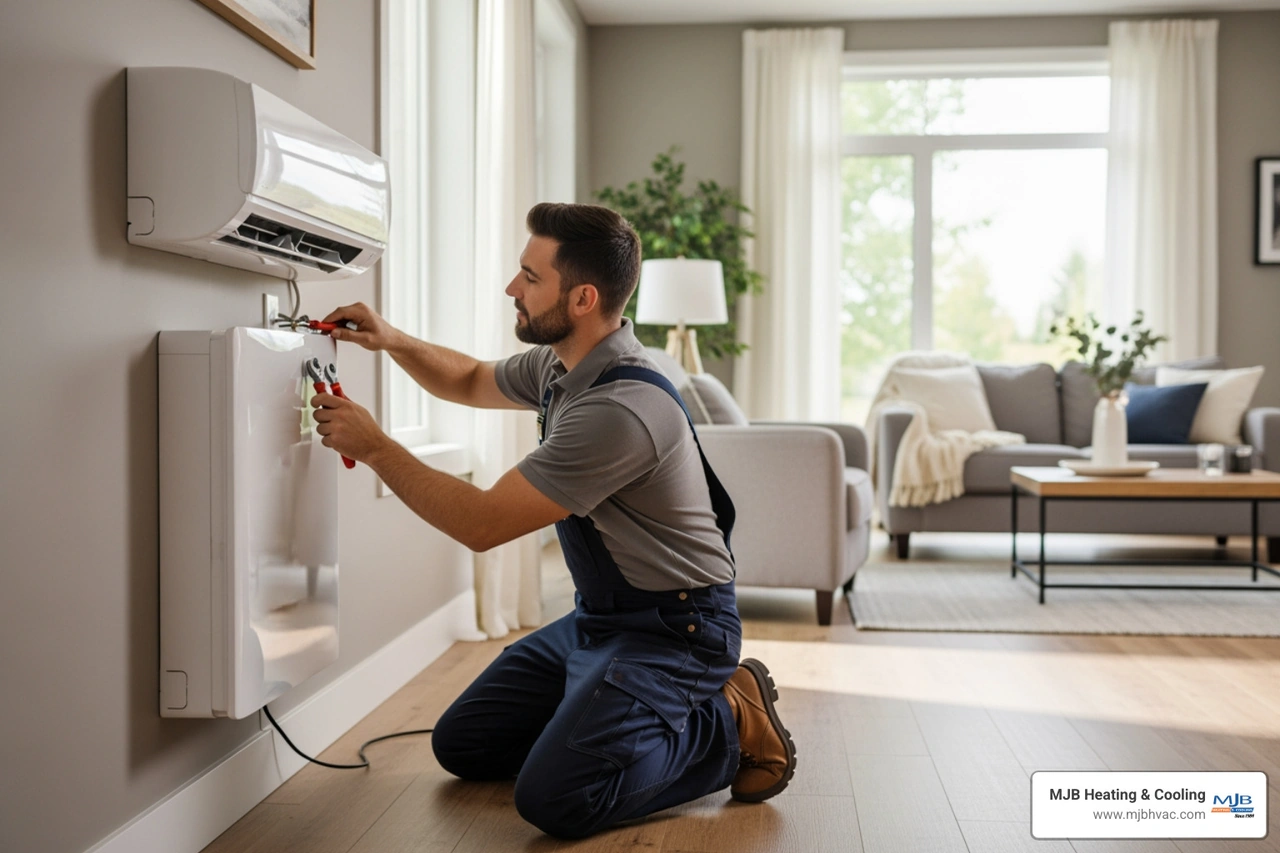

Understanding why choosing a certified Daikin installer matters comes down to one simple truth: the equipment you buy is only as good as the professional who installs it.
Quick answer — here's what certified Daikin installation delivers:
Most homeowners in the Wichita metro area focus on choosing the right equipment. That makes sense. But here's the thing — two identical Daikin systems installed in two identical homes can perform very differently depending on how they are installed. One might run quietly and efficiently for years. The other might short-cycle, spike your utility bills, and create avoidable performance problems early on.
Central Kansas throws a lot at your HVAC system. Brutal summer heat, sub-zero winter blasts, and humidity swings all demand precision installation — not guesswork. A certified Daikin installation process brings manufacturer-backed standards, the right tools, and a systematic approach that protects your investment from day one.
When homeowners ask what Daikin certification actually means, the simplest answer is this: it means the installer has been specifically prepared to work on Daikin equipment instead of treating it like a generic box with wires and refrigerant.
That matters more than ever in 2026. Modern Daikin systems use inverter technology, smart controls, communicating components, and advanced sensors that need precise setup. If any part of that setup is off, the whole system can underperform. The unit may still turn on, sure, but "it runs" and "it runs correctly" are very different things.
Certified Daikin installers are trained around manufacturer standards, installation procedures, commissioning steps, and troubleshooting methods for these systems. Research also shows Daikin operates 116 training centers across Europe and North America, which reflects how seriously the brand takes field performance. That factory-backed approach helps bridge the gap between a high-quality unit and high-quality comfort inside your home.
For Wichita-area homeowners, that translates into real-world benefits:
It also helps explain why we talk so much about process. Good installation is not just hanging equipment on a wall or pad and calling it a day. It includes evaluating the home, matching the equipment to the load, checking airflow, charging refrigerant correctly, testing controls, and documenting the final commissioning.
If you want to better understand how Daikin efficiency ratings connect to real home performance, take a look at Discover Energy Savings With Daikins Hspf Rating Insights.
Another point homeowners often overlook is that Daikin's quality culture starts at the factory. Daikin Europe facilities have held ISO 9001 quality management certification since 1993, and ISO 14001 efforts at manufacturing sites have contributed to a 78% reduction in volatile organic compounds. While that is factory data, it supports a larger point: the brand puts structure and standards behind how products are built and supported. Certified installation extends that mindset into the home.
A high-efficiency system only delivers high efficiency when it is sized, installed, and commissioned correctly. That is the heart of why choosing a certified Daikin installer matters.
One of the biggest differences is system sizing. Certified professionals are far more likely to perform a real Manual J load calculation instead of relying on rough square-foot rules. In Central Kansas, that matters because homes in Wichita, Derby, Andover, Haysville, Augusta, and surrounding communities deal with extreme temperature swings, sun exposure differences, insulation variations, and humidity loads. A room over a garage does not behave like a shaded bedroom, and your HVAC design should know that.
Proper sizing helps avoid two common problems:
Certified installers also look beyond the equipment itself. They check airflow, static pressure, duct condition, and air distribution. Even the best heat pump or air conditioner can disappoint if the ductwork is restrictive, leaking, or poorly balanced. A professional commissioning process should include verifying that the system can actually move air the way Daikin intended.
This is where the energy impact gets serious. Research shows a poorly installed system can use up to 30% more energy than one that was correctly commissioned by a certified professional. That is a huge penalty for installation shortcuts.
Certified installation supports performance in several ways:
Some factory-backed programs also use digital commissioning records through a portal, creating a kind of installation record or "birth certificate" for the system. That documentation helps confirm the unit was set up correctly from the start and can make future support more straightforward.
Warranty language can feel like it was written by lawyers powered by strong coffee, but the homeowner takeaway is simple: installation quality affects warranty protection.
With qualifying certified installation, homeowners may unlock an industry-leading 12-year limited parts warranty when the system is registered within the required 60-day window. That is a major benefit, but only if the details are handled correctly. Registration deadlines matter. Documentation matters. Model and serial information matters. Commissioning records matter.
A certified Daikin installer is more likely to know:
If the system is not installed or documented properly, you may lose out on valuable coverage. That is one of those things homeowners often do not discover until years later, usually at the worst possible time. Like during a Kansas cold snap. Because furnaces and heat pumps have a weird sense of timing.
There is also a practical long-term benefit: when equipment has been installed to manufacturer standards and documented correctly, future service tends to be more straightforward. The system history is clearer, the setup is more predictable, and support processes are smoother.
Modern HVAC systems increasingly rely on refrigerants that require updated tools, procedures, and safety awareness. For homeowners, the important names to know are R-32 and R-290.
R-32 is a lower-GWP refrigerant used in newer systems, and research notes a GWP of 675. Lower-GWP options are an important part of where the industry is going, but they are not something to handle casually. These refrigerants require correct gauges, charging procedures, evacuation practices, leak prevention, and safety protocols.
Certified Daikin installers are more likely to be familiar with:
Moisture-free line preparation is especially important. If refrigerant lines are not evacuated properly, moisture can remain in the system, leading to acid formation, internal damage, and compressor problems. That is the kind of invisible mistake that can shorten equipment life long before anything dramatic happens.
In other words, modern refrigerants reward precision and punish shortcuts.
A lot of HVAC problems blamed on "bad equipment" are really installation mistakes wearing a fake mustache.
Here are some of the most common issues non-certified or inexperienced installers may create:
Short-cycling is a big one. When a system is oversized or poorly configured, it turns on and off too often. That wastes energy, increases wear, and often leaves the home feeling clammy because humidity removal suffers.
Placement matters too. Outdoor units need proper clearance and airflow. Indoor components need to be level and positioned for serviceability, drainage, and sound control. A technically working install can still be a bad install if it rattles, drains poorly, or blasts one room while starving another.
Certified installers also pay more attention to the "invisible" details:
These details matter in Wichita and throughout Central Kansas because our climate pushes systems hard. A small setup error that might go unnoticed in mild weather can become a major comfort problem during 100-degree summer afternoons or sub-zero winter mornings.
If certification matters, how do you verify it without turning your kitchen table into a detective agency?
Start with the basics:
For homeowners in Wichita, Derby, Andover, Augusta, Haysville, Mulvane, Bel Aire, Park City, Valley Center, Goddard, Newton, Hutchinson, El Dorado, and surrounding Central Kansas communities, local experience matters too. An installer should understand the demands our climate places on heat pumps, air conditioners, furnaces, and ductless systems.
At MJB Heating & Cooling, we have served the Wichita metro area since 1984 with a simple focus: quality workmanship and honest service. As a family-owned company founded in Derby, we believe homeowners deserve clear answers, careful installation, and long-term comfort they can count on.
Here is a simple comparison homeowners can use when evaluating contractors:
| What to Look For | Certified Daikin Professional | General Handyman or Unverified Installer |
|---|---|---|
| Manufacturer-specific knowledge | Yes | Not always |
| Manual J sizing process | Expected | Often skipped |
| Proper commissioning | Standard practice | May be limited |
| Modern refrigerant procedures | Up to date | May use outdated methods |
| Warranty registration guidance | Typically provided | Often unclear |
| Access to factory-backed support | Yes | Limited |
| Local HVAC licensing and insurance verification | Should be available | Must be checked carefully |
The goal is not to make the process complicated. It is to make sure your new system gets the setup it needs to perform the way it was designed to.
The best first step is to use the official Daikin dealer locator. You can also ask the contractor directly for current credentials and whether they hold Daikin Comfort Pro status where applicable. Beyond manufacturer listings, verify that the company is properly licensed and insured for HVAC work in Kansas and check reviews for patterns of professionalism, communication, and follow-up.
A trustworthy contractor should not be bothered by these questions. Honestly, they should expect them.
Yes, it can. Certification itself does not magically lower bills, but the installation practices that come with certified work absolutely affect energy use.
A properly installed system is more likely to have:
Those factors help the system run efficiently instead of fighting itself. Since research shows poor installation can waste up to 30% more energy, installation quality can have a very real effect on utility use over time.
Several things can go wrong, and some are not obvious right away.
Possible issues include:
Sometimes the system will seem "good enough" at first, then problems show up after a season or two. That delayed trouble is part of what makes poor installation so frustrating. The mistake happened on day one, but the homeowner pays for it later.
Choosing the right installer is one of the most important decisions you can make for your HVAC system. The best equipment in the world cannot overcome poor sizing, sloppy commissioning, or outdated refrigerant practices.
That is the real answer to why choosing a certified Daikin installer matters: it protects comfort, efficiency, warranty coverage, and long-term reliability all at once.
For homeowners across Wichita and the surrounding Central Kansas communities, professional installation is not an extra. It is the foundation of dependable heating and cooling through every scorching summer day and every bitter winter night.
If you want to keep learning about how Daikin efficiency translates into real savings at home, read Discover Energy Savings With Daikins Hspf Rating Insights.
Understanding why choosing a certified Daikin installer matters comes down to one simple truth: the equipment you buy is only as good as the professional who installs it.
Quick answer — here's what certified Daikin installation delivers:
Most homeowners in the Wichita metro area focus on choosing the right equipment. That makes sense. But here's the thing — two identical Daikin systems installed in two identical homes can perform very differently depending on how they are installed. One might run quietly and efficiently for years. The other might short-cycle, spike your utility bills, and create avoidable performance problems early on.
Central Kansas throws a lot at your HVAC system. Brutal summer heat, sub-zero winter blasts, and humidity swings all demand precision installation — not guesswork. A certified Daikin installation process brings manufacturer-backed standards, the right tools, and a systematic approach that protects your investment from day one.
When homeowners ask what Daikin certification actually means, the simplest answer is this: it means the installer has been specifically prepared to work on Daikin equipment instead of treating it like a generic box with wires and refrigerant.
That matters more than ever in 2026. Modern Daikin systems use inverter technology, smart controls, communicating components, and advanced sensors that need precise setup. If any part of that setup is off, the whole system can underperform. The unit may still turn on, sure, but "it runs" and "it runs correctly" are very different things.
Certified Daikin installers are trained around manufacturer standards, installation procedures, commissioning steps, and troubleshooting methods for these systems. Research also shows Daikin operates 116 training centers across Europe and North America, which reflects how seriously the brand takes field performance. That factory-backed approach helps bridge the gap between a high-quality unit and high-quality comfort inside your home.
For Wichita-area homeowners, that translates into real-world benefits:
It also helps explain why we talk so much about process. Good installation is not just hanging equipment on a wall or pad and calling it a day. It includes evaluating the home, matching the equipment to the load, checking airflow, charging refrigerant correctly, testing controls, and documenting the final commissioning.
If you want to better understand how Daikin efficiency ratings connect to real home performance, take a look at Discover Energy Savings With Daikins Hspf Rating Insights.
Another point homeowners often overlook is that Daikin's quality culture starts at the factory. Daikin Europe facilities have held ISO 9001 quality management certification since 1993, and ISO 14001 efforts at manufacturing sites have contributed to a 78% reduction in volatile organic compounds. While that is factory data, it supports a larger point: the brand puts structure and standards behind how products are built and supported. Certified installation extends that mindset into the home.
A high-efficiency system only delivers high efficiency when it is sized, installed, and commissioned correctly. That is the heart of why choosing a certified Daikin installer matters.
One of the biggest differences is system sizing. Certified professionals are far more likely to perform a real Manual J load calculation instead of relying on rough square-foot rules. In Central Kansas, that matters because homes in Wichita, Derby, Andover, Haysville, Augusta, and surrounding communities deal with extreme temperature swings, sun exposure differences, insulation variations, and humidity loads. A room over a garage does not behave like a shaded bedroom, and your HVAC design should know that.
Proper sizing helps avoid two common problems:
Certified installers also look beyond the equipment itself. They check airflow, static pressure, duct condition, and air distribution. Even the best heat pump or air conditioner can disappoint if the ductwork is restrictive, leaking, or poorly balanced. A professional commissioning process should include verifying that the system can actually move air the way Daikin intended.
This is where the energy impact gets serious. Research shows a poorly installed system can use up to 30% more energy than one that was correctly commissioned by a certified professional. That is a huge penalty for installation shortcuts.
Certified installation supports performance in several ways:
Some factory-backed programs also use digital commissioning records through a portal, creating a kind of installation record or "birth certificate" for the system. That documentation helps confirm the unit was set up correctly from the start and can make future support more straightforward.
Warranty language can feel like it was written by lawyers powered by strong coffee, but the homeowner takeaway is simple: installation quality affects warranty protection.
With qualifying certified installation, homeowners may unlock an industry-leading 12-year limited parts warranty when the system is registered within the required 60-day window. That is a major benefit, but only if the details are handled correctly. Registration deadlines matter. Documentation matters. Model and serial information matters. Commissioning records matter.
A certified Daikin installer is more likely to know:
If the system is not installed or documented properly, you may lose out on valuable coverage. That is one of those things homeowners often do not discover until years later, usually at the worst possible time. Like during a Kansas cold snap. Because furnaces and heat pumps have a weird sense of timing.
There is also a practical long-term benefit: when equipment has been installed to manufacturer standards and documented correctly, future service tends to be more straightforward. The system history is clearer, the setup is more predictable, and support processes are smoother.
Modern HVAC systems increasingly rely on refrigerants that require updated tools, procedures, and safety awareness. For homeowners, the important names to know are R-32 and R-290.
R-32 is a lower-GWP refrigerant used in newer systems, and research notes a GWP of 675. Lower-GWP options are an important part of where the industry is going, but they are not something to handle casually. These refrigerants require correct gauges, charging procedures, evacuation practices, leak prevention, and safety protocols.
Certified Daikin installers are more likely to be familiar with:
Moisture-free line preparation is especially important. If refrigerant lines are not evacuated properly, moisture can remain in the system, leading to acid formation, internal damage, and compressor problems. That is the kind of invisible mistake that can shorten equipment life long before anything dramatic happens.
In other words, modern refrigerants reward precision and punish shortcuts.
A lot of HVAC problems blamed on "bad equipment" are really installation mistakes wearing a fake mustache.
Here are some of the most common issues non-certified or inexperienced installers may create:
Short-cycling is a big one. When a system is oversized or poorly configured, it turns on and off too often. That wastes energy, increases wear, and often leaves the home feeling clammy because humidity removal suffers.
Placement matters too. Outdoor units need proper clearance and airflow. Indoor components need to be level and positioned for serviceability, drainage, and sound control. A technically working install can still be a bad install if it rattles, drains poorly, or blasts one room while starving another.
Certified installers also pay more attention to the "invisible" details:
These details matter in Wichita and throughout Central Kansas because our climate pushes systems hard. A small setup error that might go unnoticed in mild weather can become a major comfort problem during 100-degree summer afternoons or sub-zero winter mornings.
If certification matters, how do you verify it without turning your kitchen table into a detective agency?
Start with the basics:
For homeowners in Wichita, Derby, Andover, Augusta, Haysville, Mulvane, Bel Aire, Park City, Valley Center, Goddard, Newton, Hutchinson, El Dorado, and surrounding Central Kansas communities, local experience matters too. An installer should understand the demands our climate places on heat pumps, air conditioners, furnaces, and ductless systems.
At MJB Heating & Cooling, we have served the Wichita metro area since 1984 with a simple focus: quality workmanship and honest service. As a family-owned company founded in Derby, we believe homeowners deserve clear answers, careful installation, and long-term comfort they can count on.
Here is a simple comparison homeowners can use when evaluating contractors:
| What to Look For | Certified Daikin Professional | General Handyman or Unverified Installer |
|---|---|---|
| Manufacturer-specific knowledge | Yes | Not always |
| Manual J sizing process | Expected | Often skipped |
| Proper commissioning | Standard practice | May be limited |
| Modern refrigerant procedures | Up to date | May use outdated methods |
| Warranty registration guidance | Typically provided | Often unclear |
| Access to factory-backed support | Yes | Limited |
| Local HVAC licensing and insurance verification | Should be available | Must be checked carefully |
The goal is not to make the process complicated. It is to make sure your new system gets the setup it needs to perform the way it was designed to.
The best first step is to use the official Daikin dealer locator. You can also ask the contractor directly for current credentials and whether they hold Daikin Comfort Pro status where applicable. Beyond manufacturer listings, verify that the company is properly licensed and insured for HVAC work in Kansas and check reviews for patterns of professionalism, communication, and follow-up.
A trustworthy contractor should not be bothered by these questions. Honestly, they should expect them.
Yes, it can. Certification itself does not magically lower bills, but the installation practices that come with certified work absolutely affect energy use.
A properly installed system is more likely to have:
Those factors help the system run efficiently instead of fighting itself. Since research shows poor installation can waste up to 30% more energy, installation quality can have a very real effect on utility use over time.
Several things can go wrong, and some are not obvious right away.
Possible issues include:
Sometimes the system will seem "good enough" at first, then problems show up after a season or two. That delayed trouble is part of what makes poor installation so frustrating. The mistake happened on day one, but the homeowner pays for it later.
Choosing the right installer is one of the most important decisions you can make for your HVAC system. The best equipment in the world cannot overcome poor sizing, sloppy commissioning, or outdated refrigerant practices.
That is the real answer to why choosing a certified Daikin installer matters: it protects comfort, efficiency, warranty coverage, and long-term reliability all at once.
For homeowners across Wichita and the surrounding Central Kansas communities, professional installation is not an extra. It is the foundation of dependable heating and cooling through every scorching summer day and every bitter winter night.
If you want to keep learning about how Daikin efficiency translates into real savings at home, read Discover Energy Savings With Daikins Hspf Rating Insights.


Our A/C stopped working on a Sunday and due to health issues, we needed to find a service company available on a Sunday. I called MJB and left a message on their emergency voice mail. Within 10 minutes Tom Buck called me to hear my description of the symptoms. He was just finishing an appointment in Wichita and would be on his way to my home on the south end of Derby. He arrived within 30 minutes! From start to finish he was the perfect example of what you could ever hope for in an HVAC tech and a human being. His evaluation of our system inside and out was as thorough as I could ever imagine and once he was done with the repair, our system is running as well or better than ever. Well worth the price for the evaluation, parts, and labor. Thank you again Tom for an awesome experience.
Our AC went out during the hottest days of the year, and they were out next day! We have been jerked around by a shoddy home warranty for years. We finally had a chance to pick our own repair people, and MJB came highly recommended. I can see why! I was impressed with the honesty and speed at which they fixed our AC unit!
Our commercial building had a lightening/electrical strike and damaged our 20 ton AC unit. No one could find us a new unit before the end of September. Imagining going all of August and September with no AC in Kansas and working inside near 100 degree temps is less than thrilling. Dale and the team at MJB called around and saved the day. They had us a new unit 5 weeks earlier than other could promise and I now have happy employees. The unit is amazingly quiet, super cold and so much more energy efficient. Thank you for being our super hero!
Came out and installed my new furnace. Was very polite and affordable. They are very acknowledgeable and I highly recommend!
Thank you very much. We had our 1st warm night in 3weeks. MJB took the time and effort to find the real problem. And the employees were kind and thoughtful and explained things very well. I cannot thank you and all of MJB. Will recommend you highly. Thanks again Marjorie Herman Oxford Kansas
We had a new system installed and I was so impressed with how quick they were in come out and install it, in the middle of a hot summer day. They were so friendly & very professional. I had a small problem with a weird sound and they came over immediately and fixed it. Love them!


